
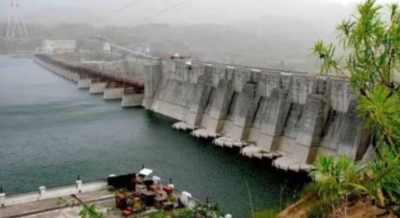
The Bhakra Beas Management Board (BBMB) has initiated an emergency structural study following reports that the Bhakra Dam’s main wall has tilted outward beyond permissible limits. Recent monitoring indicates an outward tilt of 1.77 inches, exceeding the maximum allowable design limit of 1.03 inches. Commissioned in 1963 on the Sutlej River, the dam faces severe hydraulic stress from prolonged high reservoir levels and heavy siltation, which has depleted its original storage capacity by more than 25%. The Indian Institute of Technology (IIT) Roorkee has been tasked with conducting the comprehensive safety assessment and recommending urgent remedial measures.
Bhakra Dam: Structural and Geographical Profile
Engineering and Location
Bhakra Dam is a concrete gravity dam located in Bilaspur, Himachal Pradesh. It forms the Gobind Sagar reservoir along the Sutlej River. It stands at a height of 225.55 meters, making it one of the highest gravity dams in Asia. The dam was constructed to control floods in the Sutlej-Beas basin, provide irrigation water to neighboring states, and generate hydroelectric power.
The Bhakra Beas Management Board (BBMB)
The administration, maintenance, and operation of the dam fall under the BBMB. Originally constituted as the Bhakra Management Board under the Punjab Reorganisation Act, 1966, it was later renamed the Bhakra Beas Management Board in 1976. The board manages the waters and power generation facilities of both the Sutlej and Beas rivers, regulating supply to Punjab, Haryana, Rajasthan, Himachal Pradesh, Delhi, and Chandigarh.
Key Factors Behind the Structural Stress
Siltation and Capacity Loss
The Gobind Sagar reservoir has experienced heavy siltation over six decades of operation. Accumulation of loose soil, debris, and river runoff has reduced the effective water storage capacity of the reservoir by over 25%. This high accumulation of silt exerts immense underwater pressure on the upstream face of the concrete wall.
Hydrostatic Pressure and Tilting
The combination of dead weight from the accumulated silt and the hydrostatic force of the water column creates continuous hydraulic stress. Gravity dams rely on their weight to resist the horizontal pressure of water. The current outward tilt of 1.77 inches indicates that the bending and shearing stresses have surpassed the structural thresholds calculated during its initial design.
Economic and Agricultural Dimensions
Driving the Green Revolution
Bhakra Dam served as the bedrock of the Green Revolution in Northern India during the late 1960s. By ensuring a perennial supply of water through an extensive canal network, it turned semi-arid regions of Punjab and Haryana into highly fertile agricultural zones.
Irrigation and Power Generation
The dam supports large-scale intensive cultivation of water-heavy crops like paddy and wheat. It commands an irrigation culturable area of millions of hectares across northern states. Additionally, the Bhakra Left Bank and Right Bank powerhouses have a combined installed capacity of 1,325 Megawatts (MW), supplying electricity to regional grids and vital industrial clusters.
Institutional Framework for Dam Safety in India
National Committee on Dam Safety (NCDS)
The Dam Safety Act, 2021, provides a statutory framework for the surveillance, inspection, operation, and maintenance of specified dams across India. The Act establishes the National Committee on Dam Safety (NCDS), which formulates safety policies and recommends necessary regulations.
National Dam Safety Authority (NDSA)
The NDSA functions as a regulatory body to implement the policies framed by the NCDS. It resolves inter-state disputes regarding dam safety, provides technical assistance, and maintains a national database of major dams. It also investigates structural failures and major safety lapses.
| Organization / Parameter | Details for Bhakra Dam |
| River Basin | Sutlej River Basin |
| Managing Authority | Bhakra Beas Management Board (BBMB) |
| Type of Structure | Concrete Straight Gravity Dam |
| Current Structural Issue | Outward tilt of 1.77 inches (Permissible: 1.03 inches) |
| Investigating Agency | IIT Roorkee |
| Storage Loss | Exceeds 25% due to sedimentation |
IASPOINT Booster Facts for UPSC
- Sutlej River Origin: The Sutlej River originates near Lake Rakshastal in Tibet, near Mount Kailash. It enters India through the Shipki La pass in Himachal Pradesh.
- The Indus Water Treaty (1960): Under this treaty, the waters of three eastern rivers—the Sutlej, Beas, and Ravi—are allocated to India for unrestricted use. The Bhakra-Nangal project directly utilizes these waters.
- Nangal Dam: Located 13 kilometers downstream from the Bhakra Dam, the Nangal Dam is a secondary barrage that takes up the regular fluctuations of water released from the main Bhakra powerhouses and channels water into the Nangal Hydel Channel.
- Dam Rehabilitation and Improvement Project (DRIP): This is a flagship initiative co-funded by the World Bank to improve the safety and operational performance of selected existing dams across India, alongside institutional strengthening.
- Gravity Dam Principles: A gravity dam utilizes its own weight to counteract the force of water pushing against it. If the reservoir forces exceed the frictional and gravitational resistance of the concrete blocks, tilting or sliding can occur.