
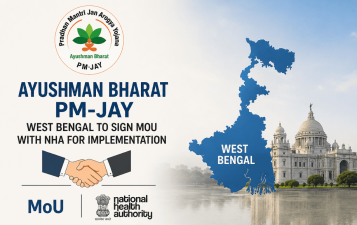
The National Health Authority (NHA) and the Government of West Bengal signed a Memorandum of Understanding (MoU) at Vigyan Bhawan, New Delhi, to formally implement the Ayushman Bharat Pradhan Mantri Jan Arogya Yojana (AB PM-JAY). With this development, West Bengal has officially become the 36th State/UT to adopt the scheme, completing its nationwide rollout. The formalization took place in the presence of Union Health Minister J.P. Nadda and West Bengal Chief Minister Suvendu Adhikari. The integration incorporates existing state beneficiaries under the Swasthya Sathi pool into the central health assurance architecture to achieve Universal Health Coverage.
Key Provisions and Scope of the Scheme
AB PM-JAY operates as the world’s largest publicly funded health assurance initiative. It aims to protect marginalized populations from catastrophic medical expenses.
Financial Coverage and Eligibility
The scheme provides a health cover of up to ₹5 lakh per family per year for secondary and tertiary care hospitalization. The benefits are completely cashless and paperless at the point of service delivery. Entitlement is determined based on defined deprivation and occupational criteria using the Socio-Economic Caste Census (SECC) data database alongside designated state beneficiary registers.
Demographic Impact in West Bengal
The rollout expands the approved beneficiary base in the state to approximately 1.43 crore families, encompassing nearly 6 crore individuals. The target group includes:
- Eligible Beneficiary Families: About 1.24 crore households transition directly into the framework.
- Frontline Health Workers: Around 3.03 lakh families of Accredited Social Health Activists (ASHAs), Anganwadi Workers, and Anganwadi Helpers receive complete coverage.
- Senior Citizens: Nearly 15.95 lakh families with individuals aged 70 years and above are included. They receive additional health cover irrespective of their socio-economic status.
Operational Infrastructure and Financing Model
The implementation architecture utilizes a coordinated operational model shared between central authorities and participating states.
Funding Mechanism
AB PM-JAY is a Centrally Sponsored Scheme where the fiscal burden is shared between the Government of India and the state governments. For general category states like West Bengal, the funding pattern follows a 60:40 ratio. The central government will contribute nearly ₹1,000 crore annually to support the state’s medical grid, with an immediate initial release of ₹527 crore to bolster infrastructure.
Institutional Architecture
| Parameter | National Status / Metric | Impact on West Bengal |
| Total Card Issuances | Over 44 Crore Ayushman Cards | Integration of ~6 crore state residents |
| Empanelled Hospitals | More than 36,000 public & private units | Access to state public, private, and national networks |
| National Cumulative Treatments | Over 12 crore admissions worth ₹1.82 lakh crore | Onboarding opens up domestic referral access |
| Out-of-Pocket Expenditure (OOPE) | National decline from 64.6% (pre-2018) to 43.4% | Projected decline in rural/urban household medical debt |
National Portability Feature
A structural asset of the scheme is the portability of benefits. Migrant workers and residents of West Bengal can access cashless treatment across any of the 36,000 empanelled hospitals nationwide. This eliminates regional boundaries for specialized surgical procedures and critical care therapies.
Integration with Preventive and Public Health Targets
The onboarding of the state health machinery links curative assurance directly with existing national and regional preventive public health initiatives.
Cervical Cancer Prevention
The public health infrastructure aligns with the state-wide Human Papillomavirus (HPV) Vaccination Programme launched for 14-year-old adolescent girls. Out of a targeted 7.65 lakh beneficiaries in the state, more than 33,000 girls have already received the vaccine, creating an institutional link between primary immunization and tertiary care security.
Elimination of Tuberculosis
The scheme strengthens the Pradhan Mantri TB Mukt Bharat Abhiyan within the state. Over 80% of local public representatives have been integrated to lead localized awareness campaigns. The comprehensive healthcare network ensures that secondary complications or specialized clinical care needed by tuberculosis patients are covered under the empanelled treatment packages.
IASPOINT Booster Facts for UPSC
- National Health Authority (NHA): The NHA is the successor of the National Health Agency and functions as an attached office of the Ministry of Health and Family Welfare. It possesses full operational autonomy to implement AB PM-JAY at the national level, while State Health Agencies (SHAs) execute it at the state level.
- Ayushman Bharat Pillars: The Ayushman Bharat umbrella rests on two distinct pillars: the creation of Ayushman Arogya Mandirs (AAMs) to provide comprehensive primary health care, and the AB PM-JAY for secondary and tertiary care.
- Sustainable Development Goals (SDG) Alignment: The universal rollout of AB PM-JAY directly addresses SDG Target 3.8, which aims to achieve universal health coverage, including financial risk protection, access to quality essential health-care services, and access to safe, effective, quality, and affordable essential medicines and vaccines for all.
- NITI Aayog Health Index: Financial risk protection metrics and reductions in out-of-pocket health expenditures constitute major components monitored under the annual Health Index report released by NITI Aayog to rank states on incremental health performance.