
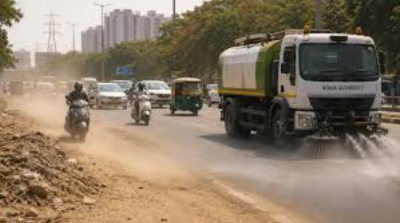
The CSIR-Central Road Research Institute (CSIR-CRRI) signed a Memorandum of Agreement (MoA) with the Government of Haryana to execute the Commission for Air Quality Management’s (CAQM) standard framework for urban road modifications. This scientific project focuses on systemic road design, paving, and greening across Haryana’s urban centers. Developed in coordination with the School of Planning and Architecture (SPA), New Delhi, the program addresses the persistent issue of loose road dust, which remains an active contributor to the atmospheric particulate matter load across the National Capital Region (NCR).
Core Functional Work Packages
The inter-agency project transitions the recommendations outlined in CAQM’s “Standard Framework and Detailed Guidance Document for Paving and Greening of Urban Roads” into actionable, field-level enforcement across Haryana’s municipal limits.
Space Standards and Cross-Section Engineering
The initiative structures engineering design parameters tailored to complex urban configurations. SPA New Delhi and CSIR-CRRI work together to redesign standard urban road cross-sections. This includes reallocating available right-of-way space to ensure that unpaved central verges, open utility trenches, and broken shoulders are properly aligned or sealed.
Right-of-Way Greening Measures
Unpaved or barren earthen surfaces immediately adjacent to active carriage ways are major sources of wind-blown dust. The framework addresses this by mandating targeted bio-engineering steps inside the right-of-way limits. This involves establishing multi-layered vegetative barriers, planting low-maintenance ground covers, and using dense grass turfing to lock loose topsoil in place and trap suspended particulate emissions.
Road Asset Management System (RAMS)
The project updates legacy infrastructure inspection methods by integrating a data-driven Road Asset Management System (RAMS). RAMS acts as a digital tracking matrix that evaluates pavement health conditions in real time, helping municipal agencies predict localized structural wear, track surface deterioration, and schedule preventive sealing repairs before potholes form and release fine mineral dust.
Adoption of Innovative Construction Materials
Traditional civil works are being updated to include new industrial and recycled materials. This includes deploying specialized permeable blocks, precast concrete paving flags for walkways, and coir or jute-based geotextiles to secure sloping embankments. Paving open soil pockets around mature tree basins with porous blocks prevents soil erosion while ensuring rainwater can still recharge the local water table.
Institutional Framework and Stakeholder Matrix
The project depends on a multi-tiered administrative structure that brings together central regulatory bodies, national research laboratories, and state-level implementation teams.
| Organization | Institutional Designation | Primary Executive Role in Project |
| CAQM | Statutory Regulatory Oversight Authority | Formulates general guidelines and monitors environmental compliance targets. |
| CSIR-CRRI | National Premier R&D Laboratory | Provides core engineering designs, technical specifications, and materials research. |
| SPA New Delhi | Specialized Higher Education Institute | Leads regional spatial planning, geometric cross-section design, and landscape integration. |
| ULBD Haryana | State Executive Agency (Urban Local Bodies Department) | Deploys on-ground field staff, provides project financing, and oversees physical civil works. |
Environmental Implications for the NCR
The systematic containment of road dust targets a key component of the winter smog and year-round air pollution challenges that impact the Indo-Gangetic plains.
Particulate Matter Control (PM10 and PM2.5)
Mechanical friction from vehicular tires grinds down road aggregate and soil into micro-fine particles. These particles are continually resuspended in the air by traffic-induced turbulence, forming a major component of the ambient PM10 and PM2.5 pollutant mix. Mechanical paving and greening create a continuous physical barrier that stops the atmospheric entrainment of these fine crustal dust minerals.
Graded Response Action Plan (GRAP) Integration
This proactive engineering framework works alongside the emergency reactive measures enforced under the national Graded Response Action Plan (GRAP). While GRAP relies on temporary, short-term actions like mechanical sweeping and water sprinkling during high-pollution periods, the paving and greening program offers a permanent structural solution to reduce the baseline dust load across the state’s urban centers.
IASPOINT Booster Facts for UPSC
- Commission for Air Quality Management (CAQM): Established as a statutory body under the Commission for Air Quality Management in National Capital Region and Adjoining Areas Act, 2021. It replaced the Supreme Court-mandated Environment Pollution (Prevention and Control) Authority (EPCA) and holds overarching powers to coordinate air quality actions across Delhi, Punjab, Haryana, Rajasthan, and Uttar Pradesh.
- CSIR-CRRI Profile: Founded in 1952, the Central Road Research Institute is a constituent laboratory of the Council of Scientific and Industrial Research (CSIR). It conducts high-end research into highway engineering, bridges, traffic planning, and transport economics.
- Source Apportionment Studies: According to reports by IIT Kanpur and the National Environmental Engineering Research Institute (NEERI), crustal road dust contributes anywhere between 25% to 40% of non-combustion PM10 emissions in urban Delhi-NCR during dry summer and post-monsoon months.
- National Clean Air Programme (NCAP): This initiative supports the central goals of NCAP, which targets a 20% to 30% reduction in particulate matter concentrations across non-attainment cities in India, using 2017 as the baseline year.