
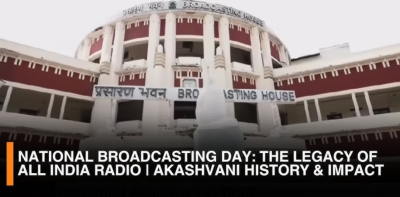
Akashvani, formerly known as All India Radio (AIR), marked 90 years since its renaming on June 8, 1936. Originally established as the Indian State Broadcasting Service, the network officially adopted the name Akashvani in 1956. Over the decades, it has expanded into one of the largest broadcasting organizations in the world. Today, Akashvani operates 591 stations, reaching 98% of India’s population and covering 92% of the country’s geographical area. It broadcasts in 23 languages and 146 dialects, fulfilling its public service mandate of informing, educating, and entertaining the masses.
Evolution and Historical Milestones
Early Experiments and Radio Clubs (1923–1927)
Radio broadcasting in India began as a private initiative in the 1920s. The Radio Club of Bombay conducted the first ever broadcast in June 1923. This was followed by the establishment of the Calcutta Radio Club in November 1923. The Madras Radio Club started its operations in 1924, pioneering broadcasting in southern India.
Indian Broadcasting Company (1927–1930)
The government authorized a private firm, the Indian Broadcasting Company (IBC), to operate two radio stations. The Bombay station commenced operations on July 23, 1927, and the Calcutta station followed on August 26, 1927. Due to financial difficulties, the IBC went into liquidation in 1930.
Indian State Broadcasting Service to All India Radio (1930–1936)
Following the failure of the IBC, the British Indian government took over the broadcasting facilities on an experimental basis, naming it the Indian State Broadcasting Service (ISBS). Lionel Fielden was appointed the first Controller of Broadcasting in August 1935. On June 8, 1936, the ISBS was permanently renamed All India Radio (AIR).
Post-Independence Expansion and Akashvani (1947–Present)
At the time of Partition in 1947, India was left with six radio stations: Delhi, Bombay, Calcutta, Madras, Tiruchirappalli, and Lucknow. Three stations (Lahore, Peshawar, and Dhaka) went to Pakistan. In 1956, the name ‘Akashvani’ was officially adopted for the national broadcaster, inspired by a poem written by Rabindranath Tagore for the inauguration of Calcutta’s shortwave service.
Institutional Framework and Organizational Structure
Prasar Bharati Subsumption
Akashvani operates under the Ministry of Information and Broadcasting. In 1997, the Prasar Bharati (Broadcasting Corporation of India) Act came into force, making Akashvani an autonomous public service broadcaster alongside Doordarshan.
Chronological Table of Structural Milestones
| Year | Milestone Event |
| 1923 | First amateur radio broadcast by the Radio Club of Bombay. |
| 1927 | Launch of organized broadcasting under the Indian Broadcasting Company (IBC). |
| 1930 | Government takeover and formation of the Indian State Broadcasting Service (ISBS). |
| 1936 | Renaming of ISBS to All India Radio (AIR). |
| 1947 | Division of broadcasting assets during India’s independence. |
| 1956 | Official adoption of the name ‘Akashvani’. |
| 1957 | Launch of Vividh Bharati Service for popular entertainment. |
| 1997 | Transition into an autonomous body under Prasar Bharati. |
Key Programming and Specialized Services
Vividh Bharati and Commercial Service
Launched on October 3, 1957, the Vividh Bharati Service was introduced to compete with Radio Ceylon, which was highly popular for film music. Vividh Bharati became the primary entertainment channel, broadcasting film music, skits, and short plays. Commercial advertisements were introduced on AIR for the first time on November 1, 1967, via the Vividh Bharati platform.
News Services Division (NSD)
The News Services Division of Akashvani centralizes the production of news bulletins. It broadcasts over 647 news bulletins daily in both home and external services. This includes national bulletins in Hindi and English, as well as regional bulletins managed by Regional News Units (RNUs) located across state capitals.
External Services Division (ESD)
The External Services Division serves as India’s voice projection abroad. It broadcasts in more than 100 countries in 27 languages, including 15 foreign languages (such as Arabic, Chinese, Persian, Swahili, and Russian) and 12 Indian languages. It projects India’s foreign policy, cultural heritage, and socioeconomic progress to a global audience.
Digital and Modern Initiatives
Akashvani has phased out old analog transmitters in favor of Digital Radio Mondiale (DRM) technology. It offers live streaming of its channels through the NewsOnAIR mobile application and maintains a vast digital archive of historic speeches, classical music performances, and freedom struggle records.
IASPOINT Booster Facts for UPSC
- Motto: The official motto of Akashvani is Bahujan Hitaya Bahujan Sukhaya, which translates to “For the happiness of many, for the welfare of many”.
- Signature Tune: The iconic signature tune of Akashvani was composed in 1936 by Walter Kaufmann, a Czech composer who worked as the Director of Music at AIR Bombay. The tune features a viola solo accompanied by a tambura.
- National Programme of Music: Started in 1952, this program played a major role in reviving and popularizing Indian classical music (both Hindustani and Carnatic styles) across the country after independence.
- First News Bulletin: The first news bulletin in English was broadcast from the Bombay station on July 23, 1927. The first Hindi news bulletin went on air from Delhi on September 18, 1939.
- Mahatma Gandhi’s Only Broadcast: Mahatma Gandhi made his first and only live radio broadcast from the studios of AIR Delhi on November 12, 1947. He addressed displaced people staying at the refugee camp in Kurukshetra, Haryana. This day is now celebrated annually as Public Service Broadcasting Day.
- Central Monitoring Services (CMS): This specialized wing under Prasar Bharati is responsible for monitoring foreign broadcasts, domestic electronic media channels, and news agency feeds to provide analytical reports to various government ministries.