
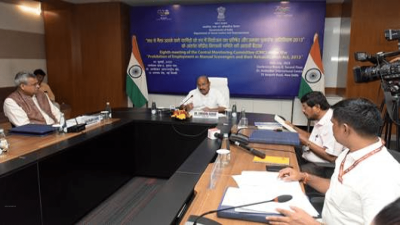
The eighth meeting of the Central Monitoring Committee was recently held at Dr Ambedkar International Centre to evaluate the implementation of the “Prohibition of Employment as Manual Scavengers and their Rehabilitation Act, 2013” (MS Act, 2013). This legislation aims to eradicate manual scavenging in all its forms and ensure the holistic rehabilitation of individuals identified as manual scavengers. In this article, we will discuss the key points highlighted during the meeting and provide an overview of manual scavenging and the MS Act, 2013.
Key Points
- As India’s deadline to declare itself manual scavenging free by August 2023 draws near, a significant number of districts still remain engaged in this practice. According to officials, out of the country’s 766 districts, 246 are yet to submit reports declaring themselves free from manual scavenging. However, it is noteworthy that 520 districts have successfully declared themselves manual scavenging free.
- Madhya Pradesh and Maharashtra have a significant number of non-compliant districts. In Madhya Pradesh, 35 out of 52 districts have not submitted the report, while 21 out of 36 districts in Maharashtra are yet to declare themselves manual scavenging free.
- During the meeting, distressing statistics of sewer deaths in the country were revealed, with a reported 1,056 cases. These deaths serve as a grim reminder of the hazardous nature of manual scavenging work and highlight the urgent need to eradicate this practice completely.
- Furthermore, it was reported that 931 individuals have received compensation of Rs 10 lakh each, while 42 individuals are yet to receive any assistance. This emphasizes the importance of swift and comprehensive rehabilitation measures to support manual scavengers in their transition to alternative livelihoods.
About Manual Scavenging
Manual scavenging is defined as “the removal of human excrement from public streets and dry latrines, cleaning septic tanks, gutters, and sewers.” It is a dehumanizing practice that has plagued Indian society for decades. Recognizing its detrimental impact on human dignity and the need for eradication, India banned the practice under the Prohibition of Employment as Manual Scavengers and their Rehabilitation Act, 2013 (PEMSR).
About the Act
- The Prohibition of Employment as Manual Scavengers and their Rehabilitation Act, 2013 aims to eliminate insanitary latrines and prohibit employment as manual scavengers. It recognizes manual scavenging as a dehumanizing practice and acknowledges the historical injustice and indignity suffered by manual scavengers.
- Under the Act, states are responsible for identifying and rehabilitating manual scavengers. The Act provides measures such as training, loans, assistance, and even houses to support their rehabilitation. In 2013, the definition of manual scavengers was broadened to include people employed to clean septic tanks, ditches, or railway tracks.
- The Act also imposes a responsibility on each local authority, cantonment board, and railway authority to survey unsanitary (dry) latrines within their jurisdiction and construct sanitary community latrines. Offences under the Act are cognizable and non-bailable, highlighting the seriousness of the issue.