
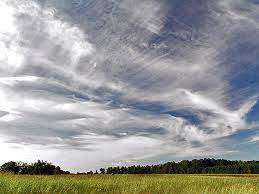
A recent study has established a significant statistical correlation between worldwide thunderstorm occurrences and the formation of delicate cirrus clouds, composed mainly of ice crystals. These high-altitude cirrus clouds, often resembling “mare’s tails,” can potentially contribute to global warming. The study suggests that thunderstorms play a role in the creation of these wispy clouds, which trap heat in the Earth’s atmosphere. Cirrus clouds, which form above 20,000 feet, are distinct due to their thin, filamentous appearance. Understanding this relationship is crucial for assessing their impact on climate change and addressing their potential contributions to temperature rise.
Facts/Terms for UPSC Prelims
- Cirrus Clouds: Cirrus clouds are high-altitude clouds primarily consisting of ice crystals. They have a delicate, wispy appearance and are often referred to as “mare’s tails.” Their formation is influenced by wind currents that spread ice crystals into strands.
- Cumulus Clouds: Cumulus clouds are puffy, cotton-like clouds that typically indicate fair weather. However, if they grow tall, they can lead to thunderstorms. Their base is relatively close to the ground.
- Stratus Clouds: Stratus clouds are low-level cloud formations known for their uniform, featureless appearance. They often cover the sky like a continuous sheet and are associated with overcast or cloudy weather conditions. They form at lower altitudes.
- Thunderstorm: A thunderstorm is a weather phenomenon characterized by lightning, thunder, heavy rain, and sometimes strong winds or hail. It results from rapidly rising warm, moist air in an unstable atmosphere and can vary in intensity and duration.
- Global Warming: Global warming refers to the long-term increase in Earth’s average surface temperature due to the buildup of greenhouse gases in the atmosphere. Wispy cirrus clouds can contribute to this phenomenon by trapping heat in the atmosphere, emphasizing the importance of understanding their formation and impact on climate change.