
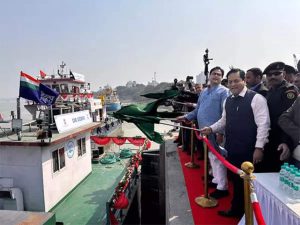
The Government of India has initiated development in cargo transportation by launching a fixed scheduled service of cargo vessels. This step aims to promote the use of inland waterways for trade. The service commenced under the ‘Jalvahak’ scheme, which incentivises long-haul cargo movement across National Waterways 1, 2, and 16. The launch event was led by Shri Sarbananda Sonowal, the Union Minister of Ports, Shipping and Waterways.
Overview of the Jalvahak Scheme
The ‘Jalvahak’ scheme is designed to promote cargo movement via national waterways. It offers a reimbursement of up to 35% of total operating costs for transporting goods over 300 kilometres. This initiative aims to reduce logistics costs and encourage businesses to utilise waterways for cargo transport.
Scheduled Cargo Vessel Service
The service operates between Kolkata, Patna, Varanasi, and Pandu in Guwahati. The first vessels, including MV Trishul, MV AAI, and MV Homi Bhaba, have set sail carrying various cargo types. The transit times are fixed, ensuring timely delivery and boosting user confidence in the waterways’ efficiency.
Economic Impact and Goals
The government targets a modal shift of 800 million tonne-kilometres by investing ₹95.4 crores by 2027. This is expected to enhance cargo movement through waterways, which has seen a substantial increase from 18.07 million tonnes in 2013-14 to 132.89 million tonnes in 2023-24. The long-term goal is to achieve 200 million tonnes by 2030 and 500 million tonnes by 2047.
Environmental Considerations
Utilising waterways for cargo transport is seen as an eco-friendly alternative to road and rail transport. The initiative aligns with sustainable development goals by reducing congestion and promoting a cleaner mode of transportation.
Infrastructure and Development
India’s inland waterways network spans over 20,236 km, yet it remains under-utilised compared to global standards. The government aims to enhance infrastructure to support increased cargo transport via these routes. The Inland Waterways Authority of India (IWAI) plays a very important role in this development.
Stakeholder Involvement
The initiative involves multiple stakeholders, including the IWAI and the Shipping Corporation of India. The collaboration aims to facilitate a seamless cargo transport experience for businesses, enhancing the overall logistics landscape in India.
Future Prospects
The successful implementation of the ‘Jalvahak’ scheme could revolutionise cargo transport in India. It is expected to transform the logistics sector, especially in eastern India, encouraging economic growth and improving connectivity for communities along the waterways.
Questions for UPSC:
- Examine the significance of the Jalvahak scheme in promoting sustainable transportation in India.
- Discuss the role of inland waterways in enhancing trade and economic growth in India.
- With suitable examples, discuss the potential challenges faced by the Jalvahak scheme in its implementation.
- Critically discuss the impact of improved logistics infrastructure on regional development in India.
Answer Hints:
1. Examine the significance of the Jalvahak scheme in promoting sustainable transportation in India.
- Encourages modal shift from road and rail to waterways, reducing congestion.
- Offers financial incentives (up to 35% reimbursement) for long-haul cargo transport.
- Supports eco-friendly transport, aligning with sustainable development goals.
- Facilitates timely delivery of goods, enhancing user confidence in waterways.
- Aims to increase cargo movement, contributing to economic growth and environmental responsibility.
2. Discuss the role of inland waterways in enhancing trade and economic growth in India.
- Inland waterways offer a cost-effective alternative for cargo transport.
- Significant potential for decongesting road and rail networks, improving logistics efficiency.
- Supports the government’s target of increasing cargo movement to 200 million tonnes by 2030.
- Promotes regional development by improving connectivity for communities along waterways.
- Increases competitiveness of Indian trade by optimizing supply chain networks.
3. With suitable examples, discuss the potential challenges faced by the Jalvahak scheme in its implementation.
- Under-utilization of waterways compared to global standards poses a challenge.
- Infrastructure development may lag behind the growth of cargo transport demand.
- Coordination among multiple stakeholders (IWAI, ICSL, shipping companies) can be complex.
- Environmental concerns regarding waterway maintenance and pollution control need addressing.
- Market acceptance and awareness of the scheme among businesses may take time.
4. Critically discuss the impact of improved logistics infrastructure on regional development in India.
- Enhanced logistics infrastructure can lead to increased trade and economic opportunities.
- Improved connectivity encourages investment in local businesses and industries.
- Facilitates faster movement of goods, reducing delivery times and costs.
- Encourages sustainable practices, contributing to environmental conservation in regions.
- Promotes equitable growth by connecting remote areas to major economic hubs.