
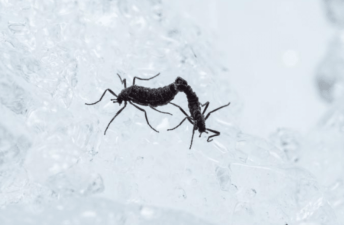
The Antarctic midge, scientifically known as Belgica antarctica, is the only insect native to Antarctica. It has adapted remarkably to the continent’s harsh climate. Recent research has shed light on how this unique insect survives freezing temperatures. The study reveals two critical strategies – quiescence and obligate diapause. These strategies are vital for the midge’s life cycle, which spans two years.
Life Cycle of the Antarctic Midge
The life cycle of the Antarctic midge is divided into two main phases over two years. In the first year, the midge undergoes quiescence. This is a temporary dormancy triggered by immediate adverse conditions. When temperatures rise, the midge resumes activity quickly. This ability allows the midge to exploit warmer periods effectively.
Quiescence
Quiescence is a survival mechanism that enables the midge to respond rapidly to environmental changes. When temperatures drop, larvae enter a dormant state. This state allows them to conserve energy and remain inactive until conditions improve. The midge can transition smoothly between active and inactive states, maximising growth during favourable weather.
Obligate Diapause Mechanism
As the second winter approaches, the midge larvae enter obligate diapause. This is a fixed dormant period that occurs at a specific time in the life cycle. It is a preparation for the harsh winter ahead. During this phase, larvae accumulate energy reserves and seek suitable sites for overwintering. This strategy is rare among insects, particularly in extreme environments like Antarctica.
Adaptations for Survival
The Antarctic midge’s adaptations are crucial for its survival. In summer-like conditions, larvae can develop rapidly from egg to fourth instar without interruption. However, as winter nears, they do not pupate. Instead, they remain in the fourth instar stage until summer arrives. This timing ensures that all adults emerge simultaneously when conditions are optimal for mating.
Importance of Timing in Reproduction
The timing of diapause and quiescence is essential for reproductive success. As adults, midge lifespan is limited to a few days. They must find a mate quickly to ensure the continuation of their species. The synchronised emergence of adults maximises mating opportunities, ensuring the survival of the next generation.
Research Significance
About the survival strategies of the Antarctic midge provides vital information about how life adapts to extreme environments. These findings can inform research in ecology, climate change, and evolutionary biology. The midge serves as a model organism for studying resilience in the face of climate extremes.
Questions for UPSC:
- Discuss the significance of quiescence and obligate diapause in the life cycle of Belgica antarctica.
- Critically examine how the adaptations of Belgica antarctica contribute to its survival in extreme environments.
- What are the ecological implications of studying extremophile organisms like the Antarctic midge? Explain.
- With suitable examples, discuss the impact of climate change on insect life cycles and survival strategies.
Answer Hints:
1. Discuss the significance of quiescence and obligate diapause in the life cycle of Belgica antarctica.
- Quiescence allows immediate response to adverse conditions, enabling rapid activity when temperatures rise.
- Obligate diapause is a fixed dormancy that prepares the midge for harsh winter conditions, ensuring survival.
- Both strategies maximize growth during favorable weather and ensure synchronized emergence for mating opportunities.
- These mechanisms are critical for energy conservation and reproductive success within the midge’s two-year life cycle.
2. Critically examine how the adaptations of Belgica antarctica contribute to its survival in extreme environments.
- The midge’s ability to enter quiescence allows it to conserve energy during freezing temperatures.
- Obligate diapause enables larvae to accumulate energy reserves and seek suitable overwintering sites.
- Rapid development during summer conditions ensures that larvae can grow without interruption.
- The timing of adult emergence aligns with optimal conditions for mating, crucial for species continuation.
- These adaptations are essential for thriving in one of the harshest climates on Earth.
3. What are the ecological implications of studying extremophile organisms like the Antarctic midge? Explain.
- Research on extremophiles provides vital information about biological resilience and adaptability in extreme conditions.
- About these organisms informs ecological responses to climate change and habitat alterations.
- They serve as model organisms for studying evolutionary biology and the limits of life on Earth.
- Findings can contribute to conservation strategies and ecosystem management in fragile environments.
- Studying extremophiles may also have implications for astrobiology and the search for life beyond Earth.
4. With suitable examples, discuss the impact of climate change on insect life cycles and survival strategies.
- Climate change alters temperature and precipitation patterns, affecting insect development and behavior.
- For example, warmer temperatures can lead to earlier emergence in species like the Monarch butterfly, disrupting synchrony with food sources.
- Insects may shift their geographic ranges in response to changing climates, impacting ecosystems and food webs.
- Species with flexible life cycles, like the Antarctic midge, may adapt better, while others face increased extinction risks.
- Overall, climate change poses challenges to insect survival, necessitating adaptive strategies for continued existence.