
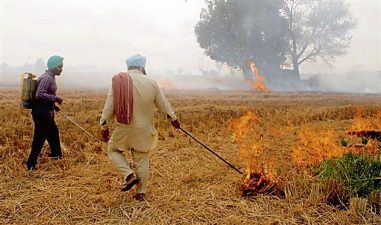
The Supreme Court of India has recently raised the issue of prosecuting farmers who burn crop residue to prepare fields for the rabi season. This practice, known as stubble burning, worsens air pollution in Delhi, Punjab, Haryana, Uttar Pradesh and neighbouring regions. The problem peaks in October and November when weather conditions trap harmful particles in the air. Despite known causes and potential solutions, efforts to curb this pollution remain insufficient.
Air Pollution and Stubble Burning
Stubble burning releases large amounts of toxic particulate matter. This worsens air quality in northern India, especially after the southwest monsoon ends. Along with vehicle emissions, industrial pollution and garbage burning, it creates hazardous smog. The health impacts include respiratory diseases and reduced visibility.
Role of the Commission for Air Quality Management
The Commission for Air Quality Management (CAQM) was established to coordinate pollution control across Punjab, Haryana, Delhi, Uttar Pradesh and Rajasthan. It has statutory powers to enforce measures beyond state boundaries. However, the CAQM often faces political pressure and has struggled to implement policies independently or effectively.
Challenges in Enforcement
The CAQM’s recent order to ban petrol and diesel sales for old vehicles in the National Capital Region was delayed due to political and public opposition. Similarly, it has failed to hold farmers accountable for stubble burning. Enforcement by Punjab and Haryana authorities is weak. Farmers’ economic constraints and debt limit their options, making stubble burning a default choice.
Transparency and Data Issues
Punjab has reported reductions in stubble burning despite evidence to the contrary. The CAQM has not disclosed this discrepancy, undermining trust. Without transparent and accurate data, policy-making and enforcement become ineffective.
Policy Recommendations
Legal action against farmers is being discussed as a deterrent. However, experts argue that a balanced approach is needed. This includes creating incentives for alternative crop residue management, better enforcement of existing laws and transparent communication. Punitive measures alone may alienate farmers and fail to solve the root problems.
Economic and Social Context
Farmers face financial pressures and limited access to technology for residue management. The agricultural economy and credit systems must be reformed to support sustainable practices. Collaboration between governments, farmers and civil society is essential to reduce pollution without harming livelihoods.
Questions for UPSC:
- Taking example of air pollution in northern India, discuss the challenges of inter-state coordination in environmental governance.
- Examine the role of judiciary in balancing environmental protection and farmers’ livelihoods in India.
- Analyse the impact of agricultural practices on air quality and suggest sustainable alternatives with examples.
- Discuss in the light of recent policies how economic incentives and legal frameworks can jointly address environmental issues.