
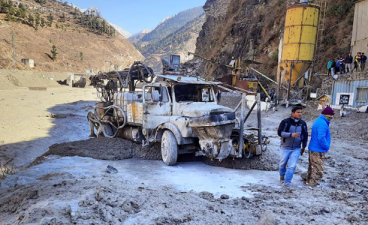
The late 2025 protests in Ladakh have brought urgent attention to the region’s environmental crisis. The disturbances in Leh, marked by curfews and the arrest of environmentalist Sonam Wangchuk, show a deeper issue beyond politics. Ladakh’s glaciers are rapidly melting, threatening water security and climate stability across northern India. This crisis is a warning for the entire subcontinent.
The Himalayan Cryosphere Under Threat
The Himalayas act as a natural barrier and water source for India. However, satellite data from 2000 to 2021 shows glacier mass loss in Ladakh. The Parkachik Glacier shrinks by about twenty metres yearly. Many glaciers in the Drass region have thinned by over a metre. Melting glaciers create fragile glacial lakes prone to sudden floods, followed by droughts as water sources dry up. This flood-then-drought cycle is already impacting villages from Kargil to Nubra.
Ladakh’s Unique Water Scarcity
Ladakh lies in a rain shadow, receiving only 100 mm of rain annually. It depends almost entirely on glacier meltwater. As glaciers retreat, groundwater levels drop sharply, threatening agriculture and livelihoods. Local innovations like Sonam Wangchuk’s ice stupas temporarily store winter water for summer use but cannot replace the vanishing glaciers. The region faces a growing desertification risk.
Impact on Food Security and Climate Feedbacks
Climate change reduces crop yields in India’s main staples such as wheat, rice, and maize by up to 25% by mid-century. This will worsen malnutrition for billions. Melting snow and ice reduce the earth’s reflectivity, accelerating warming. Pollution darkens glaciers, increasing heat absorption. Rising water vapour and warmer oceans intensify greenhouse effects. Northern India’s temperature could rise by 4 to 8 °C if global warming reaches 2 °C, making extreme heatwaves deadly and crippling infrastructure.
Water Stress and Future Conflicts
Water scarcity will intensify in Indian cities like Jaipur, Indore, and Srinagar, all facing severe shortages soon. Historically, wars were fought over land and oil; future conflicts may centre on water. Strengthening cooperative water-sharing agreements within India and with neighbouring countries is vital to prevent disputes. Sustainable water management must become a national priority.
Economic Growth Versus Environmental Sustainability
India has already lost about 10% of its economic growth due to climate impacts, with potential losses up to 30% by 2050. Some argue development should come before climate action, but the two are inseparable. True progress requires adaptation and sustainability. Building infrastructure while degrading the environment is self-defeating. The Himalayas are the foundation of India’s water and climate systems.
Ladakh as a Climate Mirror
Temperature in Leh has risen by 1.6 °C since 1980, with glaciers losing 14% of their mass in two decades. Ladakh’s environmental crisis reflects the future for much of India. Melting glaciers, erratic monsoons, and soil degradation will affect food and water security nationwide. The Himalayas are not just scenic but a vital cooling system for the subcontinent.
Political and Social Dimensions of the Protests
The protests in Ladakh are ecological warnings, not merely political dissent. Demands include declaring Ladakh an ecologically vulnerable zone with strict limits on tourism and construction. These measures require political will rather than technology. The arrest of Sonam Wangchuk has drawn attention to the need for collective action to protect Himalayan ecosystems and promote renewable energy.
Awareness and Action Imperatives
Climate change is often seen as distant or technical, but it affects daily life. The protests urge society to recognise the interconnectedness of environment, economy, and health. Protecting the Himalayas means securing water, food, and livelihoods for millions. The crisis in Ladakh is a call to end denial and embrace sustainable living.
Questions for UPSC:
- Critically discuss the impact of Himalayan glacier retreat on India’s water security and agricultural productivity.
- Analyse the role of climate change in exacerbating urban water scarcity in Indian cities and suggest sustainable management strategies.
- Examine the economic consequences of climate change on India’s growth trajectory and the challenges of balancing development with environmental protection.
- Point out the significance of regional cooperation in South Asia for managing transboundary water resources and preventing future conflicts.
Answer Hints:
1. Critically discuss the impact of Himalayan glacier retreat on India’s water security and agricultural productivity.
- Himalayan glaciers are crucial freshwater sources feeding major rivers sustaining millions across northern India.
- Glacier retreat leads to initial floods from glacial lake outbursts, followed by long-term droughts as water reserves dwindle.
- Declining glacier melt reduces groundwater recharge, lowering water tables in regions like Ladakh, threatening irrigation.
- Reduced water availability directly impacts agriculture, causing crop failures and declining yields in staple crops (wheat, rice, maize).
- Food security is at risk as agricultural productivity falls by up to 25% by mid-century due to water stress and climate change.
- Changing hydrology disrupts traditional farming cycles, forcing migration and economic instability in rural Himalayan and adjoining plains.
2. Analyse the role of climate change in exacerbating urban water scarcity in Indian cities and suggest sustainable management strategies.
- Rising temperatures and erratic monsoons reduce surface water and groundwater recharge, worsening urban water shortages.
- Over 30 Indian cities, including Jaipur, Indore, and Srinagar, face severe water scarcity in coming decades due to climate stress.
- Urban demand outstrips supply, compounded by inefficient water use, leakage, and pollution of existing sources.
- Sustainable strategies include rainwater harvesting, wastewater recycling, and demand-side management to reduce consumption.
- Strengthening groundwater regulation and restoring natural recharge zones are essential to replenish aquifers.
- Integrated urban water management with community participation and smart technologies can enhance resilience.
3. Examine the economic consequences of climate change on India’s growth trajectory and the challenges of balancing development with environmental protection.
- Climate change has already reduced India’s GDP growth by about 10%, with potential losses up to 30% by 2050 under worst scenarios.
- Damage to crops, infrastructure, and health from extreme heat, floods, and droughts impose heavy economic costs.
- Short-term focus on GDP growth often overlooks environmental degradation, undermining long-term sustainability.
- Balancing development requires integrating climate adaptation and mitigation into planning and investment.
- Transitioning to renewable energy, enforcing ecological regulations, and promoting sustainable agriculture are key challenges.
- Political will and public awareness are critical to shift from growth-at-all-costs to inclusive, green development models.
4. Point out the significance of regional cooperation in South Asia for managing transboundary water resources and preventing future conflicts.
- Many major rivers in South Asia, including the Ganges and Indus, cross national boundaries, requiring joint management.
- Water scarcity is projected to intensify, increasing risk of conflicts if cooperative frameworks are weak or absent.
- Existing treaties (e.g., Indus Waters Treaty) provide models but need strengthening to address climate-induced variability.
- Regional cooperation can facilitate equitable sharing, joint infrastructure, and disaster risk reduction (floods, droughts).
- Collaborative water governance promotes peace, security, and sustainable development in a geopolitically sensitive region.
- Building trust through dialogue and data sharing is essential to prevent water-related disputes escalating into conflicts.