
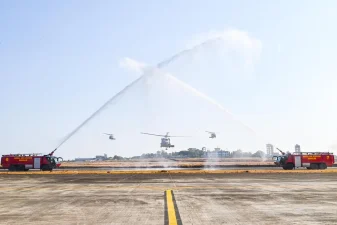
India’s maritime security architecture received a significant operational boost with the commissioning of INAS 335 ‘The Ospreys’, the second Indian Naval Air Squadron equipped with MH-60R multi-role helicopters. The development strengthens the Indian Navy’s combat readiness, particularly in the strategically sensitive Western Indian Ocean Region.
What Was Commissioned and Where
INAS 335 was commissioned on 17 December 2025 at INS Hansa, Goa, in a formal naval ceremony. The event marked the induction of the second squadron operating MH-60R helicopters, following the commissioning of the first such squadron at Kochi in March 2024. INS Hansa, India’s premier naval air station, serves as a key hub for naval aviation operations along the western coast.
Operational Significance of MH-60R Helicopters
The MH-60R Seahawk is an advanced, all-weather, multi-role helicopter designed to operate seamlessly from frontline warships. Its induction addresses a long-standing capability gap in shipborne aviation. The platform is capable of:
- Anti-Submarine Warfare (ASW)
- Anti-Surface Warfare (ASuW)
- Search and Rescue (SAR)
- Medical Evacuation (MEDEVAC)
- Vertical Replenishment (VERTREP)
These capabilities enhance the Navy’s ability to detect, track, and neutralise underwater and surface threats while also supporting humanitarian and logistics missions.
Why the Western Seaboard Matters
The Western Seaboard is critical due to its proximity to key Sea Lines of Communication (SLOCs), major ports, offshore energy assets, and increased naval activity in the Arabian Sea. The deployment of MH-60R helicopters with INAS 335 significantly strengthens maritime domain awareness and anti-submarine deterrence in this region, especially amid rising submarine deployments in the Indian Ocean.
Naval Aviation Modernisation in Context
The commissioning of INAS 335 reflects the Indian Navy’s broader push to modernise its aviation arm. The MH-60R acquisition is part of a larger effort to replace ageing helicopters and align naval capabilities with network-centric warfare, integrating ships, aircraft, and sensors into a unified operational grid. It also complements initiatives under the Atmanirbhar Bharat framework, even as select critical platforms are sourced internationally to meet urgent operational needs.
Institutional and Strategic Messaging
High-level presence at the commissioning ceremony underscored the strategic importance of the squadron. The event symbolised continuity in naval leadership and operational doctrine, with participation from serving commanders, former naval chiefs, and representatives of naval families. Such ceremonies reinforce institutional morale and signal India’s sustained maritime intent to regional and extra-regional actors.
Broader Implications for Maritime Security
With increasing emphasis on the Indo-Pacific and cooperative maritime security, enhanced rotary-wing aviation capability allows the Indian Navy to undertake extended surveillance, joint exercises, and rapid response missions. It also strengthens India’s role as a net security provider in the region, particularly in humanitarian assistance and disaster relief operations.
What to Note for Prelims?
- INAS 335 ‘The Ospreys’ commissioned at INS Hansa, Goa.
- Second Indian Naval squadron operating MH-60R helicopters.
- MH-60R roles: ASW, ASuW, SAR, MEDEVAC, VERTREP.
- First MH-60R squadron commissioned at Kochi in March 2024.
What to Note for Mains?
- Role of naval aviation in strengthening maritime security.
- Strategic importance of the Western Seaboard and Arabian Sea.
- Addressing capability gaps in Anti-Submarine Warfare.
- India’s naval modernisation in the context of Indo-Pacific dynamics.