
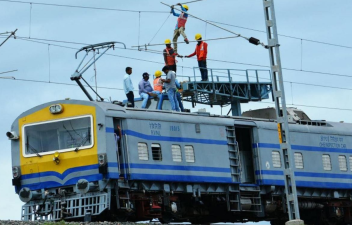
By November 2025, Indian Railways had electrified about 99.2% of its broad-gauge network, placing it among the most extensively electrified rail systems in the world. What appears today as a near-finished project is, in fact, the culmination of a century-long transition — one that has dramatically accelerated over the past decade and now sits at the heart of India’s climate, energy, and infrastructure strategy.
A silent revolution on the tracks
For decades, Indian Railways relied heavily on diesel traction, particularly on freight and long-distance routes. That reality is now rapidly fading. Under Mission 100% Electrification, overhead electric wires have spread across almost the entire network, enabling faster, cleaner, and more reliable train operations.
This is not merely a technical upgrade. Electrification represents a decisive shift towards lower emissions, reduced dependence on imported fossil fuels, and a more efficient national transport backbone. Today, electric traction dominates railway operations, supported increasingly by renewable energy sources such as solar power.
A century-long journey, sharply accelerated
Railway electrification in India began in 1925, when the first electric train ran between Bombay Victoria Terminus and Kurla Harbour using a 1,500 V DC system. At Independence, progress was modest — only 388 route kilometres (RKMs) were electrified, and steam and diesel engines continued to dominate.
The transformation gathered pace much later. Electrified track share rose from about 24% in 2000 to 40% in 2017. The real inflection point came in the last decade. Electrification speed jumped from around 1.42 km per day between 2004 and 2014 to more than 15 km per day during 2019–2025.
By November 2025, a total of 69,427 RKMs — about 99.2% of the 70,001 RKM broad-gauge network — had been electrified. Notably, nearly 46,900 RKMs were completed between 2014 and 2025 alone, underscoring the scale of recent execution.
Wiring the final miles
India is now on the threshold of complete electrification. As of late 2025:
- 25 States and Union Territories have achieved 100% electrification.
- Only five States have residual sections pending.
- These remaining stretches total just 574 RKMs, or about 0.8% of the network.
States such as Rajasthan, Tamil Nadu, Karnataka, Assam, and Goa account for the last unfinished segments, with electrification levels already above 90% in each case.
Why electrification matters beyond trains
Electrification is a cornerstone of India’s sustainable transport and economic growth strategy. Its benefits extend well beyond rail operations:
- Lower carbon emissions and local air pollution
- Greater energy security by reducing diesel consumption
- Lower operating costs and higher hauling capacity
- Improved reliability and faster services
Electrified corridors also act as growth catalysts, supporting industrial clusters, logistics efficiency, and regional connectivity across rural and urban India.
India in global perspective
With 99.2% electrification, Indian Railways now compares favourably with the world’s leading rail networks. According to the International Union of Railways (UIC), only a handful of countries have achieved full or near-full electrification.
While Switzerland stands at 100%, major systems such as China (82%), Japan (64%), France (60%), and the United Kingdom (39%) trail India. This comparison highlights the scale of India’s achievement, especially given the size and complexity of its network.
Railways powered by the sun
Electrification has been complemented by a rapid push towards renewable energy. Solar power adoption has been especially striking. Indian Railways expanded its solar capacity from just 3.68 MW in 2014 to 898 MW by November 2025 — nearly a 244-fold increase.
Solar installations now cover 2,626 railway stations nationwide. About 70% of this capacity (629 MW) is used for traction, directly supporting electric train operations, while the remainder powers stations, workshops, offices, and staff quarters. This dual use reduces electricity costs and dependence on conventional grid power.
Engineering speed and scale
Behind the numbers lies a shift in execution methods. Indian Railways has increasingly adopted mechanised and technology-driven construction:
- Cylindrical mechanised foundations using augering have replaced labour-intensive excavation for overhead equipment.
- Automatic Wiring Trains now install catenary and contact wires simultaneously, ensuring precise tensioning and faster completion.
These innovations have been critical in sustaining high electrification speeds while maintaining safety and quality.
More than modernisation
Railway electrification today is not just an infrastructure milestone; it is a statement of intent. A diesel-driven system is being reshaped into a cleaner, quieter, and more efficient network capable of carrying India’s economic and mobility aspirations.
As the final kilometres are wired, electrification stands as one of independent India’s most consequential transport transformations — where climate goals, energy strategy, and infrastructure capacity converge on steel tracks.
What to note for Prelims?
- India has electrified ~99.2% of its broad-gauge rail network.
- Electrification speed rose to over 15 km/day after 2019.
- Solar capacity of Indian Railways reached 898 MW by 2025.
- UIC provides global railway electrification comparisons.
What to note for Mains?
- Analyse railway electrification as part of India’s climate and energy strategy.
- Discuss economic and operational benefits of electric traction.
- Evaluate India’s performance in global railway modernisation.
- Examine the role of renewable energy in transport decarbonisation.