
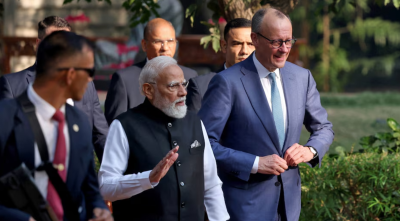
German Chancellor Friedrich Merz’s first official visit to India, though brief, carried strong strategic intent. Against a backdrop of global instability and weakening multilateral norms, New Delhi and Berlin used the visit to signal that cooperation among democratic powers must now deepen in substance, not just rhetoric.
A shared reading of a fragile global order
A central thread of the discussions between Prime Minister Narendra Modi and Chancellor Merz was the changing nature of the international system. Merz spoke candidly about the erosion of global stability and the growing fragility of existing arrangements, arguing that India and Germany needed to “do much more” together.
This strategic convergence translated into Germany’s support for the early conclusion of the India–European Union Free Trade Agreement, which both sides now see as economically and geopolitically necessary.
Trade ties and economic resilience
Prime Minister Modi highlighted that bilateral trade has crossed nearly $51 billion, accounting for roughly a quarter of India’s total trade with the EU. Both leaders agreed that this growth requires a forward-looking vision to sustain momentum amid supply-chain disruptions and protectionist trends.
Addressing the CEOs’ Forum, Merz underlined the importance of economic resilience and warned against dangerous one-sided dependencies—an implicit reference to lessons learned from Europe’s past over-reliance on limited partners.
Technology cooperation in an era of control and coercion
Technology cooperation emerged as another key pillar. Both leaders acknowledged the increasing “weaponisation” of critical technologies and the tightening of controls over supply chains, semiconductors, and advanced manufacturing.
The emphasis was on trusted partnerships, signalling India and Germany’s intent to work more closely in areas where strategic autonomy and secure access are becoming as important as efficiency.
A recalibrated defence partnership
Germany’s approach to defence engagement with India has undergone a noticeable shift. Export clearances that were earlier slow and uncertain are now moving faster, with much of the backlog reportedly cleared.
During the visit, both sides announced plans to develop a defence industrial cooperation roadmap, including discussions on submarine-related collaboration. Differences were handled pragmatically rather than ideologically. India reiterated that defence sourcing decisions are guided strictly by national interest and operational requirements, while Germany signalled a more flexible and strategic approach towards India.
A key takeaway was that Berlin needs to avoid publicly positioning itself as trying to wean India away from Russia—an approach that New Delhi sees as counterproductive.
Green hydrogen and the energy transition
Cooperation in green energy was deepened through a significant commercial and strategic announcement: a long-term off-take agreement for green ammonia between India’s AM Green and Germany’s Uniper Global Commodities.
This partnership aligns India’s green hydrogen ambitions with Germany’s clean energy transition needs, illustrating how climate cooperation is becoming an economic opportunity rather than just a moral imperative.
People-to-people ties and diaspora concerns
With nearly 300,000 people of Indian origin in Germany and close to 60,000 Indian students, Merz’s explicit welcome to Indian students and skilled professionals carried both political and economic weight. Prime Minister Modi echoed this sentiment, reinforcing mobility as a pillar of the partnership.
At the same time, sensitive diaspora-related issues—such as the Baby Ariha case and the expulsion of students attending virtual classrooms—underline the need for more empathetic handling to prevent trust deficits.
Convergences and differences on global hotspots
The leaders exchanged views on the Russia–Ukraine conflict, developments in West Asia, and the Indo-Pacific. While perspectives are not identical, the emphasis remained on dialogue, shared principles, and practical coordination rather than alignment for its own sake.
Beyond symbolism: sustaining momentum
With 19 memoranda of understanding signed and eight additional announcements—27 outcomes in total—the visit went well beyond symbolism. The invitation to Prime Minister Modi to attend the next India–Germany Intergovernmental Consultations in Berlin later this year signals an intent to institutionalise this momentum.
What to note for Prelims?
- Germany is India’s largest trading partner in the EU.
- India–EU FTA negotiations and their strategic significance.
- Green hydrogen and green ammonia in energy diplomacy.
What to note for Mains?
- Role of middle powers in stabilising a fragmented global order.
- Economic resilience and diversification of dependencies.
- Defence industrial cooperation as a tool of strategic partnership.
- Linkages between climate cooperation and industrial policy.