
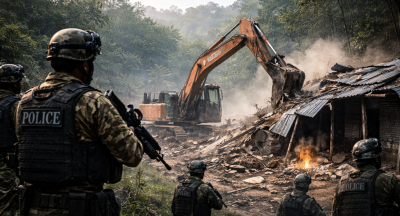
India’s campaign against Left-Wing Extremism (LWE) has entered a new phase with “Operation Demolishment” — an initiative aimed at dismantling memorials and monuments allegedly erected by Naxal groups to glorify their leaders and propagate ideology. According to security agencies, 203 such structures have been demolished across Chhattisgarh and Maharashtra, two states historically most affected by Naxal violence. The move reflects a shift in counterinsurgency strategy from purely kinetic operations to targeting the ideological ecosystem sustaining extremism.
From Armed Cadres to Ideological Symbols
Left-Wing Extremism, often associated with Maoist insurgency, has traditionally been countered through combing operations, intelligence gathering, and targeted action against armed cadres. However, officials now argue that physical memorials functioned as ideological anchors in remote and forested areas.
These structures were reportedly used to:
- Commemorate slain cadres and leaders.
- Organise anniversaries and gatherings.
- Mobilise and recruit local youth.
- Symbolically assert territorial influence.
By removing these sites, security agencies aim to weaken the psychological hold of extremist narratives in vulnerable regions.
Escalation in 2026: A Quantitative Shift
Data shared by officials show a sharp escalation in 2026:
- Chhattisgarh: No demolitions in 2023; 8 in 2024; 11 in 2025; 130 in 2026 — total 149.
- Maharashtra: 1 in 2023; 2 in 2024; 7 in 2025; 45 in 2026 — total 55.
The bulk of demolitions occurring in 2026 indicates a deliberate intensification of the campaign. It signals that the state is no longer focusing solely on armed engagement but also on dismantling symbolic structures that reinforce insurgent identity.
Broader Counter-Insurgency Framework
Operation Demolishment forms part of a wider security doctrine that combines:
- Security operations against active cadres.
- Intelligence-led disruption of support networks.
- Prevention of recruitment through community outreach.
- Infrastructure and development initiatives in affected districts.
The Union government has repeatedly articulated a “zero tolerance” approach to LWE, alongside developmental programmes in tribal and backward regions under initiatives such as the Aspirational Districts Programme.
Balancing Security and Civil Sensitivities
While security agencies argue that the memorials served as tools of radicalisation, such measures also require careful handling in socially sensitive tribal regions. Counterinsurgency in democratic systems must balance:
- Security imperatives,
- Protection of civil liberties,
- Trust-building with local communities,
- Addressing socio-economic grievances that fuel extremism.
Purely symbolic dismantling, without parallel socio-economic engagement, may not produce durable peace. Hence, development, governance reforms, and political inclusion remain central to long-term conflict resolution.
Ideological Warfare in Modern Counter-Terrorism
Globally, counterinsurgency strategies increasingly recognise that extremist movements sustain themselves not just through weapons but through narratives. By targeting monuments and symbols, the state seeks to disrupt the glorification cycle that sustains recruitment.
The 2026 surge suggests that India’s LWE policy is evolving towards a comprehensive model — combining security, psychological operations, and governance outreach.
What to Note for Prelims?
- Left-Wing Extremism (LWE)-affected states in India.
- Role of central armed police forces in counterinsurgency.
- Aspirational Districts Programme in LWE areas.
- Concept of ideological radicalisation in internal security.
What to Note for Mains?
- Discuss the evolution of India’s strategy against Left-Wing Extremism.
- Analyse the role of ideology and symbolism in sustaining insurgencies.
- Examine the balance between security operations and development interventions in conflict regions.
- Evaluate whether targeting ideological symbols can weaken extremist movements sustainably.