
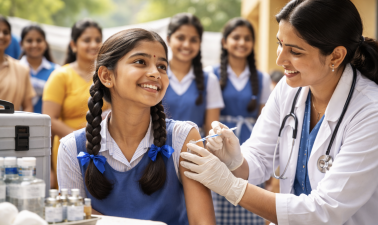
India began a historic step in 2026 by launching a free Human Papillomavirus (HPV) vaccination programme. This initiative targets 1.15 crore girls aged 14 years across the country. The vaccine aims to prevent cervical cancer, the second most common cancer among Indian women. The programme marks India’s entry into over 160 nations offering HPV vaccines in their national immunisation schedules.
and Programme Launch
On 28 February 2026, Prime Minister Narendra Modi inaugurated the HPV Vaccination Programme in Ajmer, Rajasthan. Simultaneous launches occurred in all States and Union Territories. The vaccine, Gardasil-4, is provided free at government health facilities. Girls turning 15 within 90 days of launch are also eligible. The intensive 90-day vaccination campaign runs daily to maximise coverage. Afterwards, the vaccine will be part of routine immunisation schedules.
Cervical Cancer Burden in India
Cervical cancer is the fourth most common cancer globally in women. India accounts for 25% of global cervical cancer deaths. The country records over 1,20,000 new cases and nearly 80,000 deaths annually. HPV infection, particularly types 16 and 18, causes over 80% of these cases. Cervical cancer disproportionately affects younger women and is preventable by timely vaccination.
Gardasil-4 Vaccine and Immunisation Strategy
Gardasil-4 protects against HPV types 16, 18, 6, and 11. It is approved by India’s drug regulator and procured through a partnership with GAVI, the Vaccine Alliance. The vaccine is administered to girls before sexual activity begins, ensuring maximum protection. The programme uses digital platforms like U-WIN for registration and monitoring. Vaccination is only at government centres with cold chain facilities and medical supervision.
Safety, Eligibility, and Monitoring
Vaccination sessions operate from 9 AM to 2 PM, including weekends and holidays. Girls must not be vaccinated if pregnant, ill, allergic to yeast, or previously vaccinated against HPV. Post-vaccination observation lasts 30 minutes. Adverse events are managed by trained medical officers. Recipients receive digital certificates and a mark on the left index finger during the campaign.
Topics for Prelims:
Human Papillomavirus (HPV)
- HPV is a group of viruses, some causing cervical cancer.
- Types 16 and 18 are high-risk HPV strains linked to cancer.
- HPV also causes genital warts (types 6 and 11).
- Transmission is mainly through sexual contact.
- Vaccination prevents persistent HPV infections.
Gardasil-4 Vaccine
- Quadrivalent vaccine protecting against HPV types 6, 11, 16, 18.
- Approved by Indian drug regulators and WHO.
- Administered as a single dose with 93-100% effectiveness.
- Stored in cold chain facilities to maintain efficacy.
- Procured in partnership with GAVI for quality assurance.
Cervical Cancer in India
- Second most common cancer among Indian women.
- Over 1,20,000 new cases annually.
- Causes nearly 80,000 deaths per year.
- Majority caused by persistent HPV infection.
- Prevention possible through vaccination and screening.
Questions for UPSC:
- Discuss in the light of India’s HPV vaccination programme, the role of immunisation in preventing non-communicable diseases.
- Analyse the challenges and strategies in implementing nationwide vaccination programmes in India with suitable examples.
- Examine the burden of cervical cancer globally and in India. How can public health policies address this issue effectively?
- With suitable examples, discuss the significance of public-private partnerships like GAVI in strengthening India’s healthcare system.
Answer Hints:
1. Discuss in the light of India’s HPV vaccination programme, the role of immunisation in preventing non-communicable diseases.
- Immunisation traditionally targets communicable diseases but can prevent some cancers caused by infections, e.g., HPV causing cervical cancer.
- HPV vaccine prevents persistent HPV infections, thereby reducing cervical cancer incidence, a major non-communicable disease (NCD) in women.
- Early vaccination (age 14) ensures protection before exposure, denoting prevention as a cost-effective NCD control strategy.
- Vaccination reduces healthcare burden by preventing costly treatments and deaths linked to cervical cancer.
- India’s programme exemplifies immunisation expanding beyond infectious diseases to NCD prevention, aligning with global elimination goals.
- Successful immunisation can promote health equity by targeting vulnerable populations and reducing disease disparities.
2. Analyse the challenges and strategies in implementing nationwide vaccination programmes in India with suitable examples.
- Challenges – large diverse population, geographical barriers, vaccine hesitancy, cold chain logistics, and health infrastructure gaps.
- Strategy – phased launches with simultaneous state-level events to ensure uniform awareness and rollout (e.g., HPV vaccine launch in 2026).
- Use of digital platforms (U-WIN, eVIN) for registration, monitoring, and stock management enhances transparency and coverage.
- Partnerships with organizations like GAVI provide funding, technical support, and vaccine procurement assurance.
- Targeted campaigns (90-day intensive drive) with flexible timings, including weekends and holidays, improve accessibility.
- Training healthcare workers for AEFI management and community engagement to build trust and manage adverse events.
3. Examine the burden of cervical cancer globally and in India. How can public health policies address this issue effectively?
- Cervical cancer is the fourth most common cancer globally in women; India accounts for 25% of deaths with 1,20,000 new cases annually.
- HPV types 16 and 18 cause over 80% of cervical cancer cases in India, making vaccination a key preventive tool.
- Public health policies should integrate HPV vaccination into national immunisation schedules, ensuring free and easy access.
- Screening programmes (Pap smear, HPV DNA testing) complement vaccination for early detection and treatment.
- Awareness campaigns to reduce stigma and promote vaccination and screening uptake are essential.
- Strengthening healthcare infrastructure, cold chain, and trained workforce ensures sustained programme success.
4. With suitable examples, discuss the significance of public-private partnerships like GAVI in strengthening India’s healthcare system.
- GAVI partnership provides financial support (e.g., US$250 million) enabling vaccine procurement and programme scaling.
- Facilitates access to quality vaccines like Gardasil-4, ensuring safety and efficacy through transparent procurement.
- Supports health system strengthening via technology platforms (eVIN, U-WIN) for vaccine logistics and beneficiary tracking.
- Encourages innovation and capacity building in government health facilities and staff training.
- Enables India to join global immunisation efforts, improving disease control and meeting international health goals.
- Example – Introduction of HPV and Typhoid Conjugate Vaccine into routine immunisation schedules through GAVI collaboration.