
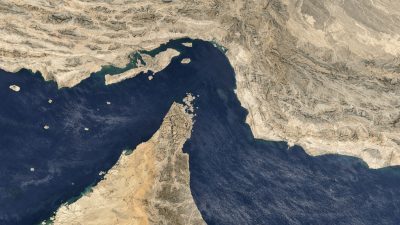
Iran’s Islamic Revolutionary Guard Corps (IRGC) warned of trapping enemies in a “deadly vortex” after US President Donald Trump ordered a naval blockade of the Strait of Hormuz. The IRGC claimed full control over the strait and stated all maritime traffic is closely monitored by Iranian forces. The blockade aims to restrict ships from entering or leaving the strait, a key route for nearly 20% of global crude oil supplies.
US Blockade Announcement
President Trump directed the US Navy to immediately interdict vessels in international waters that pay tolls to Iran. Trump stated the blockade would involve other countries and targeted illegal toll payments to Iran. The announcement followed failed nuclear talks with Iranian representatives in Islamabad. Trump emphasised that Iran must not acquire nuclear weapons and declared the US military “locked and loaded” for further action if necessary.
Iran’s Military Position
The IRGC’s naval command posted a video showing vessels in crosshairs, signalling readiness to counter hostile moves. It asserted complete control over the Strait of Hormuz’s traffic and warned adversaries against making wrong moves. Iran’s statement came amid heightened tensions and ongoing conflict in the region.
Casualties and Regional Impact
Since February 28, the conflict involving the US, Israel, and Iran has resulted in over 3,000 deaths in Iran, 2,020 in Lebanon, 23 in Israel, and casualties in Gulf Arab states. Infrastructure damage across the Middle East has been significant. Iran’s control of the strait has disrupted Persian Gulf access, affecting global oil and gas exports and causing energy price increases.
Diplomatic Talks and Stalemate
US representatives Vice President J D Vance, Special Envoy Steve Witkoff, and Jared Kushner held talks with Iranian officials Mohammad Bagher Ghalibaf, Abbas Araghchi, and Ali Bagheri. Most points were agreed upon except nuclear issues. Trump reaffirmed the US stance that Iran will never obtain nuclear weapons despite diplomatic efforts.
What to Study for UPSC Exams?
- Strait of Hormuz Strategic Importance
- International Maritime Law and Blockades
- Middle East Geopolitical Conflicts
- Nuclear Non-Proliferation Treaties
Strait of Hormuz Strategic Importance
The Strait of Hormuz connects the Persian Gulf with the Gulf of Oman and the Arabian Sea. Approximately 21 million barrels of oil pass through daily, making it one of the world’s most critical chokepoints. It is only about 21 miles wide at its narrowest point, with shipping lanes just 2 miles wide in each direction.
International Maritime Law and Blockades
Under the United Nations Convention on the Law of the Sea (UNCLOS), blockades in international waters are generally prohibited except during declared war. A naval blockade requires effective enforcement and notification to be legally binding. Neutral vessels have rights to innocent passage unless actively violating blockade terms.
Middle East Geopolitical Conflicts
The Middle East hosts overlapping conflicts involving ethnic, religious, and national interests, including Sunni-Shia rivalries and Arab-Israeli disputes. Proxy wars between regional powers Iran and Saudi Arabia have intensified since the 2000s. Control of energy resources and strategic waterways remains a core driver of tensions.
Nuclear Non-Proliferation Treaties
The Treaty on the Non-Proliferation of Nuclear Weapons (NPT) entered into force in 1970 to prevent nuclear weapons spread. It recognizes five nuclear-weapon states but obligates non-nuclear states to forgo weapons development. The treaty allows peaceful nuclear technology use under strict safeguards by the International Atomic Energy Agency (IAEA).
Last Modified: April 12, 2026