
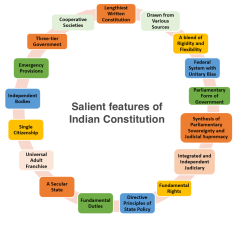
Constitution of India is renowned for its uniqueness, versatility, and comprehensive nature. As it stands today, it incorporates various features that make it distinct from other constitutions in the world. Its key features are as follows:
Lengthiest Written Constitution
The Constitution of India holds the distinction of being the longest written constitution in the world. It is an elaborate document that provides a comprehensive framework for governance.
- Original Structure: When adopted in 1949, the Constitution had a Preamble, 395 Articles divided into 22 Parts, and 8 Schedules.
- Present Form: Today, it comprises a Preamble, approximately 450 Articles in 24 Parts, and 12 Schedules. Various amendments have added new Articles, Parts, and Schedules while deleting some outdated provisions.
- Reasons for Its Length:
- Geographical Diversity: The vastness and diversity of India necessitated detailed provisions.
- Historical Influence: Borrowed extensively from the Government of India Act of 1935.
- Single Constitution: Applicable to both the Centre and states, except Jammu and Kashmir (prior to the abrogation of its special status).
- Legal Expertise: Dominance of legal luminaries in the drafting process.
- Unlike other countries, India’s Constitution includes not only governance principles but also detailed administrative provisions and subjects typically left to legislation in other democracies.
Drawn from Various Sources
The Indian Constitution is a synthesis of the best features of constitutions from across the world, as well as indigenous elements.
- Structural Features: Borrowed heavily from the Government of India Act, 1935.
- Philosophical Underpinnings:
- Fundamental Rights: Inspired by the American Constitution.
- Directive Principles of State Policy: Drawn from the Irish Constitution.
- Political System: Cabinet government and executive-legislative relations are based on the British model.
- Other Borrowed Provisions:
- Federal structure from Canada.
- Concurrent List from Australia.
- Emergency provisions from Germany.
- Ideals of justice and fraternity from the French Constitution.
- Planning principles from the USSR.
- Modifications were made to ensure suitability to Indian conditions, dispelling criticism of it being a “patchwork.”
Blend of Rigidity and Flexibility
The Indian Constitution strikes a balance between rigidity and flexibility, incorporating provisions that can be amended through different procedures:
- Special Majority: Certain amendments require a two-thirds majority in both Houses of Parliament and ratification by at least half of the state legislatures.
- Simple Majority: Other provisions can be amended through the regular legislative process, outside the purview of Article 368.
This dual amendment process makes the Constitution adaptable while preserving its core principles.
Federal System with Unitary Bias
The Indian Constitution establishes a federal structure but incorporates significant unitary features, making it a unique federal model.
- Federal Features:
- Two-tier government: Centre and states.
- Division of powers.
- Supremacy of the Constitution.
- Rigidity and independence of the judiciary.
- Bicameral legislature.
- Unitary Features:
- Strong Centre.
- Single Constitution and citizenship.
- Integrated judiciary.
- Emergency provisions that centralize power.
- Article 1 describes India as a “Union of States,” implying that states cannot secede from the Union. Scholars describe India’s federalism as “quasi-federal” or “federal in form but unitary in spirit.”
Parliamentary Form of Government
India adopts a parliamentary system of government modelled after the British Westminster system, emphasizing cooperation between the executive and legislature.
- Key Features:
- Dual executives (nominal and real).
- Collective responsibility to the legislature.
- Majority party rule.
- Dissolution of the Lower House.
- Leadership by the Prime Minister or Chief Minister.
- Differences with Britain:
- India is a republic with an elected head of state, unlike Britain’s hereditary monarchy.
- The Indian Parliament is not sovereign, as its laws are subject to judicial review.
Synthesis of Parliamentary Sovereignty and Judicial Supremacy
The Indian Constitution balances the British principle of parliamentary sovereignty with the American concept of judicial supremacy.
- The Supreme Court can review and invalidate parliamentary laws that violate the Constitution.
- Parliament can amend most parts of the Constitution, ensuring adaptability within the framework of democratic governance.
Integrated and Independent Judiciary
India’s judiciary is unified and independent, ensuring justice and safeguarding constitutional values.
- Hierarchy:
- Supreme Court at the apex.
- High Courts at the state level.
- Subordinate courts below the High Courts.
- The judiciary is empowered to enforce central and state laws, unlike the dual system in the United States.
- Provisions ensuring independence:
- Security of tenure for judges.
- Fixed service conditions.
- Financial autonomy.
- Prohibition of post-retirement practice for judges.
Fundamental Rights
Part III of the Constitution guarantees six fundamental rights to citizens:
- Right to Equality (Articles 14–18).
- Right to Freedom (Articles 19–22).
- Right against Exploitation (Articles 23–24).
- Right to Freedom of Religion (Articles 25–28).
- Cultural and Educational Rights (Articles 29–30).
- Right to Constitutional Remedies (Article 32).
- These rights are enforceable by courts, ensuring a safeguard against executive and legislative overreach.
- Certain rights can be suspended during a national emergency, except Articles 20 and 21.
Directive Principles of State Policy
Part IV outlines Directive Principles aimed at social and economic democracy. These principles:
- Are non-justiciable but impose a moral obligation on the state.
- Promote goals like establishing a welfare state.
- Strive for harmony between Fundamental Rights and Directive Principles.
Fundamental Duties
Added by the 42nd Amendment in 1976, Part IVA lists 11 Fundamental Duties. These duties, though non-justiciable, remind citizens of their responsibilities toward the nation.
A Secular State
The Constitution establishes India as a secular state, ensuring:
- Equal respect and treatment of all religions.
- Absence of a state religion.
- Provisions like freedom of conscience, equality before the law, and prohibition of religious taxes (Articles 25–30).
Indian secularism emphasizes equal respect for all religions, differing from the Western concept of church-state separation.
Universal Adult Franchise
The adoption of universal adult franchise grants voting rights to every citizen aged 18 and above, irrespective of caste, gender, religion, or wealth. This principle strengthens democratic inclusivity.
Single Citizenship
India provides for single citizenship, ensuring uniform rights and responsibilities for all citizens, unlike the dual citizenship model in countries like the USA.
Independent Bodies
The Constitution establishes independent bodies to maintain democratic integrity:
- Election Commission.
- Comptroller and Auditor General of India.
- Union and State Public Service Commissions.
These bodies operate independently to uphold transparency and accountability.
Emergency Provisions
To address extraordinary situations, the Constitution provides for three types of emergencies:
- National Emergency (Article 352).
- State Emergency (Article 356).
- Financial Emergency (Article 360).
During emergencies, the central government assumes greater authority, transforming the federal structure into a unitary one temporarily.
Three-Tier Government
The 73rd and 74th Amendments introduced a third tier of governance through Panchayati Raj and Municipalities. These amendments institutionalized local self-governance, empowering rural and urban communities.
The Indian Constitution, with its multifaceted features, reflects the vision of its framers to create a democratic, inclusive, and adaptable governance structure. Each feature contributes to its distinction as a living document that balances tradition with modernity.
Last Modified: January 5, 2025