
The Maharashtra government is currently grappling with the challenge of providing additional reservations to transgender individuals in education and public employment. The existing reservations for various communities in India have created complexities in implementing specific provisions for the transgender community. In response, transgender individuals in Mumbai have taken to the streets to protest against this issue.
Courts’ Rulings on Reservations for Transgender Community:
In the landmark case of National Legal Services Authority of India (NALSA) v Union of India (2014), the Supreme Court ruled that transgender persons have the right to reservation, as they are considered a socially and educationally backward class. The court directed the Centre and State Governments to treat transgender persons as socially and educationally backward and extend all kinds of reservation for admission to educational institutions and public appointments. However, the NALSA judgment did not explicitly clarify whether reservations for transgender persons should be vertical or horizontal in nature.
Understanding Horizontal Reservation:
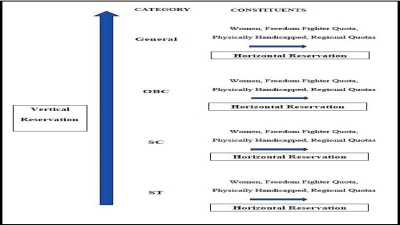
Horizontal reservation refers to equal opportunities provided to other categories of beneficiaries, such as women, veterans, the transgender community, and individuals with disabilities, cutting through the vertical categories. In a horizontal reservation system, if, for example, women have a 50% horizontal quota, then half of the selected candidates in each vertical quota category must necessarily be women. This ensures equal representation across all vertical categories, promoting inclusivity and diversity.
The Demand for Horizontal Reservation for Transgender Community:
Transgender individuals have faced long-term marginalization in society, necessitating specific provisions and recognition of their social identity. A study conducted by the National Human Rights Commission in 2017 revealed that only 6% of transgender people were formally employed, with many engaging in informal work due to societal factors and survival needs. The interpretation of the NALSA judgment suggests that reservations for transgender individuals should be in the Other Backward Classes (OBC) category, considering their identification as a socially and educationally backward class.
Challenges and Considerations:
The demand for horizontal reservation for transgender individuals raises concerns about potential conflicts with existing reservations based on caste and tribal identities. Activists argue that this could result in a difficult choice for Dalit, Bahujan, and Adivasi transgender individuals, who would have to decide between availing reservations based on caste and tribal identity or gender identity. Striking a balance and ensuring equal opportunities for all marginalized communities is a crucial consideration in the implementation of horizontal reservations.
Progress on Horizontal Reservation:
While the NALSA judgment recommended reservations for transgender persons, the Transgender Persons (Protection of Rights) Act, 2019 did not mention any reservations, either vertical or horizontal. However, some states have made progress in this regard. Tamil Nadu has categorized trans-women under the Most Backward Classes (MBC) category, while Karnataka has introduced a 1% horizontal reservation for transgender persons. Madhya Pradesh has included transgender persons in the OBC category. These initiatives provide examples of steps taken towards ensuring horizontal reservation for transgender individuals.
Last Modified: February 22, 2024