
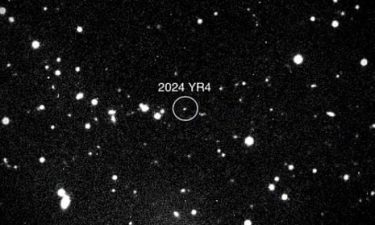
Recent assessments by NASA indicate an increased likelihood of asteroid 2024 YR4 impacting Earth in December 2032. The probability has risen to 3.1 per cent, translating to a 1 in 32 chance. This asteroid is approximately 177 feet in diameter. While it poses a serious threat to urban areas, experts emphasise that there is no immediate cause for alarm.
About Asteroid 2024 YR4
Asteroid 2024 YR4 was discovered on December 27, 2024, by the El Sauce Observatory in Chile. It is classified as a ‘city-killer’ due to its potential to cause destruction upon impact. The asteroid’s size is comparable to that of a large building. Its trajectory and impact probabilities are continuously monitored by astronomers.
Impact Probability and Calculations
NASA’s latest calculations show a rising trend in the likelihood of impact. The probability increased from 2.6 per cent to 3.1 per cent. This fluctuation reflects ongoing observations and data collection. Experts expect that as more information becomes available, the probability of a collision may rise initially but is likely to decrease over time.
Public Awareness and Simulation
A viral simulation illustrating the potential consequences of an asteroid impact has heightened public awareness. Created by animator Alvaro Gracia Montoya, the simulation depicts catastrophic destruction in a major city. This visual representation has sparked discussions on planetary defence and the implications of asteroid impacts.
Role of International Collaboration
The International Asteroid Warning Network (IAWN) plays important role in monitoring such threats. Following the initial discovery, IAWN issued an advisory in January 2025 when the likelihood of impact surpassed 1 per cent. This collaboration aims to enhance global preparedness for potential asteroid threats.
Expert and Public Reassurance
Experts like Bruce Betts from the Planetary Society provide reassurance amid rising probabilities. They note that the current chance of impact remains low. There is a 96.9 per cent likelihood that the asteroid will miss Earth entirely. Furthermore, there exists a slim 0.3 per cent chance of the asteroid striking the Moon instead.
Future Monitoring and Research
Ongoing research and monitoring are essential for understanding the asteroid’s trajectory. As scientists refine their calculations, the likelihood of collision is expected to diminish. Continuous observation will provide more accurate predictions regarding the asteroid’s path and potential impact.
Questions for UPSC:
- Critically discuss the implications of asteroid mining on global economies and space exploration.
- Examine the role of international collaboration in monitoring near-Earth objects and ensuring planetary defence.
- Point out the advancements in technology that enhance our ability to predict asteroid trajectories.
- Analyse the potential environmental consequences of asteroid impact on Earth.
Answer Hints:
1. Critically discuss the implications of asteroid mining on global economies and space exploration.
- Asteroid mining could provide access to rare minerals and metals, potentially reducing dependence on Earth-based resources.
- It may stimulate economic growth through new industries and job creation in space exploration and technology sectors.
- The development of mining technologies could enhance space exploration capabilities, making space travel more feasible.
- Regulatory frameworks will need to evolve to address ownership and environmental concerns in space mining activities.
- Potential geopolitical tensions may arise over resource ownership and access rights in outer space.
2. Examine the role of international collaboration in monitoring near-Earth objects and ensuring planetary defence.
- International collaboration, such as the International Asteroid Warning Network (IAWN), enhances data sharing and threat assessment capabilities.
- Joint efforts allow for pooling of resources and expertise, improving tracking and monitoring of near-Earth objects (NEOs).
- Collaborative initiatives can facilitate the development of global response strategies in case of a potential impact.
- International partnerships help raise public awareness and promote funding for planetary defence projects.
- Such cooperation encourages a unified approach to addressing the risks posed by asteroids and other space threats.
3. Point out the advancements in technology that enhance our ability to predict asteroid trajectories.
- Improvements in telescopic technology allow for more precise tracking of asteroids and their orbits.
- Data analytics and machine learning algorithms enhance the ability to process large datasets for trajectory predictions.
- Advancements in radar technology enable better measurements of an asteroid’s size, shape, and rotation, informing trajectory calculations.
- Space missions, such as NASA’s DART, provide real-world data on asteroid dynamics and impact responses.
- Collaboration with global observatories increases the observational capacity and accuracy of predictions.
4. Analyse the potential environmental consequences of asteroid impact on Earth.
- An asteroid impact could cause widespread destruction, leading to loss of life and habitat destruction in affected areas.
- Dust and debris ejected into the atmosphere could block sunlight, resulting in a “nuclear winter” effect and disrupting climate patterns.
- Impacts may lead to tsunamis if they strike oceans, causing additional ecological damage to marine environments.
- Long-term effects could include changes in ecosystems and biodiversity loss due to habitat alteration.
- Potential release of hazardous materials from the impact site could lead to contamination of soil and water sources.