
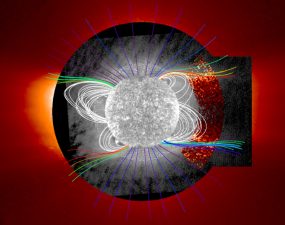
Recent advancements in astrophysics have led to a groundbreaking study estimating the abundance of Helium in the Sun’s photosphere. This research marks leap in understanding solar composition and opacity. Traditionally, Helium levels were inferred from indirect methods, as Helium lacks observable spectral lines in the Sun’s visible surface. The Indian Institute of Astrophysics has employed a novel approach to accurately measure Helium levels, providing fresh vital information about stellar compositions.
About Helium’s Role in the Sun
Helium is the second most abundant element in the Sun, following Hydrogen. Its role is crucial in understanding solar processes. The abundance of Helium influences the Sun’s opacity, affecting how light and energy are transported within the solar atmosphere. Accurate measurement of Helium levels helps in modelling stellar behaviours and characteristics.
Challenges in Measuring Helium
Historically, measuring Helium in the Sun has been difficult due to the absence of direct spectral lines. Most estimates relied on indirect methods, including observations of hotter stars and solar atmospheres. These methods lacked precision and often led to assumptions that may not reflect actual conditions in the Sun’s photosphere.
Innovative Methodology of the Study
The recent study utilised spectral lines of neutral Magnesium and Carbon atoms to derive Helium abundance. By modelling these lines in conjunction with Hydrogenated molecules, researchers could accurately constrain Helium levels. This method represents advancement in the field, allowing for more direct observations and measurements.
Key Findings from the Research
The study found that the Helium to Hydrogen (He/H) ratio is approximately 0.1. This value aligns with previous helioseismological studies, confirming the reliability of the new technique. The researchers demonstrated that the abundance of Magnesium and Carbon must correspond with their respective atomic and molecular lines, supporting their findings.
Implications of the Study
This research has deep implications for astrophysics. About Helium abundance enhances knowledge of solar dynamics and the processes governing stellar evolution. It also provides a more accurate framework for studying other stars, improving models of stellar atmospheres and compositions across the universe.
Future Directions in Solar Research
The findings open new avenues for further research. Future studies may explore the implications of Helium abundance on solar activity and its effects on space weather. Additionally, the techniques developed could be applied to other stars, broadening the scope of astronomical research.
Questions for UPSC:
- Critically analyse the significance of Helium in solar physics and its impact on solar opacity.
- What are the traditional methods used to estimate Helium abundance in stars? Discuss their limitations.
- Estimate the potential effects of solar Helium abundance on stellar evolution and solar dynamics.
- Point out the advancements in astrophysical techniques for measuring stellar compositions. How do they compare to traditional methods?
Answer Hints:
1. Critically analyse the significance of Helium in solar physics and its impact on solar opacity.
- Helium is the second most abundant element in the Sun, crucial for understanding solar processes.
- Its abundance affects the Sun’s opacity, influencing energy transport within the solar atmosphere.
- Accurate Helium measurements are vital for modeling stellar behaviors and characteristics.
- Changes in Helium levels can alter the availability of Hydrogen for molecular formation.
- About Helium’s role helps in predicting solar activity and its impact on space weather.
2. What are the traditional methods used to estimate Helium abundance in stars? Discuss their limitations.
- Traditional methods include extrapolating from hotter stars and analyzing the solar corona or solar wind.
- Seismology studies of the Sun’s interior have also been used to estimate Helium abundance.
- These methods rely on indirect observations, lacking direct spectral lines for Helium in the photosphere.
- Such approaches often lead to assumptions that may not accurately reflect the Sun’s true conditions.
- Limitations include potential inaccuracies and a lack of precision in Helium abundance estimates.
3. Estimate the potential effects of solar Helium abundance on stellar evolution and solar dynamics.
- Helium abundance influences the rate of nuclear fusion processes in stars.
- Higher Helium levels could alter energy output and stability of stars over time.
- Variations in Helium can impact solar wind and magnetic field dynamics, affecting space weather.
- About Helium levels aids in predicting the life cycle of stars and their eventual fate.
- Accurate estimations of Helium contribute to models of stellar evolution across different types of stars.
4. Point out the advancements in astrophysical techniques for measuring stellar compositions. How do they compare to traditional methods?
- Recent studies utilize high-resolution spectral lines of elements like Magnesium and Carbon for direct measurements.
- This innovative methodology allows for more accurate constraints on Helium abundance compared to indirect methods.
- Advancements include modeling spectral lines in conjunction with Hydrogenated molecules for better results.
- New techniques are more reliable and provide a clearer understanding of stellar compositions than traditional approaches.
- These methods enhance the precision of measurements, paving the way for further astrophysical research.