
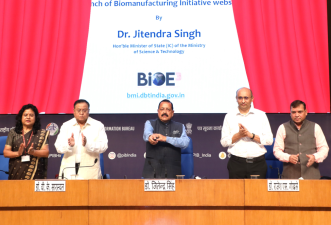
India’s biotechnology sector marked milestone in 2025 with the completion of one year of the BioE3 (Biotechnology for Economy, Environment and Employment) Policy. The government launched the BioE3 Challenge for Youth and established the country’s first National Biofoundry Network. These initiatives aim to position biotechnology as a key driver of India’s economy, environment, and employment growth.
Rapid Growth of India’s Bioeconomy
India’s bioeconomy expanded from $10 billion in 2014 to $165.7 billion in 2024. The government targets $300 billion by 2030. This rapid growth is supported by new institutions, research partnerships, and advanced biotechnological projects. The Department of Biotechnology (DBT) has been central to these achievements, encouraging innovation and collaboration nationally and internationally.
Key Infrastructure and Partnerships
India inaugurated its first Biomanufacturing Institute at Mohali. The National Biofoundry Network was launched, linking six institutions to scale proof-of-concept developments and promote indigenous biomanufacturing. DBT signed a memorandum of understanding with the Indian Space Research Organisation (ISRO) to cooperate in space biotechnology. This partnership has already led to experiments on the International Space Station, denoting India’s growing role in space biosciences.
BioE3 Challenge for Youth
The BioE3 Challenge invites students, researchers, startups, and innovators to design safe biological solutions for health, agriculture, environment, and industry. The challenge follows the DESIGN framework – Define needs, build Evidence, ensure Sustainability, pursue Integration, strategise Go-to-market, and create Net-positive impact. Monthly challenges will award ₹1 lakh to top ideas and provide up to ₹25 lakh funding for 100 selected projects. This initiative aims to empower youth and grassroots innovators.
Focus Areas and Research Initiatives
DBT has launched over a dozen joint research calls in areas like cell and gene therapy, climate-smart agriculture, carbon capture, and functional foods. More than 2,000 proposals have been received. These projects reflect the policy’s emphasis on sustainable and advanced biotechnology solutions to address national and global challenges.
State and Global Collaboration
BioE3 has encourageed centre-state partnerships, including an MoU with Assam to establish a BioE3 Cell. Globally, India’s diplomatic missions in 52 countries have engaged with the policy, supporting international cooperation. The Ministry of External Affairs works closely with DBT to implement these global linkages.
Biotechnology and Emerging Technologies
Biotechnology is increasingly converging with fields such as artificial intelligence, engineering, architecture, and space science. Innovations include biophilic urban designs, algae-based carbon capture, genetically engineered plants, biodegradable plastics, prosthetic organs, and organ-on-a-chip systems. The integration with Artificial General Intelligence (AGI) opens new career paths and research opportunities for India’s youth.
Government Vision and Future Prospects
The BioE3 Policy aligns with the vision of an Atmanirbhar Bharat (self-reliant India), focusing on green and sustainable growth. It aims to strengthen biotechnology as a pillar of economic development while addressing environmental and health challenges. The government’s support through funding, infrastructure, and partnerships is expected to accelerate innovation, employment, and inclusive growth in the bioeconomy.
Questions for UPSC:
- Critically discuss the role of biotechnology in achieving sustainable development goals in India.
- Examine the impact of public-private partnerships in advancing India’s biotechnology sector and their implications for economic growth.
- Analyse the convergence of biotechnology with Artificial General Intelligence and space science and its potential to transform India’s innovation landscape.
- Estimate the challenges and opportunities in scaling indigenous biomanufacturing in India and suggest policy measures to enhance its global competitiveness.