
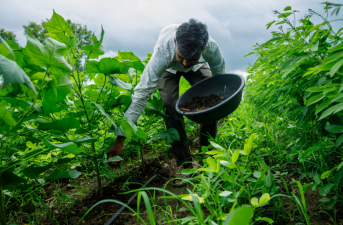
Small farmers from marginalised communities in India are pioneering natural farming methods. These methods increase food production on small farms while reducing costs and protecting the environment. Farmers like Maali Ram from Rajasthan and Balchand Ahirwar from Madhya Pradesh have demonstrated how natural farming can create sustainable rural livelihoods, promote healthy food, and address climate challenges.
Innovative Farming by Tribal and Dalit Farmers
Maali Ram, a Bhil tribal farmer in Rajasthan, uses natural farming on a small one-acre farm. He grows nearly 200 fruit trees like guava, papaya, amla and lemon alongside over 15 vegetable varieties. His farm integrates animals such as cows and goats whose waste is recycled into manure and pest repellents. Water needs are met by a traditional well. He applies a multi-layered cropping system that maximises space and biodiversity. His work is supported by the voluntary organisation Srijan, but he adds his own creativity and experimentation. His farming protects soil health, family wellbeing and the environment.
Cost-Effective and Diverse Farming Practices
Balchand Ahirwar, a Dalit farmer in Madhya Pradesh, combines natural farming with low-cost techniques. He avoids expensive chemical fertilisers and pesticides by preparing organic manure and pest repellents from local materials such as cow dung, urine, gram powder and jaggery. This reduces his input costs drastically from ₹6,000 per acre to ₹500. He also saves on irrigation as natural farming requires less water. Balchand uses a power tiller instead of tractors to protect soil fertility. On his two-acre farm, he grows 44 crop varieties including wheat, groundnut, vegetables, legumes, millets and spices, using multi-layer gardens supported by bamboo structures.
Environmental and Economic Benefits
Both farmers emphasise waste minimisation and resource recycling. Trees and plants on farm bunds conserve soil and water. The presence of earthworms in the soil indicates healthy soil ecology. Natural farming reduces dependency on chemical inputs, lowering pollution and improving food quality. It also helps farmers avoid debt by cutting input costs. These methods support climate resilience by conserving water and soil and increasing biodiversity. The farmers’ commitment and continuous care are vital for success.
Community Impact and Support Systems
Srijan plays important role by encouraging farmers and providing technical help. It has set up centres like the Palak Center where natural fertilisers and pest repellents are produced on a larger scale for local farmers. Balchand trains other farmers in natural farming techniques and has been recognised by district authorities. The success of these farmers inspires others in their villages to adopt similar sustainable practices, encouraging a wider movement towards self-reliant and eco-friendly agriculture.
Questions for UPSC:
- Taking example of small farmers adopting natural farming in India, discuss the role of sustainable agriculture in rural development and environmental conservation.
- Examine the impact of reduced chemical input usage on soil health and farmer livelihoods. How does this relate to climate change mitigation?
- Analyse the challenges and opportunities in promoting low-cost, eco-friendly farming techniques among marginalised communities in India. Discuss in the light of government policies and grassroots initiatives.
- Critically discuss the significance of community-based organisations and knowledge sharing in enhancing sustainable agricultural practices. How can such models be scaled up to benefit larger populations?
Answer Hints:
1. Taking example of small farmers adopting natural farming in India, discuss the role of sustainable agriculture in rural development and environmental conservation.
- Sustainable agriculture improves rural livelihoods by increasing food production on small farms with low costs.
- Natural farming reduces dependency on chemical inputs, lowering expenses and farmer indebtedness.
- It promotes biodiversity through multi-layer cropping and integration of trees, animals, and crops.
- Soil health and water conservation are enhanced, improving long-term farm productivity.
- Environmental conservation is achieved by reducing pollution, minimizing waste, and recycling farm resources.
- Supports climate resilience by conserving water, enhancing soil fertility, and reducing greenhouse gas emissions.
2. Examine the impact of reduced chemical input usage on soil health and farmer livelihoods. How does this relate to climate change mitigation?
- Reduced chemical use improves soil microbial activity and biodiversity, enhancing soil fertility.
- Natural fertilizers and pest repellents decrease soil and water pollution risks.
- Lower input costs increase farmer income and reduce financial vulnerability.
- Reduced irrigation needs due to healthier soil conserve water resources.
- Less chemical fertilizer use cuts nitrous oxide emissions, a potent greenhouse gas.
- Improved soil carbon sequestration helps mitigate climate change effects.
3. Analyse the challenges and opportunities in promoting low-cost, eco-friendly farming techniques among marginalised communities in India. Discuss in the light of government policies and grassroots initiatives.
- Challenges include lack of awareness, initial labor intensity, limited access to resources and markets.
- Opportunities lie in cost reduction, improved health, and sustainable income generation.
- Government schemes like Paramparagat Krishi Vikas Yojana support organic and natural farming adoption.
- Grassroots organizations (e.g., Srijan) provide technical support, training, and community mobilization.
- Peer learning and farmer trainers enhance knowledge dissemination and trust.
- Scaling up requires integration with credit, marketing support, and infrastructure development.
4. Critically discuss the significance of community-based organisations and knowledge sharing in enhancing sustainable agricultural practices. How can such models be scaled up to benefit larger populations?
- Community organizations facilitate farmer training, resource sharing, and collective problem-solving.
- They build local capacity and encourage innovation tailored to regional conditions.
- Knowledge sharing promotes adoption of best practices and reduces dependence on external inputs.
- Centers like Palak Center enable affordable access to organic inputs for small farmers.
- Scaling up requires government partnership, funding, and digital platforms for wider outreach.
- Replication of successful models across regions can create networks for sustainable agriculture promotion.