
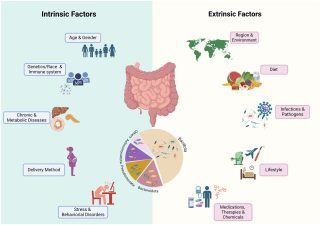
Recent research has advanced our understanding of the human gut microbiome by focusing on the complex interactions among microbial species rather than just their presence or abundance. Using mathematical models from statistical physics, scientists have uncovered key differences in the ecological stability of healthy and diseased gut microbial communities. This approach provides new vital information about the nature of dysbiosis and its role in gut-related diseases.
Gut Microbiome and Health
The human gut hosts a vast ecosystem of microbes essential for health. A balanced state called eubiosis supports digestion and immunity. When this balance is disturbed, dysbiosis occurs, linked to diseases like inflammatory bowel disease. Traditional studies focus on species counts but overlook how microbes interact.
Modelling Microbial Interactions
Researchers applied the disordered generalised Lotka-Volterra (dgLV) model to describe microbial population dynamics. This model accounts for random positive and negative interactions between species, influencing their growth rates. Interaction strengths are treated as random variables due to measurement challenges.
Data and Methodology
Using gut microbiome data from 91 healthy and 202 diseased individuals, the team matched the dgLV model parameters to observed microbial abundances. An algorithm optimised the model to reflect real-world data, enabling inference of inter-species interaction patterns and community stability.
Findings on Stability and Interaction Patterns
Healthy microbiomes exhibited stronger and more diverse interactions, forming a resilient network that absorbs fluctuations without collapsing. Diseased microbiomes showed weaker, less diverse interactions with higher randomness, indicating instability. Diseased states were mathematically closer to a critical threshold leading to chaotic dynamics.
Implications for Dysbiosis
The study shifts the focus from which microbes are present to how their interactions maintain stability. Dysbiosis arises from weakened or erratic microbial interactions rather than just missing species. This insight opens possibilities for predicting and correcting unstable microbial communities by targeting their collective behaviour.
Limitations and Future Directions
The model assumes static interactions, but microbial relationships may change with environment and time. Future research could include dynamic interaction models to better capture real gut ecosystem behaviour and improve predictions of health outcomes.
Questions for UPSC:
- Critically discuss the role of microbial interactions in maintaining human health with examples from gut microbiome studies.
- Examine the application of statistical physics in understanding complex biological systems. How can such interdisciplinary approaches benefit medical research?
- Discuss in the light of ecological stability theory, how diversity and interaction strength influence ecosystem resilience, taking microbial communities as an example.
- Analyse the challenges in modelling dynamic biological systems and suggest ways to incorporate environmental variability in such models, with reference to gut microbiome research.
Answer Hints:
1. Critically discuss the role of microbial interactions in maintaining human health with examples from gut microbiome studies.
- Microbial interactions form a complex network influencing gut ecosystem stability and host health.
- Healthy gut microbiomes show strong, heterogeneous interactions that absorb fluctuations, maintaining eubiosis.
- Dysbiosis results from weakened or erratic microbial interactions rather than absence of specific species.
- Examples – Inflammatory bowel disease linked to disrupted microbial interaction patterns causing instability.
- Microbial cooperation and competition regulate digestion, immunity, and pathogen resistance.
- Targeting microbial interactions offers potential for therapies restoring gut health beyond species replacement.
2. Examine the application of statistical physics in understanding complex biological systems. How can such interdisciplinary approaches benefit medical research?
- Statistical physics provides tools to model large, disordered, interacting systems like microbial communities.
- Models like disordered generalized Lotka-Volterra capture random species interactions and population dynamics.
- Enables extraction of mathematical fingerprints distinguishing healthy vs diseased states from metagenomic data.
- Helps identify stability zones and critical transitions in biological systems, predicting collapse or resilience.
- Interdisciplinary methods reveal collective behavior beyond individual components, aiding diagnosis and treatment strategies.
- Facilitates quantitative, predictive frameworks for complex diseases linked to microbiome or cellular networks.
3. Discuss in the light of ecological stability theory, how diversity and interaction strength influence ecosystem resilience, taking microbial communities as an example.
- Ecological stability depends on diversity and strength of species interactions within a community.
- Higher interaction heterogeneity and strength promote resilience by buffering environmental fluctuations.
- Microbial communities with diverse, strong interactions maintain stable equilibria (eubiosis).
- Reduced diversity and weak, random interactions increase susceptibility to instability and dysbiosis.
- Critical thresholds exist where ecosystems shift from stable to chaotic dynamics, threatening health.
- Microbial ecosystems exemplify how interaction networks underpin resilience in complex biological systems.
4. Analyse the challenges in modelling dynamic biological systems and suggest ways to incorporate environmental variability in such models, with reference to gut microbiome research.
- Biological systems are dynamic; interactions and species abundances fluctuate with environment and time.
- Current models often assume static interactions, limiting realism and predictive power.
- Challenges include measuring variable interaction strengths and accounting for microbial evolution and adaptation.
- Incorporating time-dependent parameters or stochastic fluctuations can capture interaction dynamics.
- Integrating multi-omics and longitudinal data improves model calibration and environmental context.
- Future models should allow interaction networks to evolve, reflecting microbial responses to diet, drugs, or disease.