
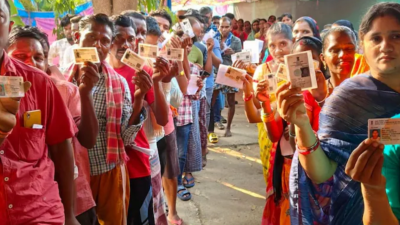
The Election Commission of India (ECI) initiated the Special Intensive Revision (SIR) of electoral rolls across nine States and three Union Territories in November 2025. This massive exercise follows the recent completion of Bihar’s electoral roll revision amid its elections. Covering over 51 crore electors, the SIR aims to update and clean voter lists before upcoming elections in various States.
Scope and Scale of the SIR
The SIR covers Tamil Nadu, West Bengal, Kerala, Uttar Pradesh, Madhya Pradesh, Rajasthan, Chhattisgarh, Goa, Gujarat, and the Union Territories of Andaman and Nicobar Islands, Lakshadweep, and Puducherry. It excludes Assam due to ongoing citizenship legal issues. The revision spans 321 districts and 1,843 Assembly constituencies, involving 5.33 lakh polling stations and an equal number of Booth Level Officers (BLOs). Over 7.64 lakh booth level agents from political parties are also engaged, reflecting the political stakes.
Challenges Across States
Each State presents unique challenges. West Bengal’s border with Bangladesh raises concerns of infiltration and citizenship verification. Uttar Pradesh’s vast electorate and social complexity add to the difficulty. Tamil Nadu and Kerala’s ruling parties have expressed reservations about the process. Unlike Bihar, other States do not face similar migration issues, but the quality of previous electoral rolls varies, affecting the revision workload.
Legal and Procedural Framework
The SIR is grounded in Article 326 of the Constitution of India, which defines an elector’s eligibility. The process emphasises transparency and fairness. No documents are collected during the initial enumeration phase to ease voter apprehension. Draft electoral rolls will be published on 9 December 2025, with final rolls out on 7 February 2026. Voters can use familiar forms for enrolment, deletion, or corrections. Each elector’s household will be visited thrice by BLOs to verify details.
Political and Administrative Responses
Political parties initially opposed the SIR but have now shifted towards cooperation, recognising its necessity. The exercise demands active participation from all stakeholders to prevent exclusion of eligible voters. The Election Commission has mandated governments to provide adequate staff and not reassign officials involved in the SIR. The Supreme Court has upheld the process’s legitimacy, emphasising voter rights protection during the revision.
Significance and Future Prospects
This is only the ninth SIR since India’s independence and the first after 21 years. The exercise aims to ensure cleaner, more accurate electoral rolls. It complements other ECI initiatives to increase voter registration and turnout. The success in Bihar’s trial phase boosts confidence for the pan-India rollout. The Commission must manage execution challenges with skill and empathy to maintain public trust in the electoral system.
Questions for UPSC:
- Critically discuss the role of the Election Commission of India in maintaining electoral integrity and managing large-scale electoral roll revisions.
- Analyse the impact of migration and citizenship issues on electoral roll management in border States and their implications for democracy in India.
- Examine the constitutional provisions related to electoral rights in India and how they safeguard voter participation during electoral roll revisions.
- Estimate the challenges and benefits of decentralised electoral management systems in a diverse and populous democracy like India, with reference to the Special Intensive Revision process.
Answer Hints:
1. Critically discuss the role of the Election Commission of India in maintaining electoral integrity and managing large-scale electoral roll revisions.
- ECI ensures accuracy and transparency in electoral rolls through systematic revisions like the Special Intensive Revision (SIR).
- It mandates standard procedures and prohibits collection of documents during initial enumeration to reduce voter apprehension.
- ECI coordinates with State governments for manpower and prevents shifting of officials involved in SIR to maintain continuity and efficiency.
- It balances uniform statutory standards with local customisation to address regional challenges and social complexities.
- Supreme Court’s validation of ECI’s processes upholds the legal legitimacy of revisions, protecting voter rights.
- ECI’s success in Bihar’s pilot SIR reflects its competence and builds public and political trust for nationwide implementation.
2. Analyse the impact of migration and citizenship issues on electoral roll management in border States and their implications for democracy in India.
- Border States like West Bengal face infiltration concerns due to proximity to Bangladesh, complicating citizenship verification.
- Migration patterns affect voter lists, causing challenges in maintaining updated and accurate electoral rolls.
- Citizenship issues can lead to exclusion or disenfranchisement fears among eligible voters, impacting democratic participation.
- Legal complexities, such as Assam’s ongoing citizenship cases, necessitate exclusion from the SIR to avoid conflicts.
- Proper management ensures electoral integrity while safeguarding the democratic right to vote for genuine citizens.
- Political sensitivities in such States require careful balancing of security concerns and inclusive electoral participation.
3. Examine the constitutional provisions related to electoral rights in India and how they safeguard voter participation during electoral roll revisions.
- Article 326 guarantees universal adult suffrage, defining eligibility to vote in elections to Parliament and State Legislatures.
- Article 324 vests the Election Commission with power to conduct free and fair elections, including electoral roll maintenance.
- Legal safeguards ensure no eligible voter is disenfranchised during revisions, with provisions for grievance redressal.
- Use of standard forms (Form 6, 7, 8) facilitates enrolment, deletion, and correction transparently and uniformly.
- Multiple household visits by Booth Level Officers ensure thorough verification and inclusion of genuine electors.
- Supreme Court oversight reinforces protection of voter rights during electoral roll updates.
4. Estimate the challenges and benefits of decentralised electoral management systems in a diverse and populous democracy like India, with reference to the Special Intensive Revision process.
- Decentralisation allows local customisation of procedures to address State-specific social and political complexities.
- Utilisation of Booth Level Officers and agents enables grassroots-level verification and rapid response to discrepancies.
- Challenges include coordination across vast geographies, large electorates (51 crore), and varying administrative capacities.
- Political party involvement at booth level increases scrutiny but may also lead to contestation or politicisation.
- Decentralised grievance redressal mechanisms enhance transparency and voter confidence in the process.
- Overall, decentralisation improves accuracy, inclusiveness, and adaptability of electoral roll management in India’s diverse context.