
A new study by the Raman Research Institute (RRI), an autonomous institute under the Department of Science and Technology, is reshaping how astronomers estimate the mass of gas surrounding galaxies. The research suggests that a significant fraction of gas previously thought to belong to a galaxy’s circumgalactic medium may actually come from the intergalactic medium — a finding with deep implications for understanding how galaxies form, evolve, and sustain themselves.
The Invisible Halo That Shapes Galaxies
While galaxies are commonly visualised as glowing collections of stars and dust, most of their mass lies beyond the visible edge. Surrounding each galaxy is a vast, diffuse halo extending up to 10–20 times the galaxy’s size. This halo is dominated by dark matter and gas, and its gaseous component is known as the circumgalactic medium (CGM).
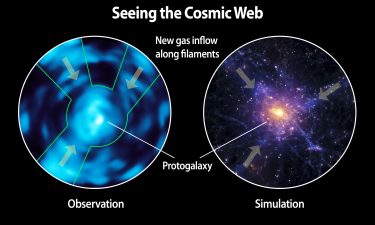
The CGM acts as a critical interface between the galaxy and the larger cosmic web — the filamentary network of matter spanning the universe. It regulates how gas flows into galaxies to fuel star formation and how energy and matter are expelled through winds and feedback processes.
How Astronomers Measure the CGM
To estimate the mass of the CGM, astronomers rely on a clever observational technique. Light from extremely bright, distant galaxies or quasars passes through the gas halo of a foreground galaxy before reaching Earth. Certain elements in the CGM absorb specific wavelengths of this light.
Highly ionised oxygen — oxygen atoms stripped of five electrons — is particularly useful because it is abundant and detectable. The amount of this ionised oxygen along the line of sight is used as a proxy to calculate the CGM’s mass.
The Core Problem: CGM and IGM Along the Same Line of Sight
The complication arises because the CGM does not exist in isolation. Beyond it lies the intergalactic medium (IGM), the diffuse gas filling the space between galaxies. Both CGM and IGM lie along the same observational line of sight, and current observational methods cannot cleanly separate their contributions.
As a result, standard models assume that all detected ionised oxygen belongs to the CGM. The new RRI study challenges this assumption, arguing that the IGM may significantly contaminate CGM measurements.
What the New RRI Study Shows
Using theoretical models that describe both the CGM and the inflowing gas from the IGM, the RRI team calculated how much ionised oxygen each region should contribute. When these estimates were compared with observational data, a mismatch emerged — especially for low-mass galaxies.
The researchers suggest that the CGM is surrounded by a “blanket” of ionised gas from the IGM, which adds substantially to the observed oxygen signal. This means that CGM masses may have been systematically overestimated.
For massive galaxies like the Milky Way, the CGM may account for only about 50% of the observed ionised oxygen. In lower-mass galaxies, the CGM contribution could drop to as little as 30%, with the majority originating in the IGM.
Why This Matters for Galaxy Evolution
Accurate CGM mass estimates are essential for tracing how galaxies acquire gas, form stars, and regulate their growth. If CGM masses are overestimated, models of galaxy formation may misjudge how efficiently galaxies retain or lose matter over cosmic time.
By highlighting the role of the IGM, the study calls for a reassessment of long-standing assumptions in observational cosmology and underscores the need for more refined models that account for gas beyond galactic boundaries.
What Comes Next in the Research
The RRI team, in collaboration with researchers from the Hebrew University of Jerusalem, is now working to develop more comprehensive models that include additional physical parameters. The aim is to precisely quantify the CGM–IGM overlap and improve the interpretation of observational data.
What to Note for Prelims?
- Circumgalactic Medium (CGM): Gas halo surrounding galaxies, crucial for galaxy evolution.
- Intergalactic Medium (IGM): Diffuse gas filling the space between galaxies.
- Ionised oxygen is used as a tracer to estimate CGM mass.
What to Note for Mains?
- Explain why distinguishing CGM and IGM contributions is critical for galaxy formation models.
- Discuss how observational limitations can bias astrophysical mass estimates.
- Highlight the role of Indian research institutions in advancing fundamental cosmology.