
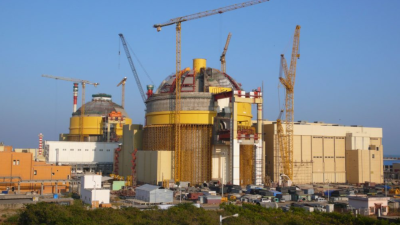
Nearly two decades after India staked major political capital on nuclear power, the country appears ready to reopen a door that never fully swung open. A new law passed by Parliament in December seeks to finally translate long-standing ambition into execution by allowing private and foreign participation in nuclear energy. If implemented well, this could reshape India’s energy mix. If done poorly, it risks compounding old governance failures in a sector where mistakes are uniquely irreversible.
The unfinished promise of the 2008 nuclear deal
In 2008, India and the US signed a landmark civilian nuclear agreement that ended India’s long isolation from global nuclear commerce. The deal came at enormous political cost. Then Prime Minister “” risked his government’s survival to push it through Parliament, amid fierce opposition. While the agreement normalised India’s status in the global nuclear order, it failed to deliver its most tangible promise: new nuclear plants built with global technology and private expertise.
The core problem lay not in diplomacy, but in domestic law. India’s nuclear liability regime diverged sharply from international norms, deterring foreign suppliers and financiers.
Why nuclear matters more now than before
Today, nuclear power accounts for only about 3% of India’s electricity generation. At the same time, renewable energy capacity is expanding rapidly. While this is essential for decarbonisation, renewables suffer from intermittency. Without reliable baseload power, coal plants risk staying online far longer than climate goals allow.
New Delhi has now acknowledged that the future grid will need firm, non-fossil capacity alongside renewables — and nuclear power is one of the few scalable options available.
The scale of India’s new nuclear ambition
The government has set a target of 100 gigawatts of nuclear capacity by 2047, India’s centenary year of independence. This is a dramatic jump from less than 9 gigawatts today. In effect, India plans to build the equivalent of the entire US reactor fleet over the next generation.
Officials estimate the cost of this expansion at around $217 billion. Domestic capital alone cannot meet this requirement, making foreign investment indispensable.
What the December law changes
The most consequential aspect of the new legislation is its alignment with global nuclear liability standards. Internationally, liability for nuclear accidents rests primarily with the plant operator, not with equipment suppliers. India’s earlier framework allowed recourse against suppliers, making projects unfinanceable.
This shift removes the single biggest obstacle that undermined the 2008 agreement. It is already generating interest, with reports suggesting that Adani Group may explore small modular reactors in Uttar Pradesh, and other conglomerates watching closely.
The long shadow of Bhopal
India’s liability exceptionalism was rooted in history. The 1984 Bhopal gas disaster — the world’s deadliest industrial accident — left deep scars. Many Indians believe “” escaped adequate accountability. This trauma shaped India’s instinct to hold suppliers liable across hazardous industries, including nuclear power.
Moving beyond this approach was politically fraught but economically unavoidable if nuclear energy was to be revived.
Private capital and the regulation dilemma
Opening nuclear power to private players will save the government billions in upfront capital costs. But it also raises a harder question: can India regulate powerful private operators in a sector where risks are extreme and information asymmetry is severe?
India’s regulatory track record is mixed. In sectors such as coal, telecom, and airports, regulators have often been accused of weakness in the face of politically influential firms. In nuclear energy, such regulatory failure would be catastrophic.
Why nuclear regulation cannot be an afterthought
Nuclear power demands a level of oversight unlike almost any other sector. Regulators must have the authority — and credibility — to delay projects, shut down plants, and publicly challenge corporate giants if safety demands it. This requires:
- Independent laboratories and testing facilities
- Highly trained, well-paid inspectors
- Real-time monitoring and transparent reporting systems
- Institutional insulation from political and corporate pressure
India has often built markets first and strengthened regulation later. In nuclear power, this sequencing would be dangerous.
The hidden cost of nuclear expansion
While private participation reduces fiscal strain, it introduces a new kind of public investment: regulatory capacity. Building the world’s second-largest reactor fleet will require billions not just in concrete and steel, but in governance expertise. This “startup cost” is unavoidable if nuclear power is to remain safe, credible, and socially acceptable.
What to note for Prelims?
- India–US Civil Nuclear Agreement signed in 2008
- Nuclear power contributes about 3% of India’s electricity
- Target of 100 GW nuclear capacity by 2047
- Global norm: operator liability in nuclear accidents
What to note for Mains?
- Analyse why the 2008 nuclear deal failed to translate into investment
- Discuss the role of nuclear power in India’s clean energy transition
- Examine the trade-off between private participation and regulatory risk
- Evaluate why strong, independent regulation is critical in the nuclear sector
India’s renewed nuclear push could become one of the most consequential energy decisions of this generation. Whether it succeeds will depend not just on attracting private capital, but on building the regulatory strength to govern it without fear or favour.
Last Modified: January 17, 2026