
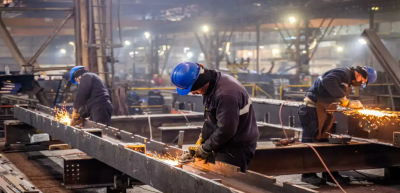
For much of independent India’s economic history, manufacturing was framed more as an aspiration than a realised outcome. Policy intent existed, but fragmented infrastructure, regulatory uncertainty, and weak logistics prevented scale and competitiveness. Manufacturing mattered in theory, yet often remained peripheral to national strategy. Over the past decade, this positioning has shifted decisively. Manufacturing is no longer treated as an adjunct to growth but as a central pillar of India’s economic and strategic future.
From aspiration to strategic priority
Under the leadership of Prime Minister “”, the state’s role in economic development has been redefined. The emphasis has moved away from managing enterprises towards enabling ecosystems. This change is less visible in slogans and more evident in outcomes — predictability in policy, scale in infrastructure creation, and coordination across ministries. Manufacturing, which depends on long investment cycles and reliable supply chains, responds more to consistency than announcements.
Infrastructure as the foundation of scale
One of the most consequential shifts has been the sustained focus on infrastructure as a strategic enabler of manufacturing. Highways, dedicated freight corridors, port modernisation, and logistics integration have reduced transaction costs that industry endured for decades. Initiatives such as the PM Gati Shakti National Master Plan reflect an understanding that modern manufacturing depends on speed, coordination, and visibility across supply chains. Infrastructure, in this context, is not merely a public asset but a productivity multiplier.
A clearer industrial policy framework
Industrial policy has also undergone a philosophical recalibration. Broad, open-ended subsidies have given way to outcome-linked incentives. The Production Linked Incentive (PLI) schemes exemplify this approach by rewarding scale, efficiency, and performance rather than protection. This clarity has encouraged both domestic and global firms to commit capital in sectors such as electronics, pharmaceuticals, automotive components, and advanced manufacturing. For investors, policy predictability matters as much as incentives, and continuity of direction has reduced long-term uncertainty.
Digital public infrastructure and ease of doing business
Another defining feature of this phase has been the expansion of digital public infrastructure. Platforms such as Aadhaar, UPI, and integrated digital compliance systems have reshaped state–industry interactions. For manufacturing enterprises, especially MSMEs, digitalisation has reduced compliance costs, increased transparency, and shortened transaction timelines. While less visible than physical infrastructure, this digital backbone has significantly improved ease of doing business and widened participation in formal supply chains.
Skills, labour, and the quality of production
Manufacturing competitiveness ultimately rests on human capital. Policy emphasis on skilling, vocational education, and industry-linked training reflects an attempt to align India’s demographic profile with industrial needs. Precision skills, quality control, and technical competence are increasingly central to manufacturing success. This focus also changes the social perception of industrial work, positioning manufacturing as a sector offering stable careers, learning, and mobility rather than low-skilled employment.
Manufacturing and global supply chain realignment
India’s renewed manufacturing push coincides with a reconfiguration of global supply chains. Firms are diversifying production bases to reduce concentration risks. India’s large domestic market, improving infrastructure, and clearer policy framework make it a credible alternative destination. However, capturing this opportunity depends on execution — maintaining quality standards, meeting delivery timelines, and remaining cost-competitive.
A shared responsibility between state and enterprise
The current phase is not driven by government action alone. Policy can create enabling conditions, but outcomes depend on enterprise investment, innovation, and operational discipline. The alignment between public intent and private capability is the defining strength of this moment. Manufacturing will be central to sustaining India’s growth trajectory as one of the fastest-growing major economies, but success is not automatic.
Beyond a policy phase
What is underway is not a short-term surge or a slogan-driven cycle. It represents the early architecture of a longer industrial transformation shaped by sustained political leadership and institutional capacity. If execution keeps pace with vision, manufacturing can evolve from a growth driver into a nation-building force — strengthening productivity, employment, and strategic autonomy.
What to note for Prelims?
- PM Gati Shakti National Master Plan for integrated infrastructure planning
- Production Linked Incentive (PLI) schemes and their objective
- Role of digital public infrastructure in ease of doing business
- Manufacturing as a pillar of economic growth and supply chain resilience
What to note for Mains?
- Analyse how infrastructure investment affects manufacturing competitiveness
- Discuss the shift from subsidy-based to performance-linked industrial policy
- Evaluate the role of digital public infrastructure in industrial development
- Examine the importance of skills and human capital in sustaining manufacturing-led growth
India’s manufacturing story is no longer about latent potential. It is about building systems that endure. The direction is clearer than before; the outcome will depend on sustained execution by both the state and industry.
Last Modified: January 17, 2026