
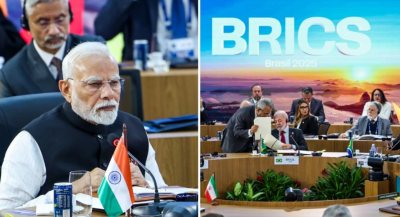
India will host the next BRICS Summit in 2026 at a time when the global order is marked by deep geopolitical fractures and an accelerating climate crisis. With the institutional experience of the G20 Presidency in 2023 behind it, the real challenge before India is not logistics, but leadership — choosing a summit focus that aligns national interest with the urgent priorities of the Global South. Climate resilience, rather than mitigation alone, offers precisely such a convergence.
A fractured global order and the vacuum in climate leadership
The current international landscape is defined by stress on multilateralism. Under President Donald Trump, the United States has openly questioned climate science, expanded fossil fuel production, and announced withdrawal from dozens of international organisations, including the India-led International Solar Alliance. Washington’s absence from COP30 in Belém in 2025 symbolised a broader retreat from collective climate responsibility.
Simultaneously, Europe — long a standard-bearer for climate ambition — is grappling with domestic climate fatigue and heightened security concerns. This combination has created a leadership vacuum in global climate governance, particularly on issues that matter most to developing countries: adaptation, resilience and finance.
Why BRICS can act as a stabilising force
In this polarised environment, BRICS has the potential to serve as a stabilising platform for collaborative action. Unlike traditional Western-led groupings, BRICS reflects the priorities and vulnerabilities of large developing economies. Its members span diverse climate risk zones — from permafrost thaw in Russia, pressures on the Amazon in Brazil, Himalayan fragility in India and China, to coastal and desert vulnerabilities across Africa and West Asia.
These shared exposures make resilience — protecting lives, livelihoods and infrastructure from climate impacts — a unifying agenda. It is also politically less divisive than mitigation targets, which are often framed as constraints on development.
Climate diplomacy beyond traditional blocs
Within the UN climate process under the United Nations Framework Convention on Climate Change, the BASIC grouping (Brazil, South Africa, India, China) has historically defended developing country interests. However, an expanded BRICS — now including Egypt, Ethiopia, Indonesia, Iran and the UAE — brings greater demographic, economic and geopolitical weight.
This broader coalition proved its relevance at COP30 in Belém, where developing countries resisted attempts to constrain fossil fuel use in ways that ignored development imperatives. A coordinated BRICS stance can similarly push back against unilateral measures such as the EU’s Carbon Border Adjustment Mechanism, which many in the Global South view as disguised protectionism.
Finance: the missing pillar of climate action
A key outcome of the July 2025 BRICS Summit in Rio de Janeiro was the BRICS Leaders’ Framework Declaration on Climate Finance. This reflects a long-standing Indian position: climate ambition without finance is rhetoric, not policy.
If climate resilience is to be the centrepiece of the 2026 Summit, India would need to widen the conversation beyond BRICS institutions like the New Development Bank. Engaging the heads of the World Bank and the International Monetary Fund is essential, given their central role in global development finance. Treating them as exclusively “G7 institutions” limits the Global South’s ability to reshape climate finance architecture from within.
India’s diplomatic tightrope
Pushing a strong BRICS climate agenda is not without geopolitical risk. President Trump has repeatedly portrayed BRICS as anti-American and a threat to the dollar. For India, which values its strategic partnership with the U.S. — including trade, technology and security cooperation — this demands diplomatic finesse.
India’s G20 Presidency demonstrated such balancing capability: safeguarding strategic autonomy through multi-alignment while amplifying Global South concerns. A resilience-focused agenda, rather than overt systemic confrontation, allows India to lead without directly provoking great power anxieties.
Why resilience suits India’s national interest
For India, climate resilience is not abstract diplomacy; it is a domestic imperative. Extreme heat, floods, cyclones and Himalayan disasters directly threaten growth, infrastructure and social stability. Positioning resilience as a development enabler — rather than a climate constraint — aligns with India’s own policy priorities and reinforces Prime Minister Narendra Modi’s emphasis on an inclusive green transition.
Geopolitically, a BRICS-led resilience agenda also prevents any single power, particularly China, from monopolising leadership on the Global South’s green discourse.
Looking ahead: BRICS 2026 and beyond
A resilience-focused BRICS Summit in India would resonate beyond the grouping. It would align with Ethiopia’s hosting of COP32 in 2027, reinforce South-South cooperation, and reposition BRICS as a solutions-oriented platform rather than a reactive bloc.
At a time when climate impacts are intensifying faster than global governance responses, India has an opportunity to shape BRICS into a forum that speaks credibly for the world’s most vulnerable — not by opposing the global system, but by stabilising and reforming it from within.
What to note for Prelims?
- BRICS expanded membership and share in global population, GDP and trade.
- International Solar Alliance and India’s leadership role.
- BASIC grouping under UNFCCC.
- BRICS Leaders’ Framework Declaration on Climate Finance (2025).
- Carbon Border Adjustment Mechanism (CBAM).
What to note for Mains?
- Assess BRICS’ potential role in global climate governance amid weakening multilateralism.
- Discuss why climate resilience is central to the Global South’s development agenda.
- Analyse India’s diplomatic challenges in balancing BRICS leadership with U.S. relations.
- Examine the importance of climate finance institutions in achieving climate resilience.