
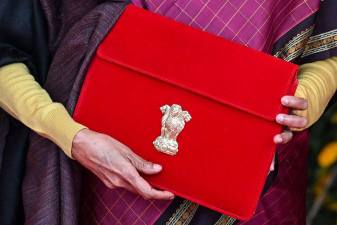
The stock market is a poor judge of a country’s annual economic policy statement. The Sensex’s 1.88% fall on Budget day — among the steepest since 2004 — says far more about short-term trader sentiment than about the quality of the Union Budget 2026–27. The decline was driven almost entirely by displeasure over a hike in the Securities Transaction Tax on derivatives, a move aimed at protecting small investors from losses in a segment largely dominated by high-frequency trading firms. To treat this reaction as a verdict on the Budget would be analytically shallow.
How Budgets Should Really Be Judged
A serious evaluation of a Budget needs a more rigorous framework. At the most basic level, it must assess whether the government has managed public finances prudently. Beyond that, it should ask whether the Budget responds to short-term risks, prepares for medium-term needs, and anticipates long-term disruptions that could reshape the economy — artificial intelligence being the most obvious example today.
This form of “horizon planning” also requires reading between the lines. Budgets often signal major shifts through small announcements — a committee, a review, or a pilot initiative — that can later redefine entire sectors. Finally, any Budget must be read as an expression of the government’s broader economic philosophy.
Fiscal Management: A Box Ticked
Measured against its primary objective, the Union Budget 2026–27 performs strongly. This was not a foregone conclusion. Tax giveaways in the previous year, combined with low inflation, had moderated tax revenues. Yet, the government met its fiscal deficit target for 2025–26 and set an even lower one for 2026–27.
The continued emphasis on capital expenditure and the clear articulation of a glide path to bring public debt down to about 50% of GDP (±1%) by March 2031 have reinforced credibility. It is difficult to argue that the Budget could have done much better on fiscal stewardship, especially in a globally uncertain environment.
Economic Context: No Crisis, But Real Risks
Despite significant geo-economic and geopolitical disruptions — including tariffs imposed by the United States — India’s economy in 2025–26 did not show signs of crisis. Export data from the first ten months of the year suggests that India has diversified its merchandise exports with some success.
That said, the Budget recognises immediate and medium-term challenges. Security, both external and internal, features prominently, reflected in higher defence spending and increased allocations for intelligence gathering. Another concern is strategic self-reliance in critical sectors, which explains the reference to a proposed rare earth corridor.
Growth Engines: Sectors and Spaces
The Budget identifies engines of growth along two axes. One is sectoral: six manufacturing areas where India aims to build globally competitive capabilities. The other is spatial: the development of new city clusters to catalyse regional growth.
While the finance minister refrained from the sweeping customs duty reforms hinted at earlier — likely because India’s expanding network of free trade agreements reduces their urgency — the Budget does focus on streamlining procedures and compliance. These process reforms may be less headline-grabbing, but they are central to improving the ease of doing business.
AI, Data and the Quiet Power of Committees
Unsurprisingly, the Budget pays homage to the defining force of this decade: artificial intelligence. It also recognises the importance of data centres as critical infrastructure in the digital economy.
More subtle, but potentially transformative, are two committee announcements. One will examine services as a driver of Viksit Bharat — India’s vision of becoming a developed country by 2047. The other will review the banking sector, widely seen as inadequate in its current form to finance India’s long-term development ambitions. History suggests that such committees often lay the groundwork for deep structural reforms.
An Unchanged Economic Philosophy
A close reading of the finance minister’s speech and the Budget documents reveals continuity rather than drift. The government’s economic philosophy remains anchored in self-reliance, fiscal prudence and the creation of globally competitive industries. Crucially, it seeks to achieve this not through protectionism or handouts, but by strengthening foundational capabilities — infrastructure, skills, finance and technology.
As articulated at the outset of the speech, this approach is framed around growth, aspirations and inclusion.
What to Note for Prelims?
- Sensex fall on Budget day linked to STT hike on derivatives.
- Fiscal deficit targets met and lowered for 2026–27.
- Debt reduction target: ~50% of GDP by 2031.
- New focus areas: rare earths, AI, data centres.
What to Note for Mains?
- Critically assess why market reactions are weak indicators of Budget quality.
- Explain horizon planning in fiscal policy with reference to Budget 2026–27.
- Analyse the role of capital expenditure in India’s fiscal strategy.
- Discuss how subtle institutional announcements can drive long-term reform.
In this broader analytical frame, the Union Budget 2026–27 scores well. The markets may suggest it is not the Budget India wants in the short term, but a more reasoned assessment indicates that it is the Budget India needs on its long journey to Viksit Bharat.
Last Modified: February 3, 2026