
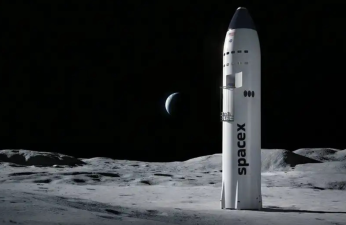
For years, the public identity of SpaceX has revolved around settling humans on Mars. Its founder, Elon Musk, has framed a self-sustaining Martian settlement as insurance against planetary catastrophe. Meanwhile, Blue Origin, founded by Jeff Bezos, articulated a parallel but distinct vision — building industrial capacity in space so that heavy industry can move off Earth.
Now, both companies appear to be converging on a nearer destination: the Moon. This recalibration reflects technological realism, commercial strategy, and intensifying geopolitical competition.
From Martian Ambition to Lunar Urgency
SpaceX has long positioned its Starship programme as the vehicle that could make large-scale interplanetary travel viable. Mars timelines were used to signal ambition, attract talent, and sustain public attention. However, the company has recently described the Moon as its immediate next priority, reportedly targeting an uncrewed lunar landing by 2027 and envisioning a “self-growing city” there within a decade.
Blue Origin, while less publicly fixated on Mars, has also pivoted. It has paused aspects of its suborbital tourism programme to accelerate development of its lunar lander and heavy-lift capabilities tied to NASA contracts.
This dual shift is not a retreat from Mars but a reordering of milestones.
Why the Moon Is Technically Easier
The Moon offers clear operational advantages over Mars:
- Travel time of under a week versus months for Mars.
- Near-real-time communication, enabling safer mission control.
- Frequent launch windows — roughly three per month.
- Lower fuel and logistical requirements.
Mars missions, by contrast, depend on narrow launch windows roughly every 26 months. Missing one opportunity can delay a programme by years. The Moon therefore functions as a proving ground — technologically, operationally, and politically.
NASA’s Artemis and Political Signalling
NASA has prioritised returning humans to the Moon under the Artemis programme. Artemis is not merely scientific; it is strategic. In an era of renewed U.S.–China competition, the ability to land humans on the Moon has become a marker of geopolitical leadership.
Congressional scrutiny has intensified around NASA’s timelines and contractors. Lawmakers have pressed agency leadership to defend a Moon-first agenda and demonstrate credible progress. For major contractors like SpaceX and Blue Origin, aligning with this priority ensures access to funding, milestones, and political support.
Lunar missions offer “legible” achievements — landings, habitats, cargo delivery — that can be demonstrated within shorter cycles than Mars expeditions.
Commercial Logic and Investor Discipline
SpaceX is reportedly approaching a potential IPO, and its claims now face heightened investor scrutiny. Public markets reward measurable milestones more than distant aspirations.
Focusing on lunar missions allows:
- Faster technological learning cycles.
- Revenue through government contracts.
- Clearer performance benchmarks.
- Reduced reputational risk from repeated Mars timeline slips.
For Blue Origin, whose heavy-lift New Glenn rocket and lunar lander are central to its future credibility, lunar work provides a structured programme with accountability and deadlines. Success in human-rated lunar systems would significantly strengthen its standing within NASA’s ecosystem.
Brand Narratives Versus Internal Strategy
The apparent “pivot” may not be as sudden as it appears. Public narratives often differ from internal roadmaps.
SpaceX’s brand identity has been built on Mars colonisation. Mars timelines symbolised audacity and long-term ambition. Internally, however, the company has been deeply embedded in lunar contracts for years.
What has changed is the alignment between external messaging and operational sequencing. The Moon is no longer a stepping stone hidden in the roadmap; it is now the headline milestone.
Geopolitics and the New Space Race
Competition with China has sharpened the Moon’s strategic value. A sustained human presence on the lunar surface could shape future claims over resources, orbital infrastructure, and scientific dominance.
In this environment, lunar capability is not just technological progress but diplomatic leverage. Contractors are responding to this geopolitical signal. Lunar milestones define national prestige and international partnerships more immediately than Mars concepts.
What This Means for Mars
Mars remains the ultimate ambition for both Musk and segments of the U.S. space community. But the timeline is longer and less forgiving. Building lunar infrastructure first:
- Tests life-support and habitat technologies.
- Develops in-situ resource utilisation techniques.
- Refines human-rated spacecraft systems.
- Strengthens political coalitions for deep-space exploration.
In this sense, the Moon is rehearsal and infrastructure; Mars is culmination.
What to Note for Prelims?
- Artemis Programme: NASA-led initiative to return humans to the Moon.
- Starship: SpaceX’s fully reusable heavy-lift launch system.
- New Glenn: Blue Origin’s heavy-lift rocket.
- Human-rated systems: spacecraft certified for carrying astronauts.
- Launch windows: optimal periods for fuel-efficient interplanetary travel.
What to Note for Mains?
- Discuss how geopolitical competition is reshaping space exploration priorities.
- Analyse the role of private space companies in national strategic objectives.
- Examine the Moon-first versus Mars-first debate in terms of technological feasibility and political economy.
- Evaluate how commercial incentives influence long-term scientific ambitions.