
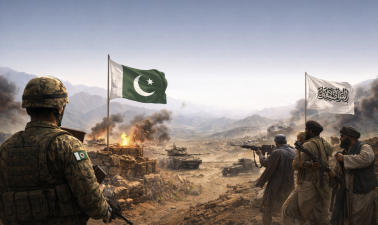
Recent tensions between Pakistan and Afghanistan have escalated sharply in 2026. Pakistan carried out air strikes on Kabul targeting what it called militant bases. Afghanistan’s Taliban government condemned the strikes, claiming hundreds of civilian casualties. This marks a serious deterioration in relations between two neighbours long linked by complex politics and militant groups.
Historical Background of Pakistan-Taliban Relations
Pakistan helped create the Afghan Taliban in the early 1990s. Islamabad sought strategic depth against India through Taliban influence. When the Taliban returned to power in 2021, Pakistan initially welcomed them. However, relations soured as the Taliban did not fully cooperate with Pakistan’s security demands. Pakistan accuses Afghanistan of harbouring militants who attack Pakistani forces. Afghanistan denies these claims and accuses Pakistan of sheltering their enemies.
Causes of Current Conflict
The Pakistani Taliban (Tehreek-e-Taliban Pakistan or TTP) and Baloch separatists reportedly use Afghan territory as a safe haven. Pakistan alleges repeated attacks by these groups originating from Afghanistan. Cross-border clashes have increased after a fragile ceasefire collapsed. Pakistan’s recent air strikes followed attacks killing Pakistani security personnel. Both sides blame each other for violating peace and supporting militants.
Military Capabilities and Strategic Outlook
Pakistan’s military is far larger and better equipped than the Taliban’s forces. Pakistan has over 600,000 active troops, hundreds of combat aircraft, and nuclear weapons. The Taliban have fewer troops and limited air power. Despite this imbalance, border skirmishes and guerrilla attacks continue. Analysts expect Pakistan to intensify military operations while Taliban retaliation may increase cross-border insurgency.
Impact on Regional Security and Diplomacy
The conflict disrupts trade and movement along the rugged Pakistan-Afghanistan border. Diplomatic efforts by China and Gulf countries have temporarily eased tensions. However, the wider regional context, including the U.S.-Israeli conflict with Iran, complicates peace prospects. The ongoing violence threatens stability in South Asia and affects global counter-terrorism efforts.
Topics for Prelims:
Pakistani Taliban (TTP)
- Formed in 2007 from militant groups in northwest Pakistan.
- Known for attacks on civilians and security forces.
- Connected to the 2012 attack on Malala Yousafzai.
- Operates mainly along Pakistan-Afghanistan border.
- Has links with Afghan Taliban and other Islamist groups.
Pakistan-Afghanistan Border Conflict
- Frequent clashes and cross-border attacks since 2022.
- Fragile ceasefires often broken by militant activity.
- Disrupts trade and civilian movement.
- Involves Pakistan, Afghan Taliban, TTP, and Baloch insurgents.
- Regional powers like China have mediated peace talks.
Military Strength Comparison
- Pakistan has over 600,000 active military personnel.
- Pakistan possesses 400+ combat aircraft and nuclear weapons.
- Taliban have fewer troops and limited air assets.
- Taliban’s air force lacks fighter jets and modern equipment.
- Military imbalance influences conflict dynamics.
Questions for Mains:
- Discuss in the light of Pakistan-Afghan Taliban relations, the role of proxy warfare in South Asian regional security. [GS-III-Internal & External Security]
- Critically examine the impact of cross-border militancy on India-Pakistan relations and regional stability. [GS-II-International Relations]
- Explain the strategic importance of the Pakistan-Afghanistan border and its influence on bilateral conflicts and counter-terrorism efforts. [GS-III-Internal & External Security]
- With suitable examples, discuss the role of external actors like China and Gulf countries in mediating conflicts in South Asia and their geopolitical interests. [GS-II-International Relations]
Answer Hints:
1. Discuss in the light of Pakistan-Afghan Taliban relations, the role of proxy warfare in South Asian regional security. [GS-III-Internal & External Security]
- Pakistan’s support to Afghan Taliban in 1990s to gain strategic depth against India exemplifies proxy warfare.
- Use of militant groups like TTP and Baloch insurgents based in Afghanistan to exert pressure on Pakistan’s rivals.
- Proxy warfare destabilizes Afghanistan-Pakistan relations, leading to cross-border violence and insecurity.
- Proxy groups complicate counter-terrorism and military operations due to blurred state and non-state actor roles.
- Proxy conflicts fuel wider regional instability affecting South Asian security architecture.
- International and regional actors often get involved, complicating resolution of proxy conflicts.
2. Critically examine the impact of cross-border militancy on India-Pakistan relations and regional stability. [GS-II-International Relations]
- Cross-border militancy via Pakistan-Afghanistan border increases mistrust between India and Pakistan.
- Militant safe havens in Afghanistan indirectly affect India by destabilizing Pakistan’s internal security.
- India-Pakistan hostility is aggravated by Pakistan’s alleged support to militant proxies, impacting peace talks.
- Militancy escalates arms race and military preparedness in South Asia, straining resources.
- Regional stability suffers due to frequent border skirmishes, terrorist attacks, and diplomatic breakdowns.
- International counter-terrorism efforts are hindered by unresolved militancy and proxy conflicts in the region.
3. Explain the strategic importance of the Pakistan-Afghanistan border and its influence on bilateral conflicts and counter-terrorism efforts. [GS-III-Internal & External Security]
- The porous and rugged Pakistan-Afghanistan border facilitates movement of militants and insurgents.
- Border areas serve as safe havens for groups like TTP and Baloch separatists, complicating security.
- Control over border impacts trade, civilian movement, and regional economic ties.
- Frequent border clashes reflect unresolved sovereignty and security issues between the two nations.
- Effective counter-terrorism requires cooperation, but mutual accusations hinder joint efforts.
- Border stability is crucial for broader South Asian peace and regional counter-terrorism strategies.
4. With suitable examples, discuss the role of external actors like China and Gulf countries in mediating conflicts in South Asia and their geopolitical interests. [GS-II-International Relations]
- China’s mediation between Pakistan and Afghanistan helped temporarily ease border tensions in 2025-26.
- Gulf countries (Qatar, Saudi Arabia) facilitated ceasefire negotiations between Pakistan and Afghan Taliban.
- These actors seek regional stability to protect economic investments and trade routes (e.g., CPEC, energy supplies).
- China aims to expand its influence in South Asia and counter U.S. presence through diplomacy.
- Gulf states use mediation to enhance their geopolitical profile and maintain security in Muslim-majority regions.
- External mediation often balances competing interests but may have limited long-term impact without local consensus.