
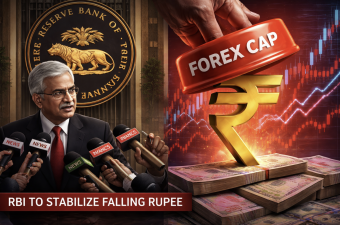
The Reserve Bank of India (RBI) recently imposed a cap on banks’ net open foreign exchange exposure to $100 million daily. This step aims to curb the rupee’s sharp fall amid rising oil prices and ongoing conflict in West Asia. Despite the cap, the rupee weakened below 95 against the US dollar, reflecting continued pressure on the currency and India’s foreign exchange reserves.
Reasons Behind RBI’s Forex Exposure Cap
The RBI introduced this limit to stabilise the rupee and protect dwindling forex reserves. Since the West Asia conflict began, the rupee has depreciated by about 4 per cent, hitting historic lows near 95 per dollar. Banks were earlier allowed net open positions up to 25% of their capital. The new $100 million cap is a strict cut to reduce currency volatility and preserve the RBI’s war chest. The move aims to increase dollar supply temporarily and ease the rupee’s decline without direct market intervention.
Impact on Banks and Market Concerns
Banks are concerned about the rapid implementation and financial impact. They seek a three-month transition period to adjust their large dollar positions gradually. Forced quick unwinding could cause mark-to-market losses, hurting profits for the current quarter. Restrictions also limit banks’ ability to earn from currency arbitrage between onshore and offshore markets. Reduced trading flexibility may shift speculative activities offshore, potentially increasing rupee volatility outside India.
Foreign Exchange Reserves and Future Measures
India’s forex reserves have dropped by over $30 billion since the conflict started. The RBI has used reserves to support the rupee but faces challenges from capital outflows and high crude prices. If the rupee continues to weaken, the RBI may deploy further tools such as swap windows, interest rate hikes, and foreign investment reforms. Past crises show RBI’s capability to attract foreign currency inflows and stabilise the currency through multiple coordinated measures.
Broader Economic Implications
The rupee’s fall impacts inflation, corporate earnings, and growth due to expensive imports like oil. Foreign portfolio investors have sold Indian assets heavily, adding pressure on the currency. The situation marks India’s vulnerability to external shocks and the need for strong policy responses to maintain financial stability amid global uncertainties.
Topics for Prelims:
Reserve Bank of India (RBI)
- Central bank of India responsible for monetary policy.
- Manages currency stability and foreign exchange reserves.
- Implements banking regulations and supervises banks.
- Uses tools like repo rates and forex interventions.
- Responds to external shocks to protect economy.
Indian Rupee Depreciation
- Rupee fell below 95 per US dollar in 2026.
- Decline triggered by West Asia conflict and oil prices.
- Foreign investors sold Indian assets heavily in March 2026.
- Depreciation raises import costs and inflation risks.
- Rupee volatility affects trade and economic growth.
Foreign Exchange Reserves
- India’s forex reserves fell by over $30 billion recently.
- Used by RBI to stabilise currency and meet external obligations.
- Include foreign currency assets, gold, SDRs, and reserve tranche.
- Reserve adequacy critical during global crises and capital outflows.
- Maintaining reserves supports investor confidence and currency stability.
Questions for Mains:
- Critically analyse the impact of foreign exchange reserves on India’s economic stability with examples from recent global crises. [GS-III-Economic Development]
- Explain the role of the Reserve Bank of India in managing currency volatility and inflation, and comment on the effectiveness of regulatory measures like forex exposure caps. [GS-II-Governance]
- With suitable examples, underline the effects of geopolitical conflicts on global commodity prices and their implications for emerging economies like India. [GS-III-World & Physical Geography]
- What are the challenges faced by banks in foreign exchange risk management, and how can regulatory policies balance financial stability with market efficiency? Critically analyse. [GS-III-Economic Development]
Answer Hints:
1. Critically analyse the impact of foreign exchange reserves on India’s economic stability with examples from recent global crises. [GS-III-Economic Development]
- Forex reserves act as a buffer against external shocks, ensuring payment for imports and external debt servicing.
- During crises like the 2008 Global Financial Crisis and 2013 Taper Tantrum, India used forex reserves to stabilize the rupee and maintain investor confidence.
- High reserves help control currency volatility and provide monetary policy flexibility.
- Decline in reserves, as seen post-West Asia conflict, increases vulnerability to capital outflows and exchange rate risks.
- Reserves support sovereign credit ratings and reduce borrowing costs.
- However, excessive reliance on reserves without structural reforms may only provide temporary relief.
2. Explain the role of the Reserve Bank of India in managing currency volatility and inflation, and comment on the effectiveness of regulatory measures like forex exposure caps. [GS-II-Governance]
- RBI manages currency stability via monetary policy tools (repo rate, CRR) and market interventions (buy/sell dollars).
- It regulates banks’ forex exposure to limit speculative volatility, exemplified by the recent $100 million net open position cap.
- Forex exposure caps aim to reduce excessive currency risk-taking and preserve forex reserves.
- RBI’s interventions help curb inflation by stabilizing import costs, especially for crude oil.
- Effectiveness depends on timely implementation and market confidence; abrupt caps may cause bank losses and shift trading offshore.
- Complementary measures like swap windows, interest rate adjustments, and FDI reforms enhance overall policy impact.
3. With suitable examples, underline the effects of geopolitical conflicts on global commodity prices and their implications for emerging economies like India. [GS-III-World & Physical Geography]
- Geopolitical conflicts (e.g., West Asia war) disrupt supply chains, pushing up oil and commodity prices globally.
- Rising crude oil prices increase import bills for energy-dependent countries like India, worsening trade deficits.
- Higher commodity prices fuel inflation, impacting cost of living and corporate earnings in emerging economies.
- Conflicts trigger capital outflows due to investor risk aversion, weakening local currencies.
- India’s rupee depreciation and forex reserve depletion post-West Asia conflict exemplify these impacts.
- Emerging economies face growth slowdown risks and must adopt policy tools to mitigate external shocks.
4. What are the challenges faced by banks in foreign exchange risk management, and how can regulatory policies balance financial stability with market efficiency? Critically analyse. [GS-III-Economic Development]
- Banks face risks from currency volatility, rapid position unwinding, and mark-to-market losses affecting profitability.
- Large net open positions expose banks to exchange rate fluctuations and liquidity risks.
- Regulatory caps (e.g., RBI’s $100 million limit) aim to reduce systemic risk but may reduce banks’ trading flexibility and income from arbitrage.
- Sudden enforcement without transition periods can cause operational and financial stress on banks.
- Balanced policies require phased implementation, risk-based limits, and market development to avoid shifting volatility offshore.
- Effective risk management combines regulatory oversight with banks’ internal hedging and capital adequacy measures.