
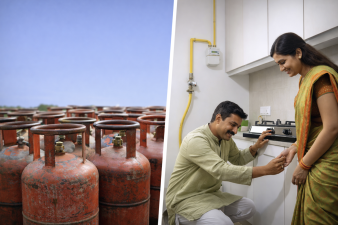
India is moving rapidly to expand piped natural gas (PNG) connections. As of early 2026, India has about 33 crore LPG connections. Officials say domestic natural gas can serve 30 crore PNG connections if households switch. The government aims to have 12 crore PNG connections by 2034. This shift is driven by energy security and supply diversification amid global uncertainties.
Differences Between LPG, PNG, LNG, and CNG
LPG (Liquefied Petroleum Gas) is made from oil refining and natural gas processing. It is stored in cylinders and delivered physically to homes. PNG is natural gas supplied via pipelines directly to consumers. LNG (Liquefied Natural Gas) is natural gas cooled to –160°C for shipping in liquid form. CNG (Compressed Natural Gas) is compressed natural gas used mainly as vehicle fuel. LPG is heavier than natural gas. Natural gas offers more energy per kilogram but is lighter.
Transportation and Supply Challenges
LPG is transported in pressurised, cooled cylinders. PNG requires pipelines. LNG is shipped in special vessels and regasified at ports. India’s pipeline network is about 25,000 km, with 10,500 km under construction. Pipelines mainly serve industrial areas and metro cities. Last-mile connectivity to homes is a major hurdle. Many regions in central, southern, and northeast India lack pipeline coverage. Building pipeline infrastructure is costlier and slower than cylinder delivery.
Government Initiatives and Targets
The government mandates households cannot hold both LPG and PNG connections. About 6 million households must switch fully to PNG soon. New policies speed pipeline approvals and expansion in cities. The Ministry targets 12 crore PNG connections by 2034. City Gas Distribution (CGD) licences cover over 300 areas but many lack pipeline links. PNG pricing is kept competitive with LPG to encourage adoption. Industrial users are encouraged to switch but face technical challenges.
Energy Security and Future Outlook
India imports 60% of its LPG, mainly via the volatile Strait of Hormuz. Natural gas imports come from diverse global sources via LNG terminals. Domestic gas production must rise by one-third to meet PNG targets. ONGC’s KG basin fields are boosting output. LNG imports will remain crucial for demand. The energy transition aims to reduce import dependence and improve supply stability. However, infrastructure and consumer adaptation remain key challenges.
Topics for Prelims:
Liquefied Petroleum Gas (LPG)
- Derived from oil refining and natural gas processing.
- Stored in pressurised cylinders for household use.
- Heavier and denser than natural gas.
- India imports about 60% of LPG needs.
- Mainly used for domestic cooking and small industries.
Piped Natural Gas (PNG)
- Delivered via pipelines directly to consumers.
- Natural gas in gaseous form, lighter than LPG.
- Requires extensive pipeline infrastructure.
- Energy efficient and cleaner than LPG.
- Government aims for 12 crore connections by 2034.
Liquefied Natural Gas (LNG)
- Natural gas cooled to –160°C to become liquid.
- Volume reduces 1,000 times for shipping.
- Transported in special insulated vessels.
- Regasified at import terminals for pipeline use.
- Enables diverse global sourcing of natural gas.
Questions for Mains:
- Critically analyse India’s shift from LPG to piped natural gas in terms of energy security and infrastructure challenges. [GS-III-Economic Development]
- Comment on the role of LNG imports in India’s natural gas supply and how global geopolitics affects this. [GS-II-International Relations]
- What are the environmental and economic implications of replacing LPG with PNG in Indian households? Explain with suitable examples. [GS-III-Environment & DM]
- Underline the challenges in expanding pipeline networks for PNG in India and suggest policy measures to overcome them. [GS-II-Governance]
Answer Hints:
1. Critically analyse India’s shift from LPG to piped natural gas in terms of energy security and infrastructure challenges. [GS-III-Economic Development]
- India imports about 60% of its LPG, mainly via the volatile Strait of Hormuz, raising energy security concerns.
- PNG sourced from domestic natural gas and LNG imports offers diversified and more secure supply routes.
- PNG infrastructure requires extensive pipeline networks, which are currently limited and concentrated in certain regions.
- Last-mile connectivity to households remains a major hurdle due to high costs and urban infrastructure constraints.
- Government’s push includes mandating households to choose PNG over LPG and setting targets for 12 crore PNG connections by 2034.
- Transition faces challenges like industrial adaptation, pipeline expansion delays, and uneven regional coverage.
2. Comment on the role of LNG imports in India’s natural gas supply and how global geopolitics affects this. [GS-II-International Relations]
- LNG imports enable India to diversify natural gas sources beyond regional constraints, reducing dependence on a few suppliers.
- India has nine LNG import terminals on both coasts facilitating just-in-time imports without large storage buffers.
- Geopolitical tensions, such as conflicts in West Asia and disruptions in Strait of Hormuz, affect LPG imports but LNG supply is more globally dispersed.
- Global liquefaction capacity is increasing, potentially improving LNG availability and price stability for India.
- LNG imports are crucial to supplement domestic production, which needs to increase by one-third to meet PNG demand.
- India’s LNG supply chain remains vulnerable to shipping and port disruptions, impacting energy security.
3. What are the environmental and economic implications of replacing LPG with PNG in Indian households? Explain with suitable examples. [GS-III-Environment & DM]
- PNG is cleaner-burning than LPG, producing lower greenhouse gas emissions and fewer pollutants, benefiting air quality.
- Switching to PNG reduces reliance on imported LPG, improving economic savings and energy security.
- PNG pipelines reduce logistical costs and carbon footprint associated with cylinder transport and distribution.
- Industrial and household equipment may require adjustments, but for cooking PNG is a drop-in replacement.
- Expansion of PNG supports India’s commitments to cleaner energy and sustainable development goals.
- However, building pipeline infrastructure involves upfront capital expenditure and urban planning challenges.
4. Underline the challenges in expanding pipeline networks for PNG in India and suggest policy measures to overcome them. [GS-II-Governance]
- Pipeline network is currently concentrated in western and northern India; large regions remain uncovered, especially in central, southern, and northeast India.
- Last-mile connectivity to households is difficult due to urban infrastructure, land acquisition, and permission delays.
- Alignment of pipelines favors industrial zones over residential areas, limiting household access.
- Policy measures include mandated timelines for pipeline approvals and restrictions on dual LPG/PNG connections to encourage transition.
- Government is issuing CGD licenses covering 300+ areas but many lack trunk pipeline connections.
- Suggested policies – streamline land and NOC clearances, incentivize private sector participation, increase funding for infrastructure, and enhance consumer awareness and technical support.