
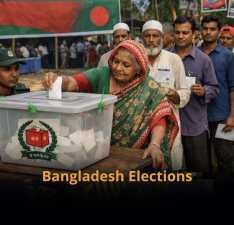
Bangladesh has entered a decisive political phase with the election of the 13th Jatiya Sangsad, returning the Bangladesh Nationalist Party (BNP) to power with a commanding parliamentary majority. Crossing the 200-seat mark in the 300-member House, the BNP’s mandate goes well beyond routine alternation of power. It follows the banning of the Awami League, the exile of Sheikh Hasina to India, and a politically unsettled interim period. The verdict signals not just a change in government, but a reconfiguration of Bangladesh’s political equilibrium — one that carries domestic and regional implications.
A Disrupted Electoral Landscape and the Return of BNP
The latest election unfolded under exceptional circumstances. The absence of the Awami League — one of the foundational pillars of Bangladesh’s post-1971 political order — created an asymmetrical contest. While the BNP’s decisive win restores the bipolar structure that has shaped politics since the 1990 democratic transition, it also leaves unresolved questions about competitive pluralism.
Founded by Ziaur Rahman and later led by Khaleda Zia, the BNP has historically articulated a strand of Bangladeshi nationalism emphasising sovereignty, Islamic cultural identity, and strategic distance from India. Under Tarique Rahman, the party’s rhetoric appears recalibrated — with greater emphasis on institutional stability and economic management. Whether this moderation reflects tactical positioning or durable transformation will shape the tenor of governance.
Jamaat-e-Islami’s Parliamentary Re-entry
Jamaat-e-Islami (JEI) has secured a substantial parliamentary presence, though below earlier projections. Its electoral relevance underscores the continuing negotiation within Bangladesh’s political imagination between liberation memory, religious identity, and governance concerns.
The party’s historical opposition to the 1971 liberation struggle remains a sensitive legacy. However, contemporary support for JEI appears driven less by historical revisionism and more by social conservatism, grassroots networks, and dissatisfaction with established political elites. Its parliamentary role will influence debates on identity, minority rights, and constitutional direction.
The Constitutional Referendum and Democratic Legitimacy
The simultaneous constitutional referendum adds institutional depth to this transition. While public endorsement confers democratic legitimacy, constitutional durability depends on political practice rather than textual authority alone.
Bangladesh’s constitutional history has witnessed multiple amendments, military interventions, and judicial recalibrations. The real test lies in whether the new dispensation strengthens:
- Separation of powers,
- Electoral integrity,
- Judicial independence, and
- Minority protections.
Legitimacy at inception must translate into procedural restraint in governance.
Minority Security and the Question of Pluralism
Reports of attacks on Hindu homes and temples during transitional phases have revived concerns about minority vulnerability. In a constitutional democracy, minority confidence acts as a silent barometer of institutional health.
The promise of 1971 rested on sovereignty anchored in equality. Electoral majorities cannot substitute for the moral obligation to ensure plural space. For the BNP government, early and credible measures to protect minority communities will be critical in shaping both domestic legitimacy and international perception.
Economic Continuity Amid Political Change
Bangladesh’s development story — anchored in garment exports, remittances, and the large-scale participation of women in the workforce — remains one of South Asia’s most significant transformations. However, global economic pressures, supply chain shifts, and debt vulnerabilities demand administrative steadiness.
Governance will be judged by:
- Macroeconomic stability,
- Export diversification,
- Infrastructure financing sustainability, and
- Employment generation for a young population.
Markets prioritise predictability; citizens prioritise delivery.
India–Bangladesh Relations in a Shifting Regional Order
For India, the transition in Dhaka requires strategic composure. The bilateral relationship rests not merely on political affinity but on geographic and economic interdependence: shared rivers, border management, energy trade, connectivity corridors, and maritime security in the Bay of Bengal.
However, regional dynamics complicate this equation:
- China’s infrastructure and port investments expand strategic leverage.
- Pakistan’s historical intelligence networks remain adaptive during political transitions.
- Western engagement framed around democratic reform carries geopolitical undertones.
Bangladesh will exercise sovereign choice, yet its foreign policy balancing will directly affect India’s eastern security architecture. Stability in Dhaka is thus intertwined with India’s own strategic calculus.
What to Note for Prelims?
- Structure of Bangladesh’s Jatiya Sangsad (300 members; 151-seat majority threshold).
- Major political parties: BNP, Awami League, Jamaat-e-Islami.
- Role of constitutional referendums in parliamentary democracies.
- India–Bangladesh cooperation areas: rivers, connectivity, energy, maritime security.
What to Note for Mains?
- Democratic resilience in post-authoritarian transitions.
- Majoritarian mandates vs. minority protection in constitutional democracies.
- Geopolitics of South Asia: China’s infrastructure diplomacy and regional security.
- India’s neighbourhood-first policy and strategic balancing in the Bay of Bengal region.
- Interplay between electoral legitimacy and institutional restraint.
Bangladesh’s 2026 moment is thus not merely electoral arithmetic. It is a test of whether decisive victory can consolidate democratic order without narrowing plural space — and whether sovereignty can be exercised amid competing strategic pulls without eroding institutional balance.
Last Modified: February 16, 2026