
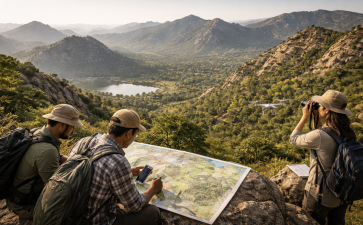
The Aravalli Hills, one of India’s oldest mountain ranges, have recently come under renewed scrutiny. Recently, the Supreme Court (SC) directed a committee to define the extent and boundaries of the Aravalli Hills. This followed disputes over a proposed definition based on a 100-metre elevation criterion, which many experts, including the Forest Survey of India (FSI), have opposed due to environmental concerns. The debate marks the complexity of mapping ancient hill ranges and protecting fragile ecosystems.
Background of Aravalli Mapping
In 2011, the FSI undertook a detailed mapping of the Aravalli Hills for 15 districts of Rajasthan. This was done after no other agency provided an authoritative map as ordered by the SC in 2010. The FSI used Survey of India topographic sheets and remote sensing technologies to delineate the hills. The mapping relied on a 3-degree slope criterion to identify hill areas rather than a simple elevation cut-off. This methodology was considered precise and environmentally sensitive.
Recent Developments and Disputes
In 2024, a committee formed by the SC revisited the definition of the Aravalli Hills. A report submitted in 2025 proposed using 100 metres elevation as the boundary, which was criticised for excluding many important hill areas. The FSI’s own analysis suggested 62 districts should be included, while the committee’s report listed only 37. The exclusion of districts like Sawai Madhopur and Chittaurgarh raised concerns as these areas are part of UNESCO’s Hill Forts of Rajasthan and important ecological zones.
Environmental Significance and Concerns
Rajasthan has only 8% forest and tree cover, mostly concentrated in the Aravalli region. The hills support biodiversity and groundwater recharge. Narrowing the definition risks environmental degradation and loss of forest cover. Experts urge the use of scientifically robust criteria like slope analysis to maintain the ecological balance. The new committee is expected to review all data carefully and avoid decisions that could harm the region’s environment.
Role of Technology and Data Integrity
The FSI’s mapping used advanced GIS and remote sensing techniques, drawing on international expertise. The 2011 digitised contours remain the most reliable dataset. Experts recommend that the new committee preserve this data integrity and avoid arbitrary changes. Accurate mapping is essential for legal, environmental, and cultural protection of the Aravalli Hills.
Topics for Prelims:
Aravalli Hills
- One of the oldest mountain ranges in India.
- Spans mainly across Rajasthan and neighbouring states.
- Important for biodiversity and groundwater recharge.
- Mapped using slope criteria rather than simple elevation.
- Contains UNESCO World Heritage Hill Forts of Rajasthan.
Forest Survey of India (FSI)
- Government agency for forest and environment mapping.
- Used remote sensing and GIS for Aravalli mapping in 2011.
- Proposed 3-degree slope criteria for hill delineation.
- Opposed 100 m elevation cut-off for Aravalli definition.
- Produced detailed reports covering 62 districts in 2025.
Supreme Court of India
- Issued orders for Aravalli mapping in 2010 and 2024.
- Formed committees to define Aravalli boundaries.
- Stayed controversial 2025 judgment on Aravalli definition.
- Ensures environmental and legal protection of natural resources.
- Directs use of scientific data for decision-making.
Questions for Mains:
- Critically discuss the role of remote sensing and GIS technologies in environmental conservation and mapping of natural resources like the Aravalli Hills. [GS-III-Science & Technology]
- Examine the challenges in defining natural geographical features such as hill ranges and their implications on environmental policies and local communities. [GS-III-Environment & DM]
- Analyse the impact of judicial interventions by the Supreme Court of India on environmental governance and sustainable development. How can such interventions balance ecological and developmental needs? [GS-II-Governance]
- Point out the significance of forest cover in arid regions like Rajasthan and estimate the consequences of reducing protected areas like the Aravalli Hills on groundwater and biodiversity. [GS-III-Environment & DM]
Answer Hints:
1. Critically discuss the role of remote sensing and GIS technologies in environmental conservation and mapping of natural resources like the Aravalli Hills. [GS-III-Science & Technology]
- Remote sensing and GIS enable precise mapping of terrain, vegetation, and land use changes over time.
- FSI’s 2011 Aravalli mapping used digitised contours from Survey of India sheets combined with GIS for accuracy.
- Use of 3-degree slope criteria via GIS allowed environmentally sensitive delineation, avoiding arbitrary elevation cut-offs.
- Technologies facilitate monitoring of forest cover, biodiversity hotspots, and groundwater recharge zones.
- Remote sensing supports data integrity and transparency for legal and policy decisions in environmental governance.
- Capacity building and international expertise (ITC Netherlands, ESRI USA) enhance technology application in India.
2. Examine the challenges in defining natural geographical features such as hill ranges and their implications on environmental policies and local communities. [GS-III-Environment & DM]
- Natural features like hills lack fixed boundaries; elevation alone (e.g., 100 m cutoff) may exclude ecologically vital areas.
- Different agencies may use varying criteria (slope, elevation, vegetation), causing inconsistent definitions and disputes.
- Excluding districts (e.g., Sawai Madhopur, Chittaurgarh) affects heritage sites, local livelihoods, and conservation efforts.
- Ambiguity hampers enforcement of environmental protections and sustainable land use planning.
- Local communities depend on forests for resources; improper definitions can threaten their rights and ecological balance.
- Requires multi-disciplinary, scientific, and participatory approaches to balance ecological, cultural, and developmental aspects.
3. Analyse the impact of judicial interventions by the Supreme Court of India on environmental governance and sustainable development. How can such interventions balance ecological and developmental needs? [GS-II-Governance]
- SC orders initiated mapping and protection of Aravalli Hills, enforcing environmental accountability.
- Judicial committees bring technical expertise and mandate evidence-based decision-making.
- Interventions can resolve inter-agency conflicts and ensure uniform standards for natural resource management.
- Stay on controversial judgments (e.g., 100 m elevation cut-off) shows judiciary’s responsiveness to scientific and public concerns.
- Balancing ecology and development requires nuanced judgments supporting conservation without stalling growth.
- Judiciary can promote sustainable development by mandating periodic reviews and stakeholder consultations.
4. Point out the significance of forest cover in arid regions like Rajasthan and estimate the consequences of reducing protected areas like the Aravalli Hills on groundwater and biodiversity. [GS-III-Environment & DM]
- Rajasthan’s forest/tree cover is only 8%, mostly concentrated in the Aravalli region, crucial for ecological stability.
- Aravalli forests aid groundwater recharge, vital in arid/semi-arid zones facing water scarcity.
- Forests support unique biodiversity adapted to harsh climates, including endangered species.
- Reducing protected areas risks habitat loss, soil erosion, desertification, and decline in water availability.
- Loss of green cover exacerbates climate vulnerability, impacting agriculture and livelihoods.
- Maintaining Aravalli protection is essential for sustaining ecological balance and regional development.