
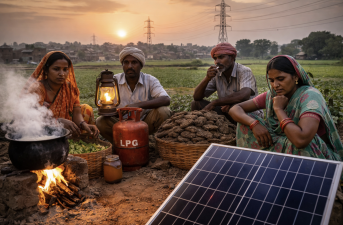
The global energy system faces disruption due to conflict in West Asia. Attacks on Iran have affected the Strait of Hormuz, a vital channel carrying 20% of global oil and LNG. This has led to fuel shortages and rising prices in countries like India. The Government of India responded by cutting fuel taxes, imposing export duties on aviation fuel, promoting piped natural gas, and reintroducing kerosene in some regions to ease LPG shortages. However, rural India’s energy use remains shaped by income, infrastructure, and local resources rather than global factors.
Rural Energy Consumption Patterns
Rural households are spending more on energy and transport. NSSO data shows rural monthly per capita expenditure on energy rose from Rs 174 in 2011-12 to Rs 536 in 2022-23. Electricity use has increased with near-universal electrification, but supply remains unreliable. LPG connections have expanded, yet refill rates vary widely. Transport costs also take a growing share of incomes. Meanwhile, the share of food expenditure has declined, reflecting rising spending on energy and mobility.
Dependence on Traditional Fuels
Despite LPG growth, biomass fuels like firewood remain dominant in many rural areas. Nearly 47% of rural households primarily use firewood and crop residue for cooking. States such as Chhattisgarh and Odisha show over 70% dependence on biomass. Solid fuels cause indoor air pollution and health risks. Although government schemes like Pradhan Mantri Ujjwala Yojana have increased LPG access, affordability limits sustained use. Many households combine LPG with biomass, a practice called fuel stacking.
Case Studies – Villages in Madhya Pradesh
In Manki village, 75% of households lack clean fuel access. Firewood collection supports livelihoods despite the village’s electrification since 2016. Electricity is unreliable with frequent outages. Families rely on clay stoves for cooking due to LPG refill costs. In nearby Kunjwan village, most households have LPG but still prefer firewood because of cost and forest proximity. Electricity use is higher but supply issues persist. Kerosene use has nearly vanished due to price rises.
Energy Security Beyond Access
Rural India’s energy crisis marks that access alone does not ensure energy security. Affordability, supply reliability, and local resource availability shape energy choices. Rising fuel and transport costs strain household budgets. Policymakers must consider these factors to support a sustainable and inclusive energy transition in rural areas.
Topics for Prelims:
Strait of Hormuz
- 33 km wide maritime passage between Iran and Oman
- Handles about 20% of global oil and LNG shipments
- Critical energy corridor for global markets
- Conflict-induced disruptions affect global fuel prices
- Strategic chokepoint in West Asia
Pradhan Mantri Ujjwala Yojana (PMUY)
- Launched in 2016 to provide LPG connections to poor households
- Over 100 million connections distributed
- Aims to reduce dependence on traditional biomass fuels
- Challenges include affordability of LPG refills
- Fuel stacking remains common among beneficiaries
Biomass Fuel in Rural India
- Includes firewood, crop residue, dung cakes
- Used primarily for cooking and heating
- Still accounts for nearly 47% of rural cooking fuel use
- Causes indoor air pollution and health hazards
- Dependence varies widely by state and income
Questions for Mains:
- Critically analyse the impact of global geopolitical conflicts on India’s energy security and policy responses. [GS-III-Economic Development]
- Comment on the challenges of rural electrification in India and how quality and reliability affect energy consumption patterns. [GS-III-Science & Technology]
- Explain the role of traditional biomass fuels in rural India and discuss the health and environmental implications with suitable examples. [GS-III-Environment & DM]
- Underline the significance of affordability and infrastructure in shaping energy transitions in rural areas and suggest policy measures for sustainable energy access. [GS-II-Governance]
Answer Hints:
1. Critically analyse the impact of global geopolitical conflicts on India’s energy security and policy responses. [GS-III-Economic Development]
- West Asia conflicts (e.g., attacks on Iran) disrupt Strait of Hormuz, a key channel for 20% of global oil and LNG supply.
- Disruptions lead to global fuel shortages and price spikes, directly impacting India’s import-dependent energy sector.
- India’s government responded by cutting central excise duty on petrol and diesel to ease consumer burden.
- Export duties on aviation turbine fuel imposed to prioritize domestic availability amid shortages.
- Promotion of piped natural gas (PNG) and temporary reintroduction of kerosene via PDS to address LPG shortages.
- Highlights India’s vulnerability to external shocks and need for diversified energy sources and strategic reserves.
2. Comment on the challenges of rural electrification in India and how quality and reliability affect energy consumption patterns. [GS-III-Science & Technology]
- Rural electrification has reached near-universal household connections (>99%), expanding appliance use (fans, TVs, coolers).
- However, electricity supply quality varies widely; frequent outages and low voltage reduce usability and increase dissatisfaction.
- Unreliable power forces households to rely on alternative fuels or limit appliance use despite paying rising electricity bills.
- Infrastructure gaps (limited handpumps, sanitation, water) compound energy access challenges in rural areas.
- Power cuts lasting hours or days disrupt daily life and economic activities, undermining electrification benefits.
- Reliability issues hinder rural energy transition and affect household expenditure patterns on energy and mobility.
3. Explain the role of traditional biomass fuels in rural India and discuss the health and environmental implications with suitable examples. [GS-III-Environment & DM]
- Biomass fuels (firewood, crop residue, dung cakes) still primary cooking fuel for ~47% rural households, higher in states like Chhattisgarh and Odisha.
- Traditional chulhas and stoves cause high indoor air pollution, linked to respiratory and other health problems.
- Despite LPG expansion under schemes like PMUY, affordability and refill costs limit exclusive LPG use, leading to fuel stacking.
- Firewood collection supports livelihoods (e.g., headloaders in Manki village) but can lead to deforestation and ecosystem degradation.
- Environmental risks include forest degradation, biodiversity loss, and contribution to local air pollution.
- Health risks disproportionately affect women and children who spend more time near cooking areas.
4. Underline the significance of affordability and infrastructure in shaping energy transitions in rural areas and suggest policy measures for sustainable energy access. [GS-II-Governance]
- Affordability limits sustained LPG use; refill costs (~Rs 1,100) are prohibitive for low-income rural households, causing reliance on cheaper biomass.
- Unreliable electricity supply discourages appliance use and increases dependence on traditional fuels.
- Local resource availability (proximity to forests) influences continued biomass use despite LPG access.
- Policy measures – subsidize LPG refills, expand piped natural gas infrastructure, improve electricity quality and reliability.
- Promote integrated energy solutions combining clean cooking, reliable power, and affordable mobility options.
- Enhance awareness, strengthen monitoring of LPG usage, and support livelihood alternatives to reduce forest dependency.