
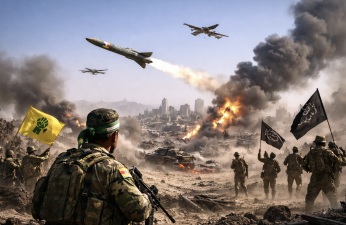
The Iran war of 2026 is not a conventional conflict aimed at immediate military threats. Instead, it targets the ideological foundation of the Iranian regime. The United States and Israel seek regime change to end Iran’s influence in West Asia. This war involves a complex proxy struggle and has regional and global consequences.
Nature and Objective of the Iran War
The war is not about stopping Iran’s nuclear programme or missile capabilities alone. It aims to eliminate the ideology driving Iran’s government. Israel views Iran as an existential threat due to its support for proxy groups. The U.S. supports Israel in this effort. The goal is to dismantle Iran’s network of non-state actors destabilising the region.
Iran’s Proxy Network and Regional Influence
Iran backs groups like Hezbollah in Lebanon, Houthis in Yemen, and Shia militias in Iraq. These groups control territories and challenge state authority. Iran’s support for Hamas led to severe Israeli retaliation after the 2023 attacks. Proxy wars have destabilised Gulf monarchies, prompting them to normalise ties with Israel through the Abraham Accords.
Military Campaign and Regional Dynamics
The 2025 bombing campaign severely damaged Iran’s military and nuclear infrastructure. Iran responded by decentralising power and expanding attacks beyond U.S. bases. The conflict exposed vulnerabilities in Gulf security and threatened global energy supplies. Israel prefers a purely military approach, while the U.S. seeks a political settlement to avoid prolonged instability.
India’s Role and Strategic Challenges
India maintains good relations with Gulf states, Israel, and Iran but faces challenges balancing these ties. India’s regional policy needs to address contradictions between allies. The Iran war complicates India’s strategic environment. It limits India’s influence and increases regional instability affecting its interests.
Topics for Prelims:
Iran’s Proxy Groups
- Hezbollah controls parts of Lebanon and influences politics.
- Houthis control large areas in Yemen and attacked Saudi targets.
- Shia militias in Iraq backed by Iran.
- Hamas supported by Iran, involved in 2023 attacks on Israel.
- Proxy groups destabilise West Asia and threaten Gulf security.
U.S. and Israel’s War Strategy
- Focus on regime change, not just military targets.
- June 2025 bombing campaign targeted Iran’s nuclear facilities.
- Reluctance to deploy ground troops.
- Conflict risks global energy security and regional stability.
- Mixed U.S. messaging on war duration and objectives.
India’s Regional Policy
- Strong bilateral ties with Gulf, Israel, and Iran.
- Balancing act amid regional conflicts.
- Observer role in U.S.-led peace efforts.
- Impacted by Iran war’s regional instability.
- Needs comprehensive strategy beyond bilateral relations.
Questions for Mains:
- Critically analyse the role of proxy wars in shaping West Asia’s geopolitical landscape with suitable examples. [GS-II-International Relations]
- Point out the challenges faced by India in maintaining balanced relations with conflicting regional powers in West Asia and estimate its strategic options. [GS-II-International Relations]
- Underline the impact of foreign military interventions on regional stability and economic security in West Asia, citing the Iran war as a case study. [GS-III-Economic Development]
- With suitable examples, critically analyse the strategic importance of the Strait of Hormuz and its implications for global energy security. [GS-I-World & Physical Geography]
Answer Hints:
1. Critically analyse the role of proxy wars in shaping West Asia’s geopolitical landscape with suitable examples. [GS-II-International Relations]
- Iran’s support for non-state actors like Hezbollah (Lebanon), Houthis (Yemen), and Shia militias (Iraq) destabilises regional governments and politics.
- Proxy groups control territories, challenge state authority, and serve Iran’s ideological export of instability.
- Hamas’ 2023 attacks on Israel, backed by Iran, triggered severe Israeli retaliation, illustrating proxy war consequences.
- Proxy wars fuel sectarian conflicts and complicate peace processes, e.g., Lebanon’s government formation delays due to Hezbollah.
- Gulf monarchies’ response includes normalisation with Israel via Abraham Accords to counter Iranian proxies.
- Proxy wars have expanded the conflict zone, making West Asia a complex battleground for regional and global powers.
2. Point out the challenges faced by India in maintaining balanced relations with conflicting regional powers in West Asia and estimate its strategic options. [GS-II-International Relations]
- India maintains strong bilateral ties with Iran, Gulf states, and Israel, each having conflicting interests.
- Iran war and regional instability constrain India’s ability to pursue an independent, balanced policy.
- India’s default cautious stance post-Khamenei’s assassination and related incidents shows difficulty in proactive engagement.
- Contradictions between allies (e.g., Saudi-Emirati schism) require nuanced diplomacy beyond bilateral relations.
- Strategic options include enhancing multilateral dialogues, balancing energy security with geopolitical interests, and deepening engagement in regional security architecture.
- India must develop a comprehensive regional policy that manages contradictions and safeguards its diaspora and economic interests.
3. Underline the impact of foreign military interventions on regional stability and economic security in West Asia, citing the Iran war as a case study. [GS-III-Economic Development]
- 2025 U.S.-led bombing campaign devastated Iran’s military, nuclear infrastructure, and oil facilities, disrupting regional stability.
- Iran’s retaliatory attacks expanded conflict beyond military targets to regional and energy infrastructure, threatening global oil supply.
- Conflict exposed vulnerabilities in Gulf security, undermining U.S. protection assurances to Gulf monarchies.
- Rising oil prices due to instability impact global economy, benefiting some (Russia) but harming others (China, India).
- Prolonged conflict risks global economic disruption, energy insecurity, and political backlash in involved countries.
- Mixed U.S. messaging and reluctance for ground troops prolong uncertainty, complicating conflict resolution.
4. With suitable examples, critically analyse the strategic importance of the Strait of Hormuz and its implications for global energy security. [GS-I-World & Physical Geography]
- Strait of Hormuz is a critical chokepoint for global oil shipments, with nearly one-third of world’s seaborne oil passing through it.
- Iran’s threat to close or disrupt the Strait escalates regional tensions and global energy market volatility.
- 2021 Houthi missile attacks on Saudi Aramco show vulnerability of energy infrastructure linked to the Strait’s security.
- U.S. and allied naval presence aims to secure safe passage, reflecting the Strait’s geopolitical and economic significance.
- Disruptions in the Strait can cause sharp spikes in oil prices, affecting global economic stability.
- India and other energy-importing countries closely monitor Strait’s security due to direct impact on their energy supplies and costs.