
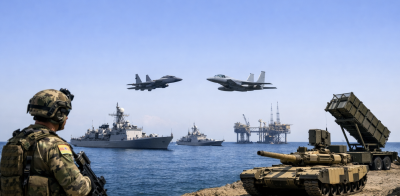
The ongoing war since February 28, 2026, involving the United States and Israel striking Iran, has escalated tensions in the Gulf region. Iran has retaliated by targeting American military bases across Gulf countries and critical energy infrastructure. The closure of the Strait of Hormuz has caused panic, shaking the long-standing security assurances provided by the U.S. to Gulf monarchies. This conflict exposes the fragility of external security guarantees and prompts a rethink of regional defence strategies.
Gulf Security Arrangement and Its Failures
Since the Iranian Revolution in 1979-80, the U.S. promised to defend Gulf stability against external threats. President Jimmy Carter in 1980 declared any attack on the Persian Gulf a vital U.S. interest, to be met with force. Despite multiple initiatives, including the 2017 proposal for a Middle East Strategic Alliance (MESA), regional security remains fragile. The recent conflict reveals that U.S. missile interceptors are depleted and not replenished for Gulf states, prioritising Israel instead. Gulf nations now doubt the reliability of U.S. security guarantees and consider alternative arrangements.
Impact of Iranian Retaliation
Iran’s strikes on American bases in Saudi Arabia, UAE, Qatar, Bahrain, Jordan, Iraq, Syria, and Oman show its capability to hit previously ‘untouchable’ targets. Attacks on oil and gas fields and the strategic Strait of Hormuz threaten global energy supplies and regional stability. This shift in warfare marks the vulnerability of conventional military bases and energy infrastructure in modern conflicts. The Gulf’s security environment is now uncertain and volatile.
India’s Defence Self-Reliance Lessons
India’s experience after the 1999 Kargil War revealed risks of over-dependence on arms imports. The Kargil Review Committee recommended self-reliance, which gained momentum post-2014 under the ‘Atma Nirbharta’ policy. Indigenous defence production has increased, reducing import dependence to 25%-30% by 2025. India’s defence exports reached ₹23,622 crore (~$2.78 billion) with platforms like BrahMos missiles and Tejas aircraft gaining global demand. The Gulf crisis puts stress on the importance of self-reliance in national security.
Future of Gulf Security Architecture
Gulf states like Saudi Arabia, UAE, and Qatar are reconsidering their ties with the U.S., including the presence of American military bases. This may transform regional security arrangements established nearly 50 years ago. The future may see new alliances or independent defence capabilities. The crisis marks that national security cannot be outsourced and must be backed by credible indigenous strength.
Topics for Prelims:
Gulf Security Arrangement
- Established post-1979 Iranian Revolution to protect Gulf monarchies.
- U.S. pledged to defend Persian Gulf as vital interest in 1980.
- Proposed Middle East Strategic Alliance (MESA) in 2017 failed.
- U.S. missile interceptors depleted in Gulf states during 2026 conflict.
- Gulf countries questioning U.S. security guarantees post-conflict.
Iranian Retaliation and Regional Impact
- Targets include U.S. bases across Gulf countries and energy infrastructure.
- Closure of Strait of Hormuz affects global oil supply.
- Demonstrates ability to strike ‘untouchable’ military targets.
- Creates panic and instability in Gulf region.
- Challenges traditional warfare and defence postures.
India’s Defence Self-Reliance
- Kargil War exposed import dependency risks in 1999.
- ‘Atma Nirbharta’ policy boosted indigenous defence production post-2014.
- Import share reduced to 25%-30% by 2025.
- Exports crossed ₹23,622 crore with platforms like BrahMos and Tejas.
- Emphasises importance of self-reliance in national security.
Questions for Mains:
- Discuss in the light of recent Gulf conflict how external security guarantees can impact regional stability and sovereignty. [GS-II-International Relations]
- Critically examine the role of indigenous defence production in strengthening national security, with reference to India’s ‘Atma Nirbharta’ initiative. [GS-III-Economic Development]
- Explain the strategic importance of the Strait of Hormuz and discuss the implications of its closure on global energy security. [GS-I-World & Physical Geography]
- With suitable examples, discuss the changing nature of warfare in the 21st century and comment on the challenges it poses to traditional military alliances. [GS-III-Internal & External Security]
Answer Hints:
1. Discuss in the light of recent Gulf conflict how external security guarantees can impact regional stability and sovereignty. [GS-II-International Relations]
- External guarantees can create dependency, limiting regional countries’ autonomy in defence decisions.
- U.S. security assurances post-1979 aimed to deter Iranian threats but failed to prevent conflict escalation in 2026.
- Depletion of U.S. missile interceptors for Gulf states during crisis exposed vulnerabilities and unreliability of guarantees.
- Reliance on external powers may undermine sovereignty and prompt reconsideration of foreign military presence.
- Failure of proposed regional alliances like MESA marks challenges in collective regional security frameworks.
- Post-conflict, Gulf states exploring alternative security arrangements signals erosion of trust, impacting long-term stability.
2. Critically examine the role of indigenous defence production in strengthening national security, with reference to India’s ‘Atma Nirbharta’ initiative. [GS-III-Economic Development]
- Kargil War (1999) exposed India’s vulnerability due to heavy reliance on arms imports.
- ‘Atma Nirbharta’ (self-reliance) policy post-2014 prioritized domestic defence manufacturing and innovation.
- Import dependence reduced to 25%-30% by 2025, enhancing strategic autonomy.
- Indigenous platforms like BrahMos missile, Tejas fighter, and artillery gained international demand, boosting exports.
- Encouragement of private sector and technology transfers strengthened defence industrial base.
- Self-reliance reduces risks from geopolitical shifts and supply disruptions, ensuring sustained readiness.
3. Explain the strategic importance of the Strait of Hormuz and discuss the implications of its closure on global energy security. [GS-I-World & Physical Geography]
- Strait of Hormuz is a narrow chokepoint connecting Persian Gulf to Gulf of Oman and Arabian Sea.
- Approximately 20-30% of global oil trade, including majority of Gulf oil exports, passes through it daily.
- Closure disrupts supply chains, causing global oil price spikes and energy market instability.
- Impacts energy security of oil-importing countries, especially Asia, Europe, and the U.S.
- Closure increases geopolitical tensions, triggers economic sanctions, and risks military confrontations.
- Ensuring free navigation is critical for global economic stability and energy security architecture.
4. With suitable examples, discuss the changing nature of warfare in the 21st century and comment on the challenges it poses to traditional military alliances. [GS-III-Internal & External Security]
- Modern warfare includes hybrid tactics – cyber attacks, asymmetric warfare, missile strikes on ‘untouchable’ targets.
- Iran’s retaliation by targeting dispersed U.S. bases and critical energy infrastructure exemplifies non-conventional strikes.
- Technological advances enable smaller actors to inflict strategic damage, challenging conventional military superiority.
- Traditional alliances (e.g., NATO, U.S.-GCC) face strain as security guarantees appear unreliable during crises.
- Depletion of missile interceptors and prioritization of Israel over Gulf states shows alliance resource constraints.
- Necessitates rethinking alliances to include cyber defence, indigenous capabilities, and flexible security frameworks.