
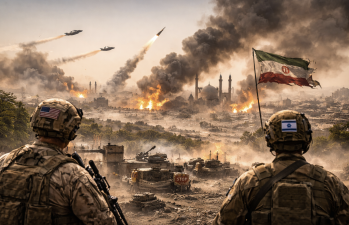
Recent news marks a joint US-Israel military strike on Iran. The operation targets Iran’s regime and military capabilities. Despite claims, the strikes are not aimed at helping Iranians overthrow their government or securing women’s rights. Iran’s fierce response has expanded the conflict across the region, affecting neighbouring countries, including India.
Background of the Conflict
The US and Israel launched attacks citing multiple reasons, including Iran’s nuclear programme and regional threats. However, the true motives remain unclear. US President Donald Trump declared major combat operations and urged Iranians to overthrow their government. Historical examples from Afghanistan and Iraq show that military interventions rarely lead to democracy or stability. Nation-building efforts often fail and result in prolonged instability.
US and Israel’s Strategic Interests
The US aimed to dismantle Iran’s nuclear, missile, and naval capabilities. Israel seeks a weakened Iran unable to function as a state. Despite calls for regime change, Israel prefers a fractured Iran that cannot support hostile groups. The US’s shifting stance, including considering regime leadership options, shows strategic ambiguity. The use of heavy munitions signals a long-term campaign rather than a quick strike.
Iran’s Response and Regional Consequences
Iran vowed to fight fiercely, expanding the conflict to involve neighbouring states with US bases. This escalates Sunni-Shia tensions, turning the war into a broader religious and geopolitical struggle. Pakistan, with its own internal and border conflicts, faces increased instability risks. The conflict threatens energy supplies and the welfare of millions of Indians working in Gulf states, impacting India’s economy and security.
Implications for India and South Asia
India is indirectly drawn into the conflict due to its economic ties and geographic proximity. The instability in Iran and the Gulf region could disrupt remittances and energy imports vital to India. Rising tensions in Pakistan and Afghanistan add to regional volatility. India’s interest lies in a stable Iran that aligns with the aspirations of its people and regional peace.
Topics for Prelims:
US-Israel Military Strategy
- Joint military strikes on Iran target regime and military assets.
- Use of 2,000lb penetrator bombs indicates heavy assault.
- Goals include dismantling nuclear and missile capabilities.
- Strategic ambiguity in US policy on Iran’s regime leadership.
- Israel prefers a weakened Iran over outright regime change.
Regional Impact and Sunni-Shia Tensions
- Conflict expands Sunni-Shia divide in Middle East.
- Iran’s response involves neighbouring countries with US bases.
- Pakistan faces increased instability on multiple borders.
- Conflict threatens energy supplies critical to global economy.
- India’s Gulf diaspora and economy affected by regional instability.
Questions for Mains:
- Critically discuss the impact of foreign military interventions on nation-building with reference to Afghanistan and Iraq. [GS-I-Modern World History]
- Analyse the strategic interests of the US and Israel in the Middle East and their implications for regional stability. [GS-II-International Relations]
- Examine the role of sectarian tensions in shaping conflicts in the Middle East and their spillover effects on South Asia. [GS-I-Indian Society]
- Estimate the economic and security challenges posed to India by instability in the Gulf region and neighbouring countries. [GS-III-Economic Development]
Keywords for Prelims
Iran
- Located in the Middle East, key Shia Muslim state.
- Has a nuclear programme causing international concern.
- Regime is clerical and authoritarian.
- Responded fiercely to US-Israel military strikes.
- Conflict threatens regional stability and energy supplies.
US-Israel Military Strike
- Joint operation targeting Iran’s regime and military.
- Use of heavy munitions like 2,000lb bombs.
- Declared aims include regime change and nuclear disarmament.
- Strategic ambiguity in US policy on Iran’s leadership.
- Escalates Sunni-Shia tensions in the region.
Regional Stability
- Threatened by widening conflict involving Iran and neighbours.
- Sunni-Shia divide intensifies with Iran’s military response.
- Pakistan’s instability worsens due to border conflicts.
- India affected economically and strategically.
- Energy supplies from Gulf region at risk.
Answer Hints:
1. Critically discuss the impact of foreign military interventions on nation-building with reference to Afghanistan and Iraq. [GS-I-Modern World History]
- Foreign interventions (US-led) aimed at regime change and counterterrorism (Afghanistan post-9/11, Iraq post-2003).
- Legal justification via UN Security Council resolutions in Afghanistan; Iraq invasion lacked WMD evidence, undermining legitimacy.
- Mission creep – initial military goals expanded to nation-building, democracy promotion, and women’s rights.
- Outcomes – Taliban resurgence in Afghanistan after 20 years; fragile Iraqi stability with sectarian violence and regional influence.
- High civilian casualties and destruction undermined local trust and governance structures.
- Lessons – Military force alone cannot build stable democracies; external nation-building often fails without local ownership and long-term commitment.
2. Analyse the strategic interests of the US and Israel in the Middle East and their implications for regional stability. [GS-II-International Relations]
- US aims – dismantle Iran’s nuclear, missile, and naval capabilities to curb regional influence.
- Israel aims – weaken Iran to prevent support for hostile non-state actors; prefers a fractured Iran over outright regime change.
- US strategic ambiguity – mixed messages on regime change vs. regime retention complicate conflict dynamics.
- Use of heavy munitions signals prolonged campaign, increasing risk of wider regional conflict.
- Implications – escalation fuels Sunni-Shia tensions, destabilizes neighboring countries, and risks wider Middle East war.
- Regional allies and adversaries may be drawn in, complicating peace efforts and security architecture.
3. Examine the role of sectarian tensions in shaping conflicts in the Middle East and their spillover effects on South Asia. [GS-I-Indian Society]
- Conflict deepens Sunni-Shia divide, with Iran (Shia) vs. Gulf States (Sunni) as central faultline.
- Iran’s retaliatory strategy aims to widen conflict, involving states hosting US bases, increasing sectarian polarization.
- Pakistan, a Sunni-Shia mixed society, faces heightened internal sectarian violence and border instability (Afghanistan and Balochistan).
- Spillover risks – sectarian tensions exacerbate communal divides, fuel militancy, and complicate regional security in South Asia.
- India’s diverse society and geopolitical interests require careful management of sectarian influences and regional stability.
- Broader impact – sectarianism undermines social cohesion, hampers development, and destabilizes governance in affected countries.
4. Estimate the economic and security challenges posed to India by instability in the Gulf region and neighbouring countries. [GS-III-Economic Development]
- India’s large diaspora (~9 million) in Gulf states sends remittances (~1.2% of GDP), vulnerable to conflict disruptions.
- Energy security threatened as Gulf is a major supplier of India’s crude oil and gas imports.
- Regional instability raises risks of supply chain disruptions, price volatility, and inflation in India.
- Security concerns – spillover of militancy and refugee flows from Afghanistan, Pakistan, and Iran impact India’s border stability.
- Pakistan’s internal instability and border conflicts add to India’s strategic challenges in South Asia.
- India’s interest lies in a stable Iran and Gulf region to safeguard economic growth and maintain regional peace.