
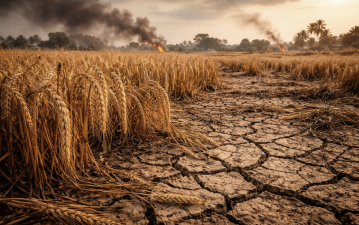
Recent reports from Punjab and Haryana show unseasonal heat in February and March 2026. This weather is accelerating wheat ripening and causing smaller grains. Farmers face increased irrigation needs and rising input costs. The pattern resembles 2022 when heatwaves reduced wheat yields by up to 16%. Experts warn that shifting climate patterns threaten India’s key grain-producing regions.
Unseasonal Heat and Wheat Growth
Wheat grains fill during February and March. Excess heat causes premature ripening. This results in smaller grains and lower yields. Farmers report crops maturing earlier than usual. Some fields are ripening 10 to 15 days ahead of schedule. Higher temperatures also increase water demand for irrigation.
Impact on Farmers and Crop Management
Farmers have altered irrigation from three to four rounds to maintain soil moisture. This increases costs and encourages weed growth. Farmers demand financial support to offset losses. Reports indicate yield drops of around 10% compared to previous years. Early heat stress reduces grain size and overall production.
Weather Patterns and Climate Shifts
Western disturbances, which bring winter rain, were largely absent until mid-February 2026. Rainfall was 98% below normal in Punjab during February. Temperatures were 5 to 6 degrees Celsius above average in many areas. These changes reflect global warming effects on wind and pressure systems. The dry spell and heat stress pose risks to rabi crops like wheat and barley.
Government and Scientific Responses
Agricultural institutions have issued advisories for light irrigation and potassium nitrate spraying to reduce heat stress. Wheat varieties tolerate temperatures up to 30°C but suffer damage above 35°C. Farmer unions warn of serious risks to northern India’s agricultural economy. They demand compensation for losses due to climate impacts. Experts call for adaptive measures to protect crop yields.
Topics for Prelims:
Wheat Crop and Climate Impact
- Wheat grains fill mainly in February and March.
- Excess heat causes premature ripening and smaller grains.
- Heatwaves can reduce wheat yields by 10-16%.
- Wheat tolerates temperatures up to 30°C; damage occurs above 35°C.
- Increased irrigation is needed during heat stress.
Climate Patterns in Punjab and Haryana
- Western disturbances bring winter rainfall.
- 2026 saw 98% rainfall deficit in Punjab in February.
- Temperatures were 5-6°C above average in many areas.
- Global warming shifts wind and pressure systems.
- Dry spells increase heat stress on rabi crops.
Farmer Adaptation and Economic Impact
- Farmers increased irrigation rounds to four from three.
- Weed growth increased despite spraying.
- Financial losses estimated at 10% yield drop.
- Farmers demand compensation of Rs 400-500 per quintal.
- Wheat ripening is advancing by 10-15 days.
Questions for Mains:
- Critically analyse the impact of climate change on India’s wheat production and suggest adaptive strategies for sustainable agriculture. [GS-III-Economic Development]
- Explain the role of western disturbances in North Indian agriculture and comment on how their shifting patterns affect crop yields. [GS-I-World & Physical Geography]
- With suitable examples, discuss the socio-economic challenges faced by Indian farmers due to unseasonal weather and rising input costs, and underline government measures to mitigate these issues. [GS-II-Governance]
- What are the implications of rising global temperatures on food security in India? How can technology and policy reforms address these challenges? [GS-III-Science & Technology]
Answer Hints:
1. Critically analyse the impact of climate change on India’s wheat production and suggest adaptive strategies for sustainable agriculture. [GS-III-Economic Development]
- Climate change causes unseasonal heat, especially in February-March, accelerating wheat ripening and reducing grain size.
- Heatwaves reduce wheat yields by 10-16%, with premature ripening advancing harvest by 10-15 days.
- Increased temperatures raise irrigation needs, raising input costs and stressing water resources.
- Changing rainfall patterns and reduced western disturbances cause dry spells, worsening crop stress.
- Adaptive strategies include developing heat-tolerant wheat varieties, adjusting sowing dates, improving irrigation efficiency, and using agro-advisories for timely interventions.
- Policy support for farmer compensation, climate-resilient infrastructure, and promoting diversification can enhance sustainability.
2. Explain the role of western disturbances in North Indian agriculture and comment on how their shifting patterns affect crop yields. [GS-I-World & Physical Geography]
- Western disturbances bring winter rainfall critical for rabi crops like wheat and barley in North India.
- They help maintain soil moisture and moderate temperatures during crucial crop growth phases.
- In 2026, western disturbances were largely absent until mid-February, causing a 98% rainfall deficit in Punjab.
- Their shifting patterns due to global warming alter wind and pressure systems, increasing weather variability.
- Reduced winter rainfall leads to drought stress, heat stress, and lower yields in wheat and other rabi crops.
- Unpredictable western disturbances complicate agricultural planning and increase vulnerability of farmers.
3. With suitable examples, discuss the socio-economic challenges faced by Indian farmers due to unseasonal weather and rising input costs, and underline government measures to mitigate these issues. [GS-II-Governance]
- Unseasonal heat causes premature wheat ripening, smaller grains, and yield drops (~10%), reducing farmer income.
- Farmers increase irrigation rounds (from 3 to 4), raising water use and input costs, while weed growth also increases.
- Rising costs and lower yields strain farmer livelihoods, leading to demands for compensation (Rs 400-500 per quintal). Example – Punjab and Haryana wheat farmers.
- Government advisories promote light irrigation and potassium nitrate spraying to reduce heat stress.
- Mitigation measures include financial compensation, crop insurance, improved extension services, and promoting climate-resilient practices.
- Long-term governance focus needed on infrastructure, water management, and farmer income security.
4. What are the implications of rising global temperatures on food security in India? How can technology and policy reforms address these challenges? [GS-III-Science & Technology]
- Rising temperatures reduce crop yields (10-16% in wheat), threaten staple food availability and increase price volatility.
- Heat stress shortens crop growing periods, reduces grain size, and increases irrigation demand, stressing water resources.
- Technology solutions – development of heat/drought-tolerant crop varieties, precision agriculture, improved weather forecasting, and irrigation efficiency technologies.
- Policy reforms – incentivize climate-smart agriculture, strengthen crop insurance, invest in R&D, and promote sustainable water and soil management.
- Integrated approaches combining technology, farmer awareness, and institutional support are essential to safeguard food security.
- Long-term climate adaptation policies must align with national food security goals and rural livelihoods protection.