
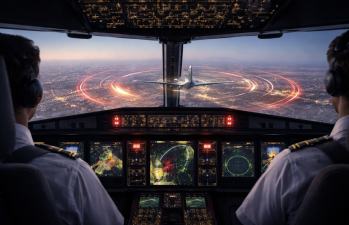
The skies over the United Arab Emirates and the Persian Gulf have become a high-risk zone due to rising military tensions between the US and Iran in 2026. A new threat called GPS spoofing is disrupting civilian flights. Unlike jamming that blocks signals, spoofing sends false GPS data to aircraft, misleading pilots about their true location. This has caused planes to appear off-course, sometimes near Iranian airspace, risking accidental entry into restricted zones.
What Is GPS Spoofing and Its Risks?
GPS spoofing involves sending fake satellite signals to an aircraft’s navigation system. The system accepts these signals as genuine, showing incorrect locations. Pilots may be misled into flying over sensitive or hostile areas. This is more dangerous than jamming because the navigation system still appears functional. Spoofed signals can cause confusion and increase the risk of military confrontation or accidents.
Impact of Electronic Warfare on Civilian Aviation
The Middle East hosts advanced electronic warfare technologies. Iran uses systems like Cobra V8 to disrupt signals within a 250-kilometre radius. These tools target military threats but also affect civilian flights. Since March 2026, over 1,000 vessels and hundreds of flights have experienced GPS disruptions near the UAE. Airlines have had to reroute flights, increasing travel time and fuel consumption, affecting safety and efficiency.
Measures to Counter GPS Spoofing
Modern aircraft are being equipped with anti-spoofing software to detect fake signals. This software attempts to distinguish between satellite and ground-based transmissions. Despite technological advances, the key defence remains pilot training. Pilots are taught to rely on traditional navigation aids such as ground-based radio beacons and physical maps when GPS data is unreliable. Human judgement is critical to avoid entering dangerous zones.
Challenges and Future Outlook
Electronic warfare is evolving rapidly, making GPS spoofing a persistent threat. Civilian flights in conflict regions face ongoing risks. Balancing advanced technology with manual navigation skills is essential. International cooperation and regulation may be needed to protect commercial aviation from electronic attacks. Awareness and preparedness are crucial for flight safety in contested airspaces.
Topics for Prelims:
GPS Spoofing
- Fake GPS signals mislead navigation systems.
- More dangerous than simple jamming.
- Causes false location displays for pilots.
- Risks accidental entry into hostile airspace.
- Used in electronic warfare scenarios.
Electronic Warfare in Middle East
- Includes signal jamming and spoofing technologies.
- Iran’s Cobra V8 disrupts signals within 250 km.
- Affects both military and civilian systems.
- Creates risks for commercial flights near conflict zones.
- Leads to rerouting and increased fuel usage.
Pilot Navigation Techniques
- Use of anti-spoofing software in modern jets.
- Reliance on ground-based radio beacons.
- Use of physical maps during GPS failure.
- Training focuses on manual navigation skills.
- Human judgement critical for flight safety.
Questions for Mains:
- Discuss in the light of recent events how GPS spoofing can impact civilian aviation safety and what measures can be taken to mitigate these risks. [GS-III-Internal & External Security]
- Analyse the role of electronic warfare in modern conflicts and its implications for non-combatant sectors such as commercial aviation. [GS-III-Science & Technology]
- With suitable examples, discuss the challenges of maintaining civilian airspace security in conflict zones and the importance of pilot training in crisis situations. [GS-II-Governance]
- Critically discuss the balance between technological advancements and human skills in ensuring aviation safety amid electronic warfare threats. [GS-IV-Ethics, Integrity and Aptitude]
Answer Hints:
1. Discuss in the light of recent events how GPS spoofing can impact civilian aviation safety and what measures can be taken to mitigate these risks. [GS-III-Internal & External Security]
- GPS spoofing sends false navigation signals, misleading aircraft location displays and causing pilots to stray off course.
- Unlike jamming, spoofing provides seemingly valid data, increasing risk of accidental entry into hostile or restricted airspace.
- Recent incidents near UAE show planes appearing over Iranian territory while actually in international airspace, risking military confrontation.
- Impacts include flight rerouting, longer travel times, increased fuel consumption, and passenger safety threats.
- Mitigation includes equipping aircraft with anti-spoofing software to detect fake signals and distinguish satellite vs ground sources.
- Pilot training on manual navigation using radio beacons and maps is critical as a fail-safe when GPS data is compromised.
2. Analyse the role of electronic warfare in modern conflicts and its implications for non-combatant sectors such as commercial aviation. [GS-III-Science & Technology]
- Electronic warfare includes jamming and spoofing technologies that disrupt enemy communication and navigation systems.
- In the Middle East, Iran’s Cobra V8 system disrupts signals up to 250 km, affecting both military and civilian systems indiscriminately.
- Commercial aviation relies heavily on GPS for navigation, precision landing, and fuel efficiency, making it vulnerable to electronic attacks.
- Non-combatant sectors face collateral damage including flight delays, rerouting, increased operational costs, and elevated safety risks.
- Electronic warfare blurs lines between military targets and civilian infrastructure, raising ethical and regulatory challenges.
- Continuous technological evolution demands adaptive countermeasures and international cooperation to safeguard civilian sectors.
3. With suitable examples, discuss the challenges of maintaining civilian airspace security in conflict zones and the importance of pilot training in crisis situations. [GS-II-Governance]
- Conflict zones feature advanced electronic warfare that can disrupt navigation, communication, and surveillance systems critical for safe flights.
- Example – GPS spoofing incidents near UAE caused planes to appear off-course, risking entry into hostile airspace and potential military response.
- Airspace security is challenged by difficulty in distinguishing real threats from electronic deception and ensuring safe commercial flight corridors.
- Pilot training in manual navigation, use of ground-based radio beacons, and crisis decision-making is vital to handle electronic interference.
- Governance requires coordination between military, civil aviation authorities, and airlines to issue advisories and reroute flights as needed.
- Maintaining civilian airspace security demands robust protocols, real-time intelligence sharing, and contingency planning for electronic warfare scenarios.
4. Critically discuss the balance between technological advancements and human skills in ensuring aviation safety amid electronic warfare threats. [GS-IV-Ethics, Integrity and Aptitude]
- Technological advancements like anti-spoofing software improve detection of fake GPS signals but cannot fully eliminate spoofing risks.
- Overreliance on technology may cause pilots to trust compromised digital data, increasing vulnerability in electronic warfare environments.
- Human skills such as manual navigation, situational awareness, and critical judgement remain essential fail-safes during system failures.
- Ethically, pilots bear responsibility for passenger safety by questioning instrument data and switching to traditional navigation methods when needed.
- Training programs must emphasize a balanced approach, integrating cutting-edge tech with rigorous development of human decision-making capabilities.
- Ensuring aviation safety requires acknowledging technology’s limits and empowering humans to act decisively in ambiguous or hostile scenarios.