
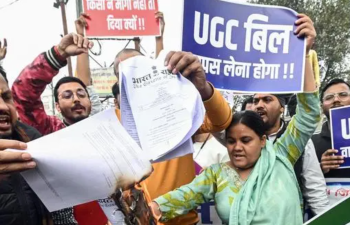
The Supreme Court’s decision to stay the new UGC regulations amid widespread protests has once again exposed a deeper fault line in Indian society. Beyond the legal ambiguities cited by the court, the episode raises a more unsettling question: why do measures aimed at correcting historical caste inequities continue to provoke intense resistance, even decades after constitutional equality became a foundational ideal?
The immediate trigger and the larger unease
The stay on the University Grants Commission’s equity regulations was justified by the Supreme Court of India on the ground that the rules could “divide society”. Public debate has since focused on the drafting of specific provisions. Yet the ferocity of the backlash points to something more structural — a persistent discomfort with acknowledging caste as a living, operative system rather than a historical wrong already resolved.
Caste as a ‘relic’: a convenient fiction
Indian society often treats caste as a problem of the past, surfacing only in exceptional moments such as atrocities or extreme discrimination. These incidents are framed as aberrations committed by deviant individuals, not as outcomes of an entrenched social order. This framing allows institutions to deny responsibility for addressing caste structurally, while continuing to benefit from its hierarchies.
Even progressive commentary, while acknowledging caste privilege, often stops short of interrogating how institutions themselves normalise and reproduce it.
What the UGC regulations reveal about policy thinking
The stated aim of the draft regulations was to promote equity and inclusion. However, even under “Measures for the Promotion of Equity”, the emphasis remained almost entirely on preventing discrimination. Students were required to pledge non-discrimination and report violations; institutions were tasked with protecting disadvantaged groups.
What was missing was any serious engagement with caste privilege. Advantaged-caste students were largely positioned as neutral actors, expected only to “not discriminate”. There was little focus on sensitisation, pedagogy, or institutional self-reflection on how privilege operates invisibly within campuses.
The myth of neutrality and invisible privilege
Sociologist Satish Deshpande has long argued that caste in modern India survives through the idea of neutrality. The norms, behaviours and cultural capital of dominant castes pass off as universal or “casteless”, while deviation from them is marked and scrutinised.
This invisibility of privilege is central to caste reproduction. Yet, as the UGC episode shows, such insights have barely travelled into policymaking, which continues to approach caste as a problem affecting only the disadvantaged.
Why Indian caste policy remains limited
India’s approach to caste has largely been legalistic:
- Punishing atrocities through criminal law
- Providing reservations in education and employment
- Creating grievance redressal mechanisms
These are necessary interventions, but they leave the deeper social legitimacy of caste privilege untouched. Caste pride remains socially acceptable, while critiques of dominance struggle to gain traction without explicit state backing. As a result, even modest equity measures are perceived as threats to the so-called “general category”.
Lessons from gender policy
A useful contrast lies in how gender inequality has been addressed. Alongside legal protections for women, the Indian state has invested in sustained public sensitisation — school curricula, mass campaigns and partnerships with civil society — that normalised conversations about patriarchy and male privilege.
While resistance persists, women’s structural disadvantage is now broadly acknowledged. No comparable effort has been made to address caste privilege at a societal level.
Why pedagogy and public discourse matter
If caste is to be addressed meaningfully, the state must confront it as a total social institution, not merely as a legal category. This requires:
- Pedagogical reform that teaches caste and caste privilege as lived realities from school onwards
- Public campaigns that challenge dominant-caste norms masquerading as neutral culture
- Institutional accountability that goes beyond grievance redressal
Without this broader engagement, resistance to reform will remain predictable and recurring.
The larger warning from Ambedkar
The protests against the UGC regulations are not an anomaly. They reflect a long-standing failure to accompany political and legal reform with social reform. As B R Ambedkar warned in Annihilation of Caste, political democracy cannot survive without social democracy.
Until caste privilege is named, taught and challenged, any attempt to correct inequality — however carefully framed — will continue to be seen not as justice, but as provocation.
What to note for Prelims?
- UGC equity regulations stayed by Supreme Court
- Court cited risk of social division
- Caste policy often focuses on discrimination, not privilege
- Satish Deshpande’s idea of “castelessness”
What to note for Mains?
- Why caste-based reforms face resistance in India
- Difference between addressing discrimination and addressing privilege
- Role of pedagogy and public discourse in social reform
- Comparing caste policy with gender policy in India
- Relevance of Ambedkar’s social democracy argument today