
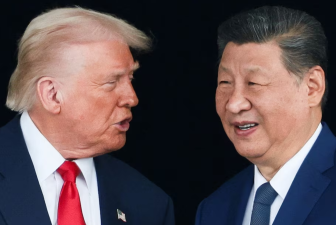
The completion of one year of Donald Trump’s second presidential term has revived a core question in global politics: will the coming years be as disruptive as the first? The answer matters far beyond Washington. What is unfolding is not just a change in American style, but a structural shift in how power is exercised globally—turning a relatively stable two-power system into a deeply unstable three-player world.
Muscle versus Money as Tools of Power
States have traditionally relied on two enduring instruments of power: economic leverage and coercive force. In his second term, Trump has clearly privileged the latter. Military signalling, sanctions, and direct pressure have replaced the slower work of alliance management and institutional consensus.
China, by contrast, has long relied on economic statecraft—trade, infrastructure finance, supply-chain dominance, and patient capital. The contrast reflects deeper cultural orientations: impatience versus patience, immediacy versus accumulation. Force delivers quick results, much like an antibiotic. Money, like long-term therapy, works gradually and uncertainly.
The paradox, however, lies in capacity. The US retains unmatched military muscle but faces fiscal and political constraints. China commands enormous financial resources but lacks comparable global military reach. India—and most other countries—possess neither at scale. This imbalance defines the current geopolitical moment.
From G2 Illusions to a Three-Player Reality
For years, global debates revolved around a prospective “G2” dominated by the US and China. In reality, the system has drifted into something far more unstable: a three-player configuration where the third category is not a single power, but “the rest of the world.”
Such systems are inherently fragile. Alliances become fluid, trust erodes quickly, and every move by one player alters the incentives of the other two. Balance becomes elusive, and miscalculation more likely.
Orwell’s Prescient Three-Bloc World
One of the clearest metaphors for this instability comes not from economics, but literature. In , George Orwell imagined a world divided into three super-blocs—Oceania, Eurasia, and Eastasia—where two are always aligned against the third.
The alliances are temporary, the conflicts perpetual, and technology central to surveillance and control. Citizens are disciplined not just through force, but through constant monitoring and narrative management. The resemblance to today’s tech-driven geopolitics, competing information systems, and surveillance states is unsettling.
What Ice Cream Vendors Reveal About Global Order
Economists have long studied why three-player systems resist equilibrium. illustrated this through his famous “ice cream vendors on a beach” model. With two vendors, stability emerges as each occupies half the market. Introduce a third, and the balance collapses as each tries to outmanoeuvre the others.
The principle of “minimum differentiation”—be similar, but slightly different—works only with two players. Add a third, and competition becomes relentless and destabilising. What applies to vendors applies, with greater consequences, to states.
Sequential Rationality and Strategic Vulnerability
Another perspective comes from , who shared the Nobel Prize with . Selten’s work shows how rational decisions made step-by-step can still lead to poor collective outcomes, especially in three-player games.
Each actor responds logically to immediate incentives, but in doing so exposes itself to the parallel calculations of others. In geopolitics, this means policies that appear sensible in the short term may produce long-term strategic traps.
Five Likely Certainties in the Emerging Order
Several broad trends appear increasingly clear.
- A global scramble for resources to satisfy capital and labour will intensify.
- The world will coalesce around three functional players: the US, China, and the rest.
- Despite efforts at diversification, the US dollar will remain the dominant reserve and trading currency.
- American technological leadership will persist, reinforced by restrictions on technology transfer and theft.
- Liberal values will continue to face pressure globally, leading to tighter politics and reduced openness.
Together, these trends point toward slower global growth, constrained trade, and greater strategic fragmentation.
Where the Real Uncertainties May Lurk
What remains unpredictable is not headline geopolitics, but the fine print—particularly in bilateral trade agreements, security pacts, and technology arrangements. These hidden clauses may shape supply chains, data flows, and strategic autonomy in ways that only become visible years later.
What to Note for Prelims?
- Concept of three-player instability in economics and geopolitics
- Harold Hotelling’s minimum differentiation principle
- Reinhard Selten and sequential decision-making
- Orwell’s three-bloc world in “1984”
- Dollar’s role as global reserve currency
What to Note for Mains?
- Compare economic versus military statecraft in US–China rivalry
- Analyse instability in multipolar and triangular power systems
- Link game theory models to contemporary geopolitics
- Assess implications for India and the Global South
- Discuss the future of liberal values and globalisation