
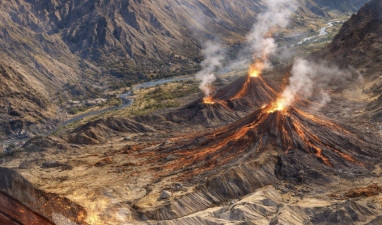
Recent studies have decoded the evolution of the Ladakh Magmatic Arc (LMA) in the northwest Himalaya. This arc records about 130 million years of plate tectonic activity involving the Indian and Eurasian plates. The LMA formed beneath the ancient Neo-Tethys Ocean before the rise of the Himalayas. Scientists analysed rock chemistry to trace subduction and collision events that shaped this region.
Formation of Ladakh Magmatic Arc
The LMA formed from Jurassic to Eocene periods (201.3 to 33.9 million years ago). It is a belt of igneous rocks created by the northward subduction of the Neo-Tethyan oceanic plate beneath Eurasia. Subduction caused molten rock to rise, forming volcanic islands and batholiths. The arc records the gradual collision of the Indian and Eurasian plates.
Magmatic Episodes and Geological Phases
The LMA shows three key magmatic episodes – 160–110 Ma, 103–45 Ma, and less than 45 Ma. Each phase has distinct geochemical signatures linked to subduction dynamics. Initially, volcanic islands formed from mantle-derived magma with minor sediment input. Later, granite batholiths formed deeper underground with increased sediment and crustal recycling due to plate collision.
Geochemical Evidence and Plate Interaction
Rock chemistry reveals the changing influence of sediments dragged by the subducting slab. Early magmas had mantle origins with little sediment. As the Indian Plate approached Eurasia, more sediments entered the mantle wedge, enriching magma chemistry. This reflects the evolving tectonic environment from subduction to collision.
Significance of Ladakh Magmatic Arc Study
About the LMA helps explain the tectonic history of the Himalayas. It shows how oceanic plate subduction and continental collision shaped the region’s geology. The arc’s long extinct volcanic system provides clues about mountain building and magmatic processes over millions of years.
Topics for Prelims:
Ladakh Magmatic Arc (LMA)
- Located in the northwest Himalaya, formed 201.3–33.9 Ma.
- Created by northward subduction of Neo-Tethyan oceanic plate.
- Records volcanic island arcs and granite batholith formation.
- Shows three magmatic episodes with distinct geochemistry.
- Important for understanding Himalayan tectonics and magmatism.
Neo-Tethys Ocean
- Ancient ocean existing before the Himalayas formed.
- Site of oceanic plate subduction beneath Eurasian margin.
- Its closure led to the collision of Indian and Eurasian plates.
- Source of sediments influencing magma chemistry in LMA.
- Key to understanding plate tectonic evolution in Asia.
Plate Tectonics and Subduction
- Process where one tectonic plate sinks beneath another.
- Causes volcanic arcs and mountain building.
- Controls magma generation and geochemical signatures.
- In LMA, involved Neo-Tethyan oceanic plate and Eurasian plate.
- Leads to recycling of sediments and crust into mantle.
Questions for Mains:
- Discuss in the light of the Ladakh Magmatic Arc how plate tectonics contributes to mountain building and magmatic activity. [GS-I-World & Physical Geography]
- Critically examine the role of oceanic plate subduction in shaping the geology of the Himalayas with suitable examples. [GS-III-Science & Technology]
- Explain how geochemical analysis of igneous rocks can reveal the history of tectonic plate interactions and magmatic processes. Comment on its significance in understanding continental collisions. [GS-III-Science & Technology]
- With suitable examples, discuss the impact of the Neo-Tethys Ocean closure on the geological evolution of South Asia and its relevance to current plate tectonic theory. [GS-I-Modern World History]
Answer Hints:
1. Discuss in the light of the Ladakh Magmatic Arc how plate tectonics contributes to mountain building and magmatic activity. [GS-I-World & Physical Geography]
- Plate tectonics drives subduction of oceanic plates beneath continental plates, causing magma formation.
- Ladakh Magmatic Arc formed due to northward subduction of Neo-Tethyan oceanic plate beneath Eurasian plate.
- Subduction leads to volcanic island arcs and granite batholiths, precursors to mountain building.
- Collision of Indian and Eurasian plates caused crustal thickening and uplift forming Himalayas.
- Magmatic activity linked to recycling of sediments and mantle melting during subduction-collision phases.
- Long-term magmatic episodes in LMA reflect evolving tectonic and mountain building processes over millions of years.
2. Critically examine the role of oceanic plate subduction in shaping the geology of the Himalayas with suitable examples. [GS-III-Science & Technology]
- Oceanic plate subduction beneath Eurasian margin initiated formation of Ladakh Magmatic Arc.
- Subduction caused melting of mantle wedge, generating magmas that formed volcanic arcs and batholiths.
- Examples – Dras-Nidar Island Arc Complex (early volcanic islands) and Ladakh Batholith (granite bodies).
- Subduction transported sediments into mantle, enriching magma chemistry and altering crust composition.
- Closure of Neo-Tethys Ocean due to subduction led to eventual continental collision and Himalayan orogeny.
- Subduction processes crucial for magmatism, crustal growth, and mountain building in Himalayas.
3. Explain how geochemical analysis of igneous rocks can reveal the history of tectonic plate interactions and magmatic processes. Comment on its significance in understanding continental collisions. [GS-III-Science & Technology]
- Geochemical signatures indicate magma sources – mantle-derived vs sediment-influenced melts.
- In LMA, early magmas showed mantle origin with minimal sediment input; later magmas enriched by subducted sediments.
- Isotopic and elemental data help identify subduction phases – pre-collisional, syn-collisional, post-collisional.
- Changes in magma chemistry reflect evolving tectonic regimes and crustal recycling during plate convergence.
- Geochemistry aids reconstruction of subduction dynamics and timing of continental collisions.
- Provides vital information about mountain building, crust formation, and geodynamic evolution.
4. With suitable examples, discuss the impact of the Neo-Tethys Ocean closure on the geological evolution of South Asia and its relevance to current plate tectonic theory. [GS-I-Modern World History]
- Neo-Tethys Ocean existed before Himalayas; its closure marked collision of Indian and Eurasian plates.
- Closure caused subduction of oceanic plate, formation of Ladakh Magmatic Arc and volcanic island arcs.
- Collision led to uplift of Himalayas, shaping South Asia’s topography and geology.
- Examples – Ladakh Magmatic Arc records subduction-collision history over 130 million years.
- Supports plate tectonic theory explaining ocean closure, continental collision, and mountain building.
- About Neo-Tethys closure helps explain regional seismicity, crustal deformation, and resource distribution.