
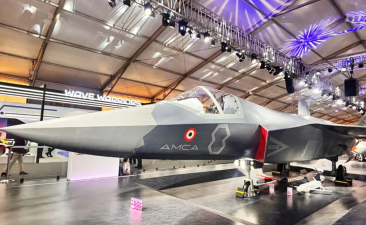
India’s decision to potentially entrust the development of five prototypes of the Advanced Medium Combat Aircraft (AMCA) to a private player — excluding Hindustan Aeronautics Limited (HAL) — marks a turning point in the country’s aerospace ecosystem. While the move could catalyse competition and create a second aircraft manufacturer, it also raises critical questions about capability, infrastructure, accountability, and national security planning. The stakes are high: AMCA is envisioned as India’s fifth-generation stealth fighter, central to the Indian Air Force’s (IAF) future combat readiness.
India’s Crowded Fighter Ecosystem
The IAF operates a diverse fleet comprising Russian-origin aircraft such as the Su-30MKI and MiG series, western platforms like the Rafale, and the indigenous Tejas. Maintenance, repair, and overhaul (MRO) for all these aircraft is largely undertaken by Hindustan Aeronautics Limited (HAL), India’s sole aircraft manufacturer.
HAL’s order book is substantial, covering production of the Tejas, helicopters, trainers, and upgrades of legacy fleets. However, concerns about delays and quality control have periodically surfaced, including observations by the Comptroller and Auditor General (CAG). Against this backdrop, the idea of developing an alternative aerospace manufacturing base appears strategically attractive.
Yet, creating a second fighter aircraft manufacturer is not merely an industrial decision; it is a systemic transformation.
AMCA: A Technological Leap
The Advanced Medium Combat Aircraft (AMCA) is being designed by the Aeronautical Development Agency (ADA) under the Defence Research and Development Organisation (DRDO). It aims to incorporate stealth features, advanced avionics, internal weapons bays, and next-generation propulsion systems.
Developing a fifth-generation fighter is exponentially more complex than assembling aerospace components or building transport aircraft. It involves:
- Low-observable airframe design and materials engineering
- Advanced flight control laws and sensor fusion
- Weapon integration and electronic warfare suites
- Rigorous multi-phase flight testing
Private sector contenders, despite being established industrial players, have limited or no prior experience in full-spectrum fighter aircraft development. In aerospace terms, they would effectively be first-time integrators.
Lessons from India’s Aerospace History
India’s earlier fighter development efforts offer instructive lessons. The HF-24 Marut was designed and produced under HAL’s Aircraft Design Bureau, integrating design, manufacturing, and testing under one institutional umbrella. Trainer aircraft such as the HT-2 and HJT-16 followed similar models.
The Tejas programme introduced a hybrid structure: design led by ADA, with HAL responsible for series production and lifetime support. Because both institutions function under the Ministry of Defence, a degree of singular administrative control ensured smoother coordination during disputes or technical divergences.
In the AMCA case, if a private entity executes prototype development while ADA retains design authority, questions arise regarding:
- Project ownership during prototype testing
- Intellectual property and modification rights
- Accountability for cost overruns or technical setbacks
Clarity on these institutional mechanics is essential before contracts are finalised.
Infrastructure and Ecosystem Constraints
HAL’s Bengaluru complex represents eight decades of accumulated aerospace infrastructure — wind tunnels, structural rigs, avionics integration labs, engine testing facilities, and flight test instrumentation. The IAF’s Aircraft and Systems Testing Establishment (ASTE) and ADA’s National Flight Test Centre (NFTC) are co-located there, enabling seamless user-designer interaction.
Establishing parallel infrastructure elsewhere would require massive capital investment and time. A fifth-generation programme demands simultaneous development of:
- Prototype assembly hangars
- Specialised tooling and composite fabrication facilities
- Flight test instrumentation and telemetry systems
- Secure data networks and classified integration labs
A key practical concern is whether a private player would invest heavily in such facilities when the initial contract covers only five prototypes without a guaranteed production order.
Synchronising Design and Production
Globally, fighter development relies on tight fusion between design engineers and production teams. As prototypes begin flying, tooling and jigs for series production are developed in parallel to avoid time lags.
Separating design (ADA) and execution (private firm) across institutions could complicate coordination. Moreover, India has limited test pilot training capacity, with a single test pilots school producing a finite number of qualified personnel annually. A new manufacturing ecosystem would require trained test crews from the outset.
One pragmatic approach could involve co-locating the private entity within existing aerospace clusters in Bengaluru. Leveraging HAL’s airfield, selected facilities, and shared infrastructure — built with public funds — may prevent duplication and accelerate timelines.
Strategic Location and National Security
The location of strategic aerospace production is not merely an economic choice but a national security decision. Locating production close to international borders increases vulnerability in times of conflict. Concentrating AMCA production in India’s aerospace hinterland — proximate to Bengaluru’s established aviation ecosystem — offers logistical depth and resilience.
AMCA is not a commercial venture alone; it is a national capability project. Its success will determine the IAF’s ability to replace ageing fleets and maintain deterrence credibility in a contested regional environment.
Balancing Reform with Prudence
Introducing private participation in fighter aircraft manufacturing aligns with broader defence reforms and the push for indigenisation. Competition can enhance efficiency, innovation, and accountability. However, aerospace manufacturing is capital-intensive, technology-dense, and risk-prone.
The central challenge lies in balancing three objectives:
- Creating a competitive second aerospace manufacturer
- Ensuring continuity of expertise and infrastructure
- Safeguarding national security imperatives
An out-of-the-box approach — including shared facilities, phased responsibility transfer, and assured production pipelines — may reconcile these competing goals.
What to Note for Prelims?
- Advanced Medium Combat Aircraft (AMCA): India’s proposed fifth-generation stealth fighter.
- Aeronautical Development Agency (ADA): Design agency under DRDO.
- Role of HAL in production and maintenance of IAF aircraft.
- Aircraft and Systems Testing Establishment (ASTE): IAF’s flight testing unit.
- National Flight Test Centre (NFTC): Prototype testing facility.
What to Note for Mains?
- Discuss the challenges of developing indigenous fifth-generation fighter aircraft in India.
- Examine the role of private sector participation in defence manufacturing.
- Analyse institutional coordination issues in complex defence projects.
- Evaluate how infrastructure location influences strategic resilience in defence production.