
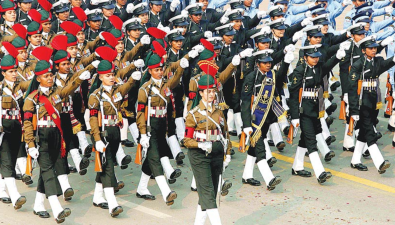
On the eve of India’s 77th Republic Day, Droupadi Murmu reflected on the Republic’s democratic and developmental journey, projecting confidence in India’s self-reliance and its role as a stabilising force in a turbulent world. The address highlighted national achievements and key priorities of the present government, while invoking the idea of constitutional nationalism. Yet, as with every Republic Day, the occasion also calls for introspection—on how far the State has lived up to the Constitution not only in rhetoric, but in practice.
Self-Reliance and India’s Global Posture
A central theme of the President’s address was India’s growing self-reliance across sectors, particularly defence and the economy. She portrayed India as a messenger of peace and stability at a time of global fragmentation, linking internal capacity-building with external credibility.
The President, in her role as Supreme Commander of the Armed Forces, referred to the success of Operation Sindoor—precision strikes against terror infrastructure—as evidence of India’s enhanced defence preparedness and indigenous capabilities. This emphasis aligned with the broader narrative of strategic autonomy and reduced dependence on external suppliers.
Economic Confidence and Reform Narrative
The speech projected optimism about India’s economic trajectory, with the President stating that the country is firmly on track to become the world’s third-largest economy. Key reforms such as the Goods and Services Tax and the new Labour Codes were cited as milestones in restructuring India’s economic framework.
This framing reflects the government’s emphasis on macroeconomic stability, formalisation of the economy, and labour market rationalisation. However, it also raises larger questions about how economic growth translates into broad-based welfare, employment generation, and reduced inequality—issues that remain central to the constitutional vision of social and economic justice.
Historical Memory and Cultural Symbols
The President wove historical and cultural references into her address, noting that Vande Mataram was a “lyrical national prayer” as the country marks the 150th anniversary of its composition. She also paid tribute to Sardar Vallabhbhai Patel on his 150th birth anniversary, highlighting his role in integrating princely States and unifying the Republic.
Such references underscore the Centre’s emphasis on national integration and cultural pride, using historical figures and symbols to reinforce a shared national narrative.
Women and the Workforce in the Republic’s Story
The President highlighted the expanding role of women across sectors—from agriculture and sanitation to science and space—while also underlining their importance as voters in a democracy. Farmers, teachers, scientists, healthcare workers, and sanitation workers were acknowledged as contributors to national progress.
This recognition reflects an inclusive vision of development, where everyday labour and public service are seen as integral to the Republic’s functioning, not merely economic growth indicators.
Constitutional Nationalism and Its Demands
Invoking constitutional nationalism, the President placed the Constitution at the heart of India’s identity. Republic Day, after all, commemorates the coming into force of the Constitution and offers an annual opportunity to assess how its ideals—liberty, equality, fraternity, and justice—are being realised.
While celebrating achievements is both natural and motivating, constitutional nationalism demands more than ceremonial reverence. It requires the State to actively protect citizens’ rights, uphold institutional checks and balances, and discharge its duties towards the most vulnerable.
Between Celebration and Self-Reflection
The address, with its confident and self-congratulatory tone, also invites a counter-question: can civilisational pride and national achievement narratives obscure unresolved material and democratic challenges? Persistent struggles—economic distress, social inequality, institutional erosion, and governance deficits—remain part of the lived reality of many citizens even in the eighth decade of the Republic.
Republic Day is as much about celebration as it is about honest self-reflection. Economic growth and military capability, while important, are not the sole measures of national progress.
Safeguarding the Republic’s Core Ideals
Ultimately, the Constitution’s strength lies not in speeches but in sustained adherence to its spirit. Sectarian politics, weakening of federalism, and corruption pose long-term risks to constitutional governance. Allowing these trends to persist would undermine the very ideals that Republic Day seeks to honour.
The enduring challenge for the Indian State is to ensure that constitutional promises are translated into everyday realities—where rights are protected, institutions remain robust, and democratic accountability is not diluted in the name of national pride.
What to Note for Prelims?
- 77th Republic Day and its constitutional significance
- Role of the President as Supreme Commander of the Armed Forces
- Key constitutional ideals: liberty, equality, fraternity, justice
- GST and Labour Codes as recent economic reforms
What to Note for Mains?
- Meaning and relevance of constitutional nationalism
- Republic Day as a moment of accountability, not just celebration
- Limits of economic growth as a sole measure of progress
- Challenges to constitutional values: federalism, secularism, corruption