
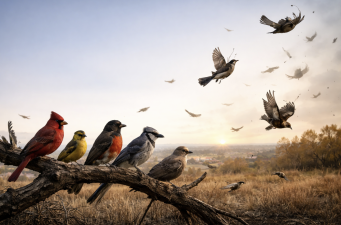
Recent studies in 2026 reveal that bird populations in the United States are declining at an accelerating rate. This trend is especially severe in regions with intensive agriculture, such as the Midwest, California and the Mid-Atlantic. Human activities like pollution, pesticide use and habitat alteration are the main drivers behind these losses. The findings show urgent concerns for biodiversity and ecosystem health.
Bird Population Trends and Regional Patterns
Data from the North American Breeding Bird Survey (1987–2021) shows a 15% overall decline in bird numbers. Nearly half of the 261 studied species have population decreases. The fastest declines occur in southern US regions with warm climates and intensive farming. Common grackle, European starling and red-winged blackbird are among the worst affected. These patterns confirm that warmer temperatures and human land use intensify bird losses.
Impact of Agricultural Practices
Intensive agriculture transforms natural habitats into large croplands. Use of pesticides and herbicides reduces insects and plants birds rely on for food. Heavy machinery and monoculture farming reduce nesting sites. Fertiliser use and chemical applications often occur together, making it difficult to isolate exact causes. However, pesticides have a strong link to bird declines through toxicity and food chain disruption. Agricultural landscapes also heat up more, compounding climate stress on birds.
Significance of Accelerating Declines
An accelerating decline means losses grow larger each year, signalling worsening conditions. Monitoring acceleration helps detect emerging hotspots before populations become critically low. Birds play key roles in pest control, seed dispersal and ecosystem balance. Their decline indicates broader environmental damage. Nearly 40% of US land is agricultural, making sustainable farming vital for conservation. Reducing chemical use and restoring habitats can enable relatively rapid recovery of bird populations.
Human and Environmental Interconnections
Agricultural workers face health risks from pesticide exposure, linking human welfare to ecosystem health. Balancing food production, environmental sustainability and human health is a shared challenge. Changes in land management can quickly affect biodiversity. This marks the importance of integrated strategies to protect wildlife and support farming communities.
Topics for Prelims:
North American Breeding Bird Survey
- Started in 1969 to monitor bird populations annually.
- Uses fixed routes for bird counts during breeding season.
- Covers US and Canada with volunteer participation.
- Tracks hundreds of bird species over decades.
- Provides data on population trends and regional changes.
Effects of Intensive Agriculture on Wildlife
- Large-scale croplands replace diverse natural habitats.
- Pesticides reduce insect prey and cause direct toxicity.
- Herbicides limit plant diversity essential for birds.
- Machinery disrupts nesting grounds and soil structure.
- Increased land temperature adds climate stress to wildlife.
Bird Roles in Ecosystems
- Control insect pest populations naturally.
- Disperse seeds aiding plant reproduction.
- Help maintain ecological balance and biodiversity.
- Serve as indicators of environmental health.
- Respond quickly to habitat restoration efforts.
Questions for Mains:
- Critically discuss the impact of intensive agriculture on biodiversity and ecosystem services in the United States. [GS-III-Environment & DM]
- Examine the role of long-term wildlife monitoring programs like the North American Breeding Bird Survey in conservation policy and action. [GS-III-Environment & DM]
- Analyse the interconnections between human health, pesticide use and environmental sustainability in agricultural landscapes. How can policies balance these concerns? [GS-II-Governance]
- Estimate the effects of climate change on regional bird populations and discuss adaptive strategies for wildlife conservation in warming areas. [GS-III-Environment & DM]
Answer Hints:
1. Critically discuss the impact of intensive agriculture on biodiversity and ecosystem services in the United States. [GS-III-Environment & DM]
- Intensive agriculture replaces diverse natural habitats with large monoculture croplands, reducing habitat availability for wildlife.
- Pesticide and herbicide use decreases insect prey and plant diversity, directly affecting bird food sources and survival.
- Heavy machinery and land modification disrupt nesting sites and soil health, limiting reproductive success of many species.
- Increased agricultural land temperature (due to lack of shade trees) compounds climate stress on wildlife populations.
- Bird declines linked to agriculture reduce ecosystem services like pest control, seed dispersal, and ecological balance.
- Multiple interacting pressures (chemical use, habitat loss, climate effects) accelerate biodiversity loss in agricultural regions.
2. Examine the role of long-term wildlife monitoring programs like the North American Breeding Bird Survey in conservation policy and action. [GS-III-Environment & DM]
- Provides extensive, standardized data on bird populations across decades and regions, enabling trend analysis.
- Detects not only population declines but acceleration of losses, offering early warnings for conservation intervention.
- Helps identify geographic hotspots of biodiversity loss linked to human activity and environmental changes.
- Supports evidence-based policy formulation by tracking effectiveness of conservation measures over time.
- Engages citizen scientists, raising awareness and encouraging community participation in biodiversity monitoring.
- Serves as a model for monitoring other wildlife groups and ecosystems, improving overall environmental governance.
3. Analyse the interconnections between human health, pesticide use and environmental sustainability in agricultural landscapes. How can policies balance these concerns? [GS-II-Governance]
- Pesticide exposure affects both wildlife (toxicity, food chain disruption) and agricultural workers’ health (acute and chronic risks).
- Environmental degradation from chemicals reduces ecosystem services essential to sustainable agriculture and human well-being.
- Policies must promote integrated pest management, reducing chemical reliance while maintaining crop productivity.
- Encouraging habitat restoration and agroecological practices can enhance biodiversity and reduce chemical inputs.
- Regulations on pesticide use, worker safety standards, and monitoring are critical for protecting health and environment.
- Multi-stakeholder approaches involving farmers, scientists and policymakers ensure balanced, sustainable solutions.
4. Estimate the effects of climate change on regional bird populations and discuss adaptive strategies for wildlife conservation in warming areas. [GS-III-Environment & DM]
- Rising temperatures cause range shifts, with many bird species moving toward cooler areas or struggling to survive in warmer southern regions.
- Climate change exacerbates existing stressors like habitat loss and agricultural intensification, accelerating population declines.
- Warmer agricultural landscapes lacking shade trees increase thermal stress on birds, compounding climate impacts.
- Adaptive strategies include habitat restoration with native vegetation, creating climate refuges and corridors for species movement.
- Integrating climate resilience into land management and conservation planning helps buffer vulnerable populations.
- Continuous monitoring and research are essential to update strategies and mitigate unforeseen climate-related threats.