
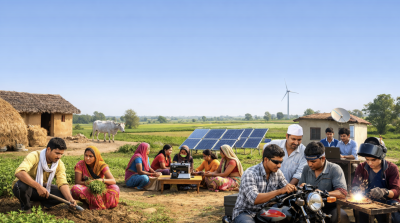
India is rapidly advancing towards becoming a global hub for skill and innovation. Recent government efforts focus on empowering youth and rural communities through education and technology. Key programmes such as RuTAG, Unnat Bharat Abhiyan, and Mera Yuva Bharat are transforming villages into self-reliant hubs. These initiatives align with the vision of a developed, inclusive, and self-sufficient India.
Government Schemes Empowering Rural India
The Ministry of Education, Youth Affairs, and MSMEs promote schemes to integrate science and technology in rural areas. RuTAG connects academic institutions with local communities to develop sustainable solutions in agriculture, clean energy, and water purification. Unnat Bharat Abhiyan links higher education institutions with villages to implement eco-friendly technologies. Mera Yuva Bharat engages youth with community projects, enhancing their practical skills and social responsibility. These schemes encourage rural entrepreneurship and innovation.
Community-Based Learning and Experiential Education
Students participate in hackathons and fieldwork to solve local problems. The Dayalbagh Educational Institute offers a MOOC on community engagement, combining theory with 30 hours of fieldwork. This approach cultivates ethics and practical knowledge. Academic credits earned through these activities encourage youth involvement in social causes. The programmes promote collaboration between students, NGOs, and local governments for holistic rural development.
Technological Interventions for Sustainable Development
Technologies like IoT and drones are used to improve agriculture, water management, healthcare, and sanitation. These digital tools increase efficiency and resilience in rural communities. Unnat Bharat Abhiyan’s focus on climate resilience and renewable energy supports sustainable livelihoods. The integration of advanced technology with traditional practices strengthens villages as economic and innovation centres.
Vision for a Self-Reliant and Inclusive India
These initiatives reflect the government’s vision of Gram Swaraj and Aatmanirbhar Village. Empowering villages through education, technology, and entrepreneurship aims to reduce hunger, illiteracy, and poverty. The youth’s active participation ensures continuous innovation and social upliftment. India’s goal is to become a global leader in inclusive growth and rural transformation by 2047.
Topics for Prelims:
Rural Technology Action Group (RuTAG)
- Launched by Ministry of Education, India.
- Connects IITs and local communities nationwide.
- Focuses on agriculture, clean energy, and water purification.
- Promotes rural entrepreneurship and sustainable solutions.
- Bridges technology gaps with prototypes and capacity building.
Unnat Bharat Abhiyan (UBA)
- Initiated by Ministry of Education and IIT Delhi.
- Links higher education institutions with villages.
- Supports sustainable agriculture, water, energy, and sanitation.
- Encourages use of IoT and drones for rural development.
- Mandatory for AICTE approval of undergraduate programmes.
Mera Yuva Bharat (MY Bharat)
- Academic experiential learning platform for youth.
- Engages students with local communities across India.
- Offers academic credits for community-based projects.
- Develops problem-solving and leadership skills.
- Supports diverse streams – engineering, arts, commerce, social sciences.
Questions for Mains:
- Critically discuss the role of community-based learning in promoting rural development and social inclusion in India. [GS-I-Indian Society]
- Examine the impact of technology interventions like IoT and drones on sustainable agriculture and rural livelihoods in India. [GS-III-Science & Technology]
- Analyse the importance of government schemes like RuTAG and Unnat Bharat Abhiyan in achieving the vision of Aatmanirbhar Bharat and Gram Swaraj. [GS-II-Governance]
- Estimate the challenges and opportunities in integrating experiential learning platforms such as Mera Yuva Bharat with India’s higher education system for skill development. [GS-III-Economic Development]
Answer Hints:
1. Critically discuss the role of community-based learning in promoting rural development and social inclusion in India. [GS-I-Indian Society]
- Community-based learning connects students with rural and urban communities, encouraging experiential learning and social responsibility.
- Programs like Unnat Bharat Abhiyan and RuTAG enable grassroots research and technology implementation addressing local challenges.
- It promotes social inclusion by empowering marginalized groups such as women Self-Help Groups, artisans, and farmers.
- Fieldwork, hackathons, and collaborations with NGOs and gram panchayats enhance ethical engagement and practical problem-solving.
- Academic incentives like credits motivate youth participation, ensuring sustained involvement in rural upliftment.
- Overall, it bridges the gap between education and societal needs, driving inclusive and sustainable rural development.
2. Examine the impact of technology interventions like IoT and drones on sustainable agriculture and rural livelihoods in India. [GS-III-Science & Technology]
- IoT enables real-time monitoring of soil, water, and weather conditions, improving agricultural efficiency and yield.
- Drones assist in crop surveillance, pest control, and precision farming, reducing resource wastage and increasing productivity.
- Technology supports climate resilience by facilitating early warning systems and adaptive farming practices.
- Integration of digital tools enhances water resource management, renewable energy use, and sanitation in villages.
- These interventions empower farmers and rural communities with data-driven decision-making and sustainable livelihoods.
- Programs like Unnat Bharat Abhiyan promote adoption of such technologies, encouraging rural innovation ecosystems.
3. Analyse the importance of government schemes like RuTAG and Unnat Bharat Abhiyan in achieving the vision of Aatmanirbhar Bharat and Gram Swaraj. [GS-II-Governance]
- RuTAG bridges technology gaps by linking academic institutions with rural communities to develop sustainable prototypes.
- Unnat Bharat Abhiyan connects higher education with villages to implement eco-friendly and advanced technologies for local needs.
- Both schemes promote rural entrepreneurship, capacity building, and self-reliance aligned with Gram Swaraj ideals.
- They empower villages as hubs of innovation and economic growth, reducing dependence on urban centers.
- The initiatives support government’s vision of inclusive development, leveraging youth and academia for grassroots transformation.
- These programmes operationalize Aatmanirbhar Bharat by encouraging local resource utilization, skill development, and technology adoption.
4. Estimate the challenges and opportunities in integrating experiential learning platforms such as Mera Yuva Bharat with India’s higher education system for skill development. [GS-III-Economic Development]
- Opportunities include bridging theory and practice, enhancing problem-solving, leadership, and social responsibility among youth.
- Mera Yuva Bharat offers academic credits, motivating participation and aligning with National Education Policy goals.
- It promotes cross-disciplinary engagement, connecting diverse streams with community development projects.
- Challenges involve ensuring uniform implementation across institutions and maintaining quality and relevance of fieldwork.
- Coordination with local administrations and NGOs requires robust frameworks and monitoring mechanisms.
- Scaling experiential learning can address skill gaps, boost employability, and contribute to rural innovation and economic growth.