
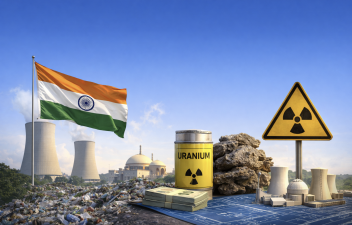
In the 2025-26 Budget, Finance Minister Nirmala Sitharaman announced a major expansion of India’s nuclear power capacity from 8.18 GW to 100 GW by 2047. This is backed by the new SHANTI Act (2025), replacing the older Atomic Energy Act (1962) and CLNDA (2010). The Act opens the nuclear sector to private and foreign investments, grants statutory status to the Atomic Energy Regulatory Board (AERB), and revises liability laws. This marks a historic shift from exclusive government control to a mixed ownership model aimed at meeting India’s energy and climate goals.
Energy and Climate Goals
India aims to become a developed nation (Viksit Bharat) by 2047 and achieve net-zero carbon emissions by 2070. Energy consumption is expected to shift heavily towards electricity from fossil fuels. In 2024, India’s per capita electricity generation was 1,418 kWh, much lower than China and the US. India’s electricity capacity in 2025 was 476 GW, with renewables constituting nearly 50%. However, renewables generated only 22% of electricity due to intermittency, while thermal power (coal) still produced 75%. Nuclear power, with 8.8 GW capacity, provided 3% of electricity. Nuclear offers steady baseload power essential for net-zero targets.
India’s Nuclear Power Landscape
India’s nuclear journey began in 1969 at Tarapur. Currently, 24 reactors operate, mostly Pressurised Heavy Water Reactors (PHWR) with capacities from 220 MW to 700 MW. The Nuclear Power Corporation of India Limited (NPCIL) manages these plants. Construction costs for 700 MW PHWRs are among the lowest globally at $2 million per MW. Plans exist for new reactors using Russian, French, and American designs, but costs are higher and projects delayed. Small Modular Reactors (SMRs) are being developed with ₹20,000 crore allocated for R&D until 2033. Nuclear power is key to supplement renewables and reduce dependence on coal.
Challenges and Strategic Directions
Achieving 100 GW nuclear capacity requires – 1. Indigenising foreign reactor designs to reduce costs. 2. Accelerating R&D on SMRs and thorium-based technologies. 3. Scaling up modular 220 MW PHWRs for captive and industrial power. Financing models must address high upfront costs and long operational life. Regulatory clarity separating civilian and defence nuclear activities is essential. Issues like tariffs, fuel ownership, waste management, liability, and dispute mechanisms must be transparently resolved. The SHANTI Act provides the legal framework, but implementation rules will determine success.
Topics for Prelims:
SHANTI Act (2025)
- Replaces Atomic Energy Act (1962) and CLNDA (2010).
- Allows private and foreign participation in nuclear power.
- Grants statutory status to Atomic Energy Regulatory Board (AERB).
- Revises liability framework for nuclear damage.
- Separates civilian and strategic nuclear activities.
India’s Energy Profile (2024-25)
- Total installed electricity capacity – 476 GW.
- Renewable capacity – 227 GW (solar 111 GW, wind 51 GW, hydro 48 GW).
- Nuclear capacity – 8.8 GW.
- Thermal (coal) capacity – 240 GW.
- Renewables generated 22% of electricity; thermal 75%; nuclear 3%.
Types of Indian Nuclear Reactors
- Pressurised Heavy Water Reactors (PHWR) – indigenised 220, 540, 700 MW.
- Boiling Water Reactors (BWR) – oldest reactors.
- VVER (Russian PWR) – at Kudankulam.
- Planned reactors – French EPR, Westinghouse-Toshiba, GE-Hitachi designs.
- Small Modular Reactors (SMRs) under R&D for 5-200 MW.
Questions for Mains:
- Discuss in the light of India’s energy transition goals, the role of nuclear power in achieving net-zero emissions by 2070. What challenges does India face in scaling nuclear energy?
- Analyse the impact of the SHANTI Act (2025) on India’s nuclear energy sector and evaluate its potential to attract private and foreign investments.
- With suitable examples, discuss the comparative advantages and disadvantages of nuclear power versus renewable energy sources in India’s power mix. How can these sources be optimally integrated?
- Critically discuss the significance of Small Modular Reactors (SMRs) in India’s nuclear strategy and examine their potential contribution to decentralised power generation and industrial growth.
Answer Hints:
1. Discuss in the light of India’s energy transition goals, the role of nuclear power in achieving net-zero emissions by 2070. What challenges does India face in scaling nuclear energy? [Energy/Environment Paper]
- Nuclear as low-carbon, steady baseload power essential for net-zero alongside intermittent renewables.
- India’s growing electricity demand – need to increase capacity from 476 GW to over 2,000 GW by 2047.
- Renewables limited by intermittency, storage costs and land intensity; nuclear offers reliable power with smaller land footprint.
- Challenges – high upfront capital costs, long construction timelines, technology indigenisation, regulatory clarity, and liability issues.
- Need for private and foreign investment due to large capital requirement (~$200 billion for 90 GW expansion).
- Implementation hurdles – fleet mode delays, integrating foreign reactor designs, and developing supporting nuclear fuel cycle technologies.
2. Analyse the impact of the SHANTI Act (2025) on India’s nuclear energy sector and evaluate its potential to attract private and foreign investments. [Polity & Governance/Infrastructure Paper]
- Replaces Atomic Energy Act (1962) and CLNDA (2010), modernising legal framework for nuclear energy.
- Opens nuclear sector to private companies for building, owning, and operating plants—historic shift from exclusive DAE control.
- Statutory status granted to Atomic Energy Regulatory Board (AERB) enhances regulatory transparency and investor confidence.
- Revised liability framework reduces risk for investors, encouraging domestic and foreign participation.
- Clear separation of civilian and strategic nuclear activities ensures security and compliance with international norms.
- Success depends on prompt notification of rules, clarity on tariffs, fuel ownership, waste management, and dispute resolution mechanisms.
3. With suitable examples, discuss the comparative advantages and disadvantages of nuclear power versus renewable energy sources in India’s power mix. How can these sources be optimally integrated? [Energy/Environment Paper]
- Nuclear advantages – reliable baseload, low carbon emissions, small land footprint, long plant life (60 years), low operating costs.
- Nuclear disadvantages – high capital cost, long gestation, radioactive waste, safety and liability concerns.
- Renewables advantages – abundant (solar, wind, hydro), low operating costs, rapidly deployable, government targets (500 GW by 2030).
- Renewables disadvantages – intermittency, seasonal/geographic variability, land and storage requirements, current generation only 22% despite 50% capacity.
- Optimal integration – nuclear for steady baseload; renewables supplemented with energy storage and grid modernization; hybrid systems and flexible grid management.
- Examples – Nuclear at Tarapur and Kudankulam for steady supply; solar and wind farms with battery storage and demand response mechanisms.
4. Critically discuss the significance of Small Modular Reactors (SMRs) in India’s nuclear strategy and examine their potential contribution to decentralised power generation and industrial growth. [Energy/Industry Paper]
- SMRs offer modular, scalable capacity (5-200 MW), suitable for remote, industrial, and captive power needs.
- Lower upfront capital, shorter construction time, and enhanced safety features compared to large reactors.
- Government allocated ₹20,000 crore for R&D by 2033; focus on indigenous designs including molten-salt reactors.
- Potential to replace fossil-fuel captive plants (10-200 MW) in steel, cement, petrochemicals, data centers, boosting industrial growth.
- Supports decentralisation of power generation, reducing transmission losses and enhancing energy security.
- Challenges – technology maturity, regulatory framework, financing models, and public acceptance need addressing for large-scale deployment.