
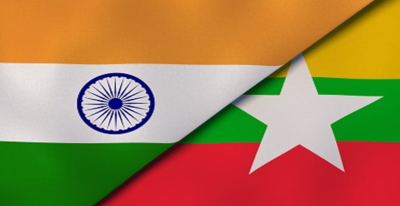
Five years after the February 1, 2021 military coup, Myanmar’s generals attempted to project political normalcy through elections held in three phases between late December 2025 and January 2026. The exercise, however, has neither resolved the country’s civil war nor restored political legitimacy. Instead, it has deepened Myanmar’s fragmentation — posing difficult questions for India, which must balance democratic principles with hard security and connectivity interests along its eastern frontier.
An election designed for control, not consent
The elections were held in only 265 of Myanmar’s 330 townships, largely restricted to urban wards under military control. Vast rural regions — where resistance groups dominate — were excluded. Unsurprisingly, the military-backed Union Solidarity and Development Party secured sweeping victories.
The junta claimed a voter turnout of about 55% — roughly 13.14 million voters out of an estimated 24 million eligible. This marked a sharp decline from the nearly 70% turnout recorded in the 2015 and 2020 elections, reflecting not apathy but widespread rejection of a tightly scripted political process.
Eliminating opposition, institutionalising legitimacy gaps
The credibility deficit was compounded by the junta-appointed Union Election Commission, which dissolved major opposition parties, including the National League for Democracy, the Arakan National Party, and the Shan Nationalities League for Democracy. Senior leaders were imprisoned, while serving and retired military officers were fielded en masse under the USDP banner.
The new Parliament is expected to be formed within two months, but its authority will remain contested both domestically and internationally.
A country still at war
Since the coup, violence has escalated dramatically. At least 7,738 people — including activists, journalists, and civilians — have been killed. Over 30,000 have been arrested, with 22,767 still in detention. Among them are Aung San Suu Kyi and former president U Win Myint.
The military’s repression has fuelled the rise of resistance forces, especially the People’s Defence Forces operating alongside long-standing ethnic armed organisations. These groups now exert control or influence over large territories, including around 91 towns, making post-election stabilisation highly unlikely.
India’s calibrated response: engagement without endorsement
For India, Myanmar is not just a neighbour but a gateway to Southeast Asia under its Act East Policy. The elections therefore sharpen an old dilemma: how to protect security and connectivity interests without legitimising a deeply flawed political process.
In statements issued in December 2025 and January 2026, External Affairs Ministry spokesperson Randhir Jaiswal reiterated India’s support for Myanmar’s democratic transition, stressing that any electoral process must be free, fair, and inclusive, with the participation of all stakeholders. India also clarified that any Indians present in Myanmar during the polls were there in a personal capacity — signalling diplomatic distance.
High-level contacts amid careful messaging
Despite this caution, engagement has continued. On the sidelines of the Shanghai Cooperation Organization meeting in August 2025, Prime Minister Narendra Modi met Senior General Min Aung Hlaing. While reviewing bilateral ties and development cooperation, the Prime Minister underscored the need for inclusive and credible elections.
This dual approach — dialogue without endorsement — reflects India’s attempt to preserve leverage while avoiding diplomatic isolation.
Humanitarian engagement as strategic signalling
India has also used humanitarian assistance to remain constructively engaged. Following the March 2025 earthquake, New Delhi deployed relief teams, medical aid, and a temporary field hospital under Operation Brahma. This allowed India to project responsibility and compassion without conferring political legitimacy on the regime.
Implications for India’s security and connectivity
Myanmar shares a 1,643-kilometre border with four of India’s northeastern States, making instability across the frontier inseparable from India’s internal security. Violence has already triggered refugee flows. India currently hosts about 90,100 displaced Myanmar nationals in Mizoram and Manipur. The absence of a national refugee policy has placed disproportionate burdens on State governments, exposing policy gaps likely to widen if instability persists.
Strategic projects such as the Kaladan Multi-Modal Transit Transport Project and the India–Myanmar–Thailand Trilateral Highway continue to face delays due to insecurity. The junta’s claims of post-election normalisation offer little reassurance on the ground, forcing India to reassess timelines and risk exposure.
Non-traditional threats along a fractured border
Weakened state control has also enabled transnational threats. Narcotics trafficking, human trafficking, and cyber scam networks have expanded rapidly in border conflict zones. Since 2022, at least 2,165 Indians have been rescued from cyber scam and cyber slavery operations in Myanmar, with many more still trapped. These developments underline emerging non-traditional security challenges that demand coordinated domestic and regional responses.
The road ahead for New Delhi
As regional and western blocs, including the Association of Southeast Asian Nations, withhold recognition of the election outcomes for now, India is likely to persist with its balanced approach. Limited engagement with the regime will continue to protect core interests, alongside quiet outreach to local and ethnic actors.
Myanmar’s elections have not marked a turning point. For India, they reinforce a hard truth: managing relations with a fractured neighbour will require constant calibration between principle and pragmatism — at a time when neither offers an easy exit.
What to note for Prelims?
- Myanmar’s 2025–26 elections and role of the USDP.
- Status of NLD and political detentions.
- India–Myanmar border length and strategic projects.
- ASEAN’s position on Myanmar elections.
What to note for Mains?
- India’s dilemma between democratic values and strategic interests.
- Impact of Myanmar instability on India’s Northeast.
- Humanitarian diplomacy as a foreign policy tool.
- Non-traditional security threats from state collapse.